
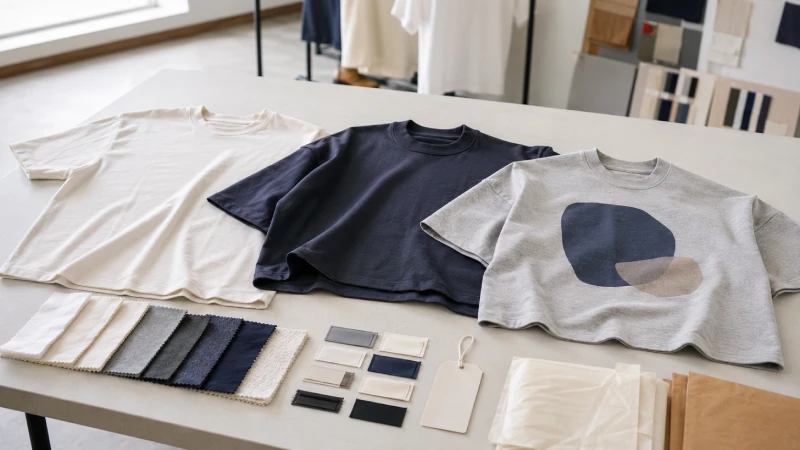
A supplier that replaces the neck label on an existing blank and a factory that develops a proprietary 280 GSM oversized T-shirt may both use the term “private label manufacturer.” They are not offering the same product, development process or commercial model.
Before comparing quotations, buyers need to decide whether they require full-custom cut-and-sew production, a pre-developed blank with private branding, or print-on-demand fulfillment. That decision affects fabric control, fit ownership, minimum quantities, sample costs, production time and long-term product differentiation.
This guide compares ten manufacturing partners and suppliers according to those distinctions. It does not treat every company as interchangeable or claim that one supplier is suitable for every brand.
Quick Answer
The right private label T-shirt manufacturer depends on your order volume, product specification and required level of customization.
Choose a full-package manufacturer if you need a proprietary pattern, custom fabric, Pantone color, garment wash, printing, labels and retail packaging. A customizable blank or white-label supplier is more practical when speed and lower development risk matter more than an exclusive fit. Print-on-demand is useful for testing designs without holding inventory, but it provides less control over fabric and construction.
When comparing suppliers, confirm what the MOQ applies to—total order, style, color or decoration—and whether sampling uses the same fabric and production method as bulk manufacturing. Public certification claims should also be checked using the relevant certification body’s database.
Quick Comparison Table
The companies below are grouped by buyer fit, not ranked from best to worst. Published minimums can change and should be reconfirmed for the exact fabric, color and decoration.
| Company | Country or production location | Production model | Best for | Publicly stated MOQ | Main trade-off |
|---|---|---|---|---|---|
| Billoomi Fashion | India | Full-package manufacturer | Small-batch product development | From 25 per style/color for qualifying solid styles; certain decorated styles from 100 | MOQ depends heavily on decoration and fabric |
| Create Fashion Brand | Portugal | Manufacturer and premium blank supplier | Premium European basics and streetwear | Full custom from 150; private label from 50 per color/style; selected blanks have no MOQ | Different programs have different customization limits |
| Lefty Production Co. | USA | Development house and manufacturer | Hands-on Los Angeles development | States low minimums; no number published | Not exclusively T-shirt focused |
| Seetime Luxury | China | OEM/ODM manufacturer | Flexible custom development and branded apparel programs | Not publicly disclosed | Exact MOQ and timing require a project review |
| Zega Apparel | Pakistan production; US-registered | Full-package manufacturer | Mid-volume custom T-shirts and streetwear | Current private-label page states 200 per design | Older official pages show lower figures |
| Thygesen Textile Vietnam | Vietnam | Large-scale OEM/ODM manufacturer | Established-volume programs | Standard T-shirts reportedly start at 3,000 per style | Generally unsuitable for small test orders |
| Royal Apparel | USA | Vertically integrated manufacturer and wholesaler | USA-made blanks and relabeling | Relabeling: 250 total and 72 per style/color | Relabeling is different from full-custom development |
| Dignity Apparel | USA | Manufacturer and wholesaler | US-sourced cotton and domestic production | Not publicly disclosed | Customization depth must be confirmed |
| Athleisure Basics | Portugal | Managed manufacturing partner | White-label launches and Portugal-made custom basics | White label from 70; full custom from 200 | Its site contains a lower figure in one section, so confirm |
| Apliiq | USA | Decorator and POD private-label supplier | Inventory-free product testing | No minimum for qualifying POD products | Limited control over blank fabric and fit |
How We Selected These Companies
To qualify for the main comparison, a company needed to publicly offer T-shirts or closely related jersey apparel and support private labeling, relabeling, OEM, ODM or branded finishing. We also looked for an official website that identifies the company’s operating model and gives enough information to define a meaningful buyer use case.
The review considered:
- T-shirt relevance
- Manufacturing or supply model
- Public business and production locations
- Fabric and fit customization
- Printing and embroidery
- Labels and packaging
- Published MOQ conditions
- Sampling support
- Information transparency
Reviewing public information does not verify current capacity, bulk quality, financial stability, subcontracting arrangements or on-time performance. Those points require direct due diligence, current documentation and physical samples.
Disclosure: Seetime Luxury publishes this guide and is included because its services match the selection criteria described above. Its inclusion is not an independent recommendation, and it has not been automatically ranked first.
Full-Custom and Full-Package T-Shirt Manufacturers
Billoomi Fashion: Small-Batch Full-Package Development in India
Billoomi Fashion describes itself as a full-package manufacturer and exporter serving private-label brands. Its services cover fabric and trim sourcing, patterns, grading, sampling, manufacturing, labels, tags, packing and delivery.
For qualifying single-color garments, its published MOQ starts at 25 pieces per style and color with mixed sizes. Printed or embroidered styles may require at least 100 pieces. Buyers should obtain an exact calculation because artwork, fabric availability and color count can change the minimum.
Its strength is accessibility for emerging brands that need development support rather than sewing alone. The trade-off is that a small garment MOQ does not eliminate pattern, sampling, trim and freight costs.
Best fit: Startups seeking small-batch full-package development in India.
Create Fashion Brand: Premium Portugal-Made T-Shirts
Create Fashion Brand produces T-shirts, sweatshirts, denim and other garments in Portugal. Its public capabilities include cut-and-sew production, jersey fabrics, garment dyeing, screen printing, embroidery and custom blanks.
The company illustrates why buyers must define “private label” carefully. It advertises custom garments from 150 units, a private-label program from 50 units per color and style, and selected wholesale blanks without a garment MOQ. These routes do not provide identical control over pattern, fabric and color.
The company states that it works with GOTS-, OCS- and OEKO-TEX-certified programs. Buyers making certified-product claims should request the applicable scope certificate and confirm that their specific product is covered.
Best fit: Premium streetwear and lifestyle brands seeking Portugal production.
Lefty Production Co.: Hands-On Los Angeles Development
Lefty Production Co. is a Los Angeles development house and apparel manufacturer. It supports sketching, fabric sourcing, labels, patterns, samples, fittings, grading, cutting, production and packing.
Its main advantage is collaborative product development. A buyer can work through fit and pattern issues locally instead of sending isolated instructions to an overseas sewing facility. Lefty states that low minimums are available to clients who develop their garments with the company, but it does not publish a numerical T-shirt MOQ.
Because its portfolio spans numerous apparel categories, buyers should ask for T-shirt examples relevant to their intended fabric, fit and construction.
Best fit: US brands needing close involvement in development and fittings.
Seetime Luxury: Flexible OEM T-Shirt Development
Seetime Luxury is a China-based OEM/ODM apparel partner supporting custom T-shirts and related apparel. Relevant services include fabric sourcing, fit and sample development, printing, embroidery, private labels and packaging.
This route is appropriate when a brand wants more control than a stock blank provides—for example, an oversized silhouette, selected jersey weight, custom wash, branded neck label or coordinated packaging. Seetime does not publicly state a universal MOQ or lead time. Both should be confirmed against the fabric, color count, decoration, size range and order quantity.
Its strength is the ability to coordinate multiple development elements within one apparel program. The trade-off is that buyers need a sufficiently detailed brief to receive a meaningful feasibility assessment.
Best fit: Brands seeking flexible OEM development for differentiated T-shirts.
Zega Apparel: Pakistan Production With US Commercial Presence
Zega Apparel states that its manufacturing facility is in Karachi, Pakistan, while the business is registered in Wyoming. Its services include pattern development, sampling, cut-and-sew production, printing, labeling and packaging.
The current private-label service page gives an MOQ of 200 pieces per design. Some older pages on the same website mention lower minimums, making written confirmation particularly important. The RFQ should specify whether 200 pieces means per design, color, fabric or total order.
The disclosed Pakistan production location helps buyers distinguish the sales presence from the manufacturing origin.
Best fit: Mid-volume brands comfortable sourcing custom T-shirts from Pakistan.
Thygesen Textile Vietnam: Scaled OEM/ODM Production
Thygesen Textile Vietnam offers OEM/ODM and full-package manufacturing for T-shirts and other apparel. Its services include material consultation, product development, sampling, manufacturing and quality control.
For standard T-shirts, the company publicly cites an MOQ starting around 3,000 pieces per style. Specialized or certified materials may require more because yarn, knitting and dyeing minimums can exceed the garment sewing quantity.
This model is better suited to an established brand with demand forecasts, approved specifications and the ability to plan fabric procurement. It is unlikely to fit a founder testing 50 units across several colors.
Best fit: Established labels and importers with larger, repeatable T-shirt programs.
Domestic, Blank-Based and White-Label Options
Royal Apparel: USA-Made Blanks and Relabeling
Royal Apparel offers USA-made T-shirts, wholesale blanks, embellishment, relabeling and custom production. It describes control over knitting, dyeing, cutting and sewing, giving it a different operating model from a decorator purchasing unrelated blanks.
For its custom relabeling program, the published minimum is 250 units per order and 72 per style and color, with sizes ordered in specified multiples. Other custom-production services have separate terms.
Royal is particularly relevant when USA-made origin or access to established natural-fiber basics matters. Buyers must still distinguish between adding labels to an existing silhouette and developing a proprietary T-shirt from scratch.
Best fit: Brands prioritizing USA-made blanks, relabeling and domestic sourcing.
Dignity Apparel: US-Sourced Cotton and Domestic Manufacturing
Dignity Apparel manufactures T-shirts, polos, sweatshirts and related garments in the United States. Its public production chain describes US-sourced cotton, knitting in Tennessee, domestic dyeing, and cutting and sewing in Iowa and Tennessee.
The company offers wholesale, private-label and custom-apparel channels, but it does not publicly state a numerical MOQ for a private-label T-shirt project. Buyers should also clarify whether they are selecting an established style or commissioning changes to pattern, fabric or construction.
The domestic production chain is the main differentiator. The likely limitation is that fabric selection and customization may not follow the same economics as a broad overseas sourcing network.
Best fit: Buyers prioritizing US-sourced cotton and domestic manufacturing.
Athleisure Basics: Portugal White Label Versus Full Custom
Athleisure Basics Manufacturing offers both white-label and full-custom programs through its Portugal manufacturing network.
Its white-label route uses pre-developed garments and starts from 70 pieces per style, according to the principal description. Full-custom development starts from 200 pieces and adds fabric sourcing, sampling and greater design control. One subsection on the same page mentions 60 pieces, so the applicable minimum should be confirmed in writing.
This is a useful option for brands deciding whether an exclusive pattern justifies additional development time. White label supports a faster launch; full custom supports stronger product differentiation.
Best fit: Brands seeking Portugal-made basics with a choice between white label and custom development.
Apliiq: Private Label Without Bulk Inventory
Apliiq is better described as a private-label decorator and print-on-demand supplier than a cut-and-sew T-shirt factory. Brands choose existing blanks and add elements such as printed or woven labels, embroidery, patches and packaging inserts.
Its print-on-demand service supports qualifying products without an order minimum and can fulfill individual ecommerce orders. That reduces inventory exposure and makes it useful for testing graphics or building an early merchandise program.
The compromise is product ownership: the brand controls artwork and selected branding, but usually not the underlying fabric, pattern or construction.
Best fit: Creators and ecommerce brands validating demand before committing to bulk production.
Choose the Production Model Before the Supplier
| Requirement | Full custom | White label or customizable blank | Print-on-demand |
|---|---|---|---|
| Proprietary fit | Yes | Usually no | No |
| Custom fabric or GSM | Usually available | Limited to program options | No |
| Custom Pantone dyeing | Often available, subject to MOQ | Sometimes | Rarely |
| Private neck and care labels | Yes | Usually | Supplier-dependent |
| Inventory required | Yes | Usually | No |
| Development time | Highest | Moderate | Lowest |
| Per-unit economics at scale | Usually strongest at suitable volume | Depends on blank price | Usually less favorable |
| Best use | Differentiated apparel collection | Faster branded launch | Demand testing |
A blank-based program is not inherently inferior. It may be the correct commercial choice when speed, predictable fit and small inventory exposure matter more than exclusivity. Buyers should avoid paying for from-scratch development if the target product is effectively an existing promotional blank with a new print.
Preparing a clear specification before contacting suppliers can reduce quotation errors and sample revisions. Brands that need help evaluating fabric, construction, labels or packaging can discuss the project with Seetime’s apparel development team after reviewing the private label clothing manufacturing process.
Technical Specification Checklist for Private Label T-Shirts
A T-shirt brief should define more than fiber content and logo position.
Fabric
Specify:
- Fiber composition and permitted tolerance
- Knit construction, such as single jersey or interlock
- Target GSM
- Combed or carded cotton
- Ring-spun yarn if required
- Stretch-fiber percentage
- Surface finish and hand-feel target
- Garment wash or fabric wash
- Shrinkage requirement
- Colorfastness requirement
- Approved color reference
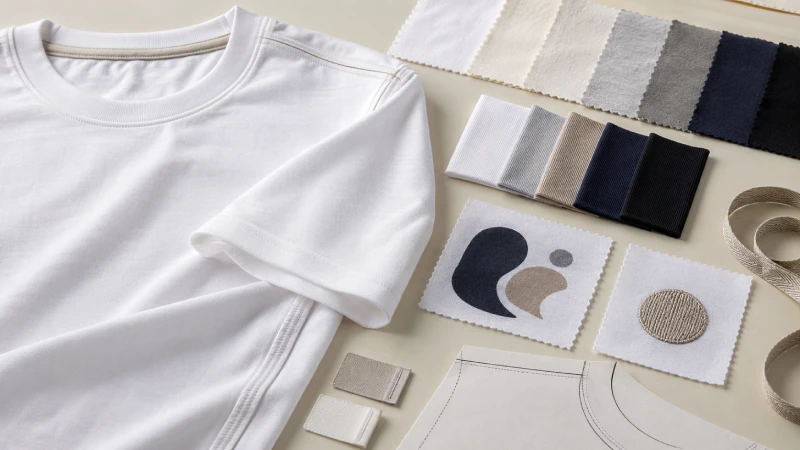
GSM alone does not determine quality. A loosely knitted heavyweight fabric can behave differently from a compact fabric of the same weight. Evaluate opacity, recovery, drape, pilling tendency and dimensional stability alongside weight. A T-shirt fabric sourcing guide can help teams translate a marketing description such as “premium heavyweight cotton” into a measurable fabric brief.
Fit and Construction
Record:
- Chest width, body length and shoulder width
- Shoulder drop
- Sleeve length and opening
- Neck opening
- Neck-rib width and composition
- Shoulder-to-shoulder tape
- Side-seamed or tubular construction
- Hem width
- Seam type
- Measurement tolerances
- Size-grading rules
For oversized T-shirts, simply scaling a regular pattern produces poor proportions. Shoulder drop, body width, sleeve volume, neck opening and body length should be developed together. Collar recovery deserves special attention on heavyweight and washed products because an unstable rib can distort after laundering.
Decoration and Branding
Provide artwork dimensions, position measurements and color references. Confirm whether screen printing, DTG, heat transfer, embroidery or another method is compatible with the fabric and finishing process.
Garment washing can affect print appearance, while heavy embroidery can distort lightweight jersey. Buyers comparing screen printing, heat transfer and DTF for T-shirts should approve the decoration on the intended production fabric—not a substitute swatch.
MOQ, Sampling and Lead-Time Considerations
A useful MOQ answer must state its basis. Ask whether the minimum applies to:
- Total purchase order
- Each style
- Each color
- Each fabric
- Each print design
- Each custom dye lot
A factory might accept 200 pieces of one style in one stock color but reject the same total split across four custom-dyed colors. Labels can also have a higher production minimum than garments, leaving unused trims that must be stored, returned or documented for reorders.
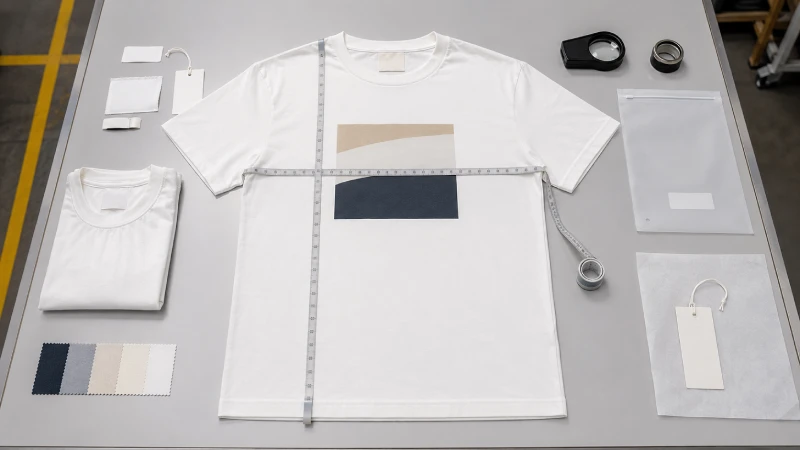
Sampling should normally establish fabric, fit, construction and decoration before bulk cutting. Ask whether the sample uses bulk-intended fabric and whether lab dips, print strike-offs or wash tests require separate approval. Lead time should be stated from a defined event, such as final sample approval and receipt of deposit, rather than from the first inquiry.
Review the apparel sampling process before treating a prototype as production-ready.
T-Shirt Sample Inspection Scorecard
Use the same checklist for every candidate so comparisons are based on execution rather than presentation.
| Inspection area | Before washing | After washing |
|---|---|---|
| Fabric | GSM, shade, opacity, hand feel and visible faults | Shrinkage, pilling, color loss and twisting |
| Measurements | Chest, length, shoulder, sleeve and neck opening | Dimensional change against tolerance |
| Construction | Seam alignment, skipped stitches, hems and shoulder tape | Seam puckering and shape retention |
| Collar | Symmetry, rib tension and attachment | Stretch recovery and deformation |
| Printing | Position, dimensions, registration and coverage | Cracking, bleeding, migration or adhesion loss |
| Embroidery | Position, density, backing and puckering | Distortion and thread performance |
| Branding | Label content, placement, comfort and legibility | Label stability and readability |
| Packaging | Correct size sticker, fold and pack components | Not normally applicable |
Record the sample version, date, measurements, wash method, photographs, accepted tolerances and outstanding corrections. Written approval should reference the exact sample and specification used for bulk production. The bulk T-shirt quality-control framework can then carry these requirements into inline and final inspection.
RFQ Information Manufacturers Need
Send the same information to each shortlisted supplier:
- T-shirt type and target market
- Full-custom, white-label or POD requirement
- Tech pack, reference sample or measurement chart
- Fabric composition, knit and target GSM
- Quantity by style, color and size
- Pantone colors
- Print or embroidery artwork
- Label, hang-tag and private label packaging requirements
- Testing or certification requirements
- Delivery country and preferred Incoterm
- Target launch or required delivery date
- Expected reorder volume
This produces more comparable quotations than asking, “How much is a custom T-shirt?”
Red Flags to Investigate
Further due diligence is appropriate when a supplier:
- Uses “based in the USA” without identifying the manufacturing country
- Gives one MOQ for every fabric, color and decoration
- Will not explain whether production is subcontracted
- Displays certification logos without certificate numbers
- Cannot provide measurement tolerances
- Wants bulk cutting to begin before sample approval
- Omits labels, testing, packaging or freight from the quotation
- Uses different fabric for the sample and bulk order
- Cannot explain how reorder colors will be controlled
Certification logos should not be accepted as proof by themselves. Organic-textile claims can be checked through the GOTS Certified Suppliers Database, while an OEKO-TEX certificate number can be checked through the OEKO-TEX Label Check.
For T-shirts sold in the United States, the Federal Trade Commission’s apparel-labeling guidance explains fiber-content, country-of-origin and responsible-business identification requirements. Care instructions are addressed separately by the FTC Care Labeling Rule.
FAQ
ما الفرق بين التيشيرتات الخاصة والبيضاء؟
غالبًا ما تسمح التسمية الخاصة للعلامة التجارية بالتحكم في المزيد من المنتج، بما في ذلك القماش، المقاس، اللون، التصنيع والعلامة التجارية. التسمية البيضاء تستخدم عادةً ملابس مطورة مسبقًا يمكن لمشترين متعددين تخصيصها بعلاماتهم أو زخارفهم الخاصة. يستخدم الموردون أحيانًا المصطلحات بشكل مختلف، لذا يجب على المشترين طلب وصف مكتوب لما يمكن تغييره.
ما هو الحد الأدنى الواقعي للكمية للتيشيرتات المخصصة بالكامل؟
لا يوجد حد أدنى عالمي للكمية. يعتمد ذلك على توفر القماش، حدود دفعة الصباغة، تطوير النموذج، الزخرفة وتوزيع الألوان. تتراوح الأمثلة المنشورة في هذا الدليل من برامج الكميات الصغيرة إلى عدة آلاف من القطع لكل نمط. تأكد مما إذا كان الحد الأدنى المذكور ينطبق لكل طلب، نمط، لون أو قماش.
هل يمكن خلط المقاسات ضمن الحد الأدنى للكمية؟
تسمح العديد من الشركات المصنعة بخلط المقاسات ضمن نمط ولون واحد، ولكن قد تكون نسبة المقاسات مقيدة. نطاقات المقاسات الواسعة جدًا قد تتطلب أيضًا أنماطًا منفصلة، حسابات استهلاك القماش أو أعمال التدرج. قم بتضمين توزيع المقاسات الكامل في طلب عرض الأسعار.
هل أحتاج إلى حزمة تقنية؟
يوصى بشدة باستخدام حزمة تقنية لمنتج خاص. يجب أن تحدد القياسات، التصنيع، القماش، الزخرفة، الملصقات والتغليف. يمكن أن تساعد عينة مرجعية مادية في توصيل الملمس والملاءمة، ولكن يجب ألا تحل محل المواصفات والتفاوتات المكتوبة.
كم تستغرق مدة الإنتاج للتيشيرتات الخاصة؟
يعتمد وقت التسليم على مصادر القماش، الصباغة المخصصة، مراجعات العينة، الزخرفة، حجم الطلب وسعة المصنع. اطلب من كل مورد فصل وقت التطوير، أخذ العينات، شراء المواد، الإنتاج بالجملة والشحن. يجب كتابة تاريخ البدء والاعتماد على الموافقات في عرض الأسعار.
هل يجب أن أختار موردًا محليًا أم خارجيًا؟
يمكن للإنتاج المحلي تبسيط الاجتماعات، التجارب وتحديد موقع بلد المنشأ. يمكن للإنتاج الخارجي تقديم خيارات مصادر أوسع أو اقتصاديات حجم مختلفة. يعتمد الاختيار الأفضل على المنتج، الكمية، الميزانية، جدول الإطلاق ومستوى دعم التطوير – وليس البلد وحده.
Final Buyer Recommendation
Shortlist suppliers only after choosing the production model. Send an identical RFQ to three suitable candidates, order samples and evaluate them with the same measurement and wash-test criteria. Compare total landed risk—including development, labels, testing, freight and potential rework—rather than unit price alone.
Buyers requesting a feasibility review from Seetime should provide the product type, target quantity, preferred fabric, size range, printing or embroidery artwork, label and packaging requirements, destination market and required delivery date. That information allows the team to determine whether a blank-based solution or full-custom OEM program is more appropriate.