
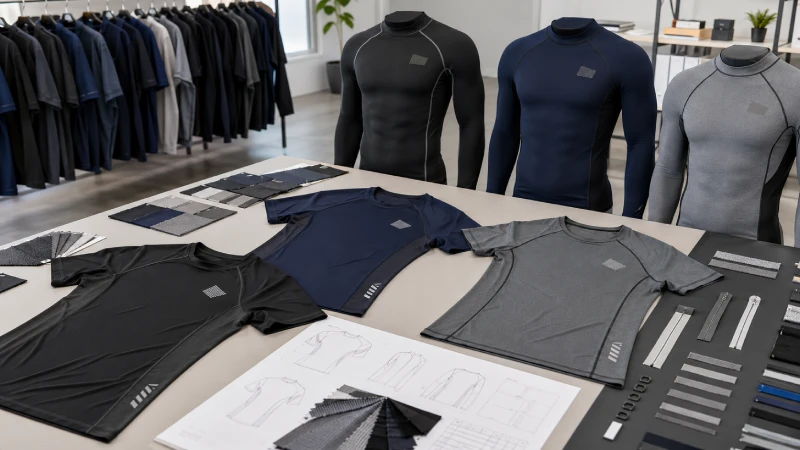
Two compression shirts can look almost identical in a supplier photo yet perform very differently after stretching, sweating, washing, and grading across sizes. The difference usually comes from fabric recovery, pattern reduction, seam engineering, decoration compatibility, and production control—not simply the percentage of elastane listed on the fabric label.
For buyers, the main challenge is therefore not finding a factory that can sew a tight-fitting top. It is finding a supplier whose production model, development ability, minimum order quantity, and technical experience match the intended product.
This guide compares eight manufacturers and sourcing partners that publicly show compression-shirt or closely related compression-clothing capabilities. They are grouped by buyer fit rather than ranked from best to worst.
Company information was checked against official websites on July 14, 2026. This review does not replace a factory audit, business-license check, certificate validation, physical sample assessment, or third-party inspection.
Quick Answer
The right compression shirt manufacturer depends on your order volume, product specification, preferred production route, and how much original development you require.
Brands testing demand may prefer a supplier with existing private-label or ODM styles. Buyers needing a proprietary fit, custom fabric, ergonomic panels, or unique grading should consider full OEM cut-and-sew production. Seamless specialists are more relevant when the product requires integrated ventilation, ribbing, or body-mapped compression zones.
The most important selection criteria are not simply price and MOQ. Buyers should compare stretch recovery, fit-development capability, seam construction, logo performance under tension, and the supplier’s ability to reproduce an approved sample consistently in bulk production.
Quick Comparison of Compression Shirt Suppliers
| Manufacturer | Country | Production Model | Best For | Public MOQ | Public Sampling Information | Main Trade-Off |
|---|---|---|---|---|---|---|
| Thygesen Textile Vietnam | Vietnam | Full-package OEM/ODM | Structured development and Vietnam production | Not publicly disclosed | Sample development offered; details should be confirmed | May be better suited to planned programs than very small test orders |
| Sansansun Sports | China | Wholesale, private label, ODM and OEM | Buyers choosing among several customization levels | 30 pieces for selected wholesale; approximately 100–150 per ODM style; around 300 for full OEM | Prototype and approval process offered | Wholesale MOQ should not be confused with full-custom MOQ |
| QYOURECLO | China | Custom cut-and-sew OEM/private label | Low-MOQ custom development | 100 pieces | 7–10 days stated for regular samples | Published timing may change with custom fabrics or repeated revisions |
| B.D. Seamless | China | Seamless OEM/ODM and stock blanks | Seamless and body-mapped compression | One piece for selected stock blanks; 300–500 per fully custom style | Samples stated from five days after technical approval | Custom seamless development needs more technical input |
| UGA Wear | China | OEM/ODM and private label | Men’s compression shirts within wider gym-wear collections | Around 100 pieces | Five to seven days stated for an initial sample | Confirm whether MOQ applies per style, fabric, or color |
| Diguan Apparel | China | OEM/ODM and full-package sportswear | Running and raglan compression tops | 50 pieces on one product page; general FAQ states 100 | 7–10 days stated for the featured style | MOQ information varies between product and general pages |
| Goodworth Sports | Pakistan | Custom manufacturing, wholesale and private label | Team, gym and combat-sports programs | Not publicly disclosed | Sampling offered; timing not publicly disclosed | Buyers need a written technical and commercial specification |
| Seetime Luxury | China | OEM/ODM apparel manufacturing and sourcing support | Compression shirts developed with a wider apparel collection | Not publicly disclosed | Confirm during quotation | Compression-specific figures and production route must be confirmed |
How We Selected These Manufacturers
A company was considered only when its official website showed compression shirts, compression clothing, performance base layers, or closely related technical manufacturing capability.
The review also looked for evidence of:
- an actual manufacturing or production-management role;
- OEM, ODM, private-label, or wholesale support;
- fabric, pattern, sampling, branding, or packaging services;
- a clear company or production location;
- information relevant to brands, importers, teams, or wholesale buyers.
Consumer brands were excluded because selling branded compression shirts is not the same as producing garments for other labels. Decorators that only print on third-party blanks were also excluded.
The manufacturers have not been described as independently verified. “Checked” means that their official websites were reviewed for compression-specific products, services, location, MOQ, lead-time statements, and customization information.
Certification logos were not treated as sufficient proof on their own. Buyers should request the certificate number, legal company name, covered facility, issuing body, scope, and expiry date. ISO explains that it develops standards but does not itself issue company certificates; certification is performed by external bodies.
Choose the Right Production Model Before Choosing a Factory
A low quoted price is not useful when two suppliers are quoting fundamentally different products. Before comparing manufacturers, establish which production route you need.
| Production Route | Suitable When | Main Advantage | Main Limitation |
|---|---|---|---|
| Stock or wholesale private label | You want to test the market quickly | Lower development cost and MOQ | Limited control over fit, fabric, and construction |
| ODM | You can modify an existing factory design | Faster than building an entirely new product | Base patterns or materials may also be available to other buyers |
| Full OEM cut-and-sew | You have a tech pack, reference sample, or proprietary fit | Greater control over panels, grading, fabric, and branding | More sampling, higher development risk, and usually higher MOQ |
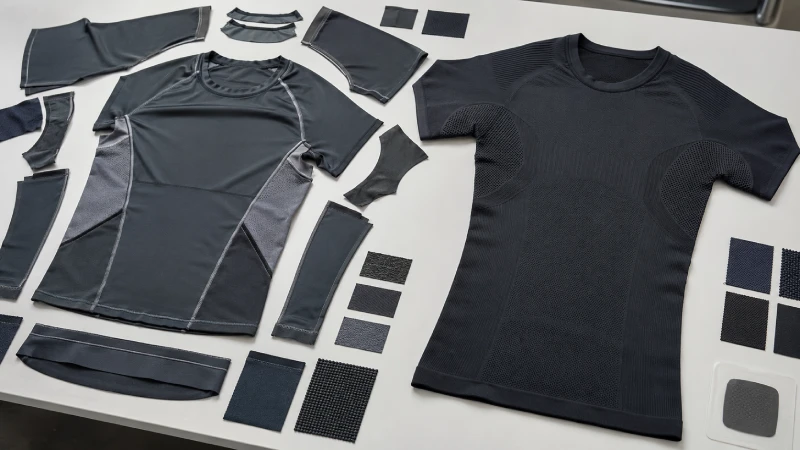
| Seamless OEM | You need integrated ribbing, ventilation, or zoned structures | Reduced seam bulk and engineered knit zones | Specialized machinery, knitting programs, and different MOQ economics |
A stock shirt with a new logo is not equivalent to a newly developed compression product. Buyers should state clearly whether they need an existing style, a modified platform, or a fully proprietary garment.
Preparing a specification sheet before requesting prices can reduce quotation errors and unnecessary sample revisions. Brands needing support with fabric, construction, labels, printing, or packaging can discuss the project with Seetime’s apparel sample development team after defining the intended production route.
Eight Manufacturers to Shortlist by Buyer Fit
Thygesen Textile Vietnam — Best for Structured Full-Package Development
Thygesen Textile Vietnam presents itself as an OEM/ODM apparel manufacturer in Hanoi and maintains a dedicated compression-clothing manufacturing service. Its published capabilities include polyester and nylon-spandex sourcing, recycled and bio-based options, sublimation, screen printing, packaging, computerized knitting, seamless knitting, 3D knitting, and laser cutting.
The company describes a full-package process covering quotation, sample development, production, quality control, packaging, and shipment. Its website also states that it conducts end-line inspections and applies AQL 2.5 for final inspection.
Thygesen does not publicly state a standard compression-shirt MOQ. The company says it develops samples before bulk production, but buyers should request current sample charges, development timing, MOQ by style and fabric, and confirmation of which facility will produce the order.
Best fit: Established or growing brands seeking structured product development and Vietnam-based manufacturing.
Trade-off: Small experimental orders may not match its mass-production-oriented process.
Sansansun Sports — Best for Choosing Between Wholesale, ODM and OEM
Dongguan-based Sansansun Sports separates its offering into wholesale/private label, ODM, and full OEM pathways. This distinction is useful because each route carries different development work and MOQ requirements.
Its compression-shirt category includes performance base layers for men, women, and younger users. The company also offers fabric sourcing, design support, pattern development, sampling, printing, labels, packaging, and other activewear categories.
Sansansun states that selected wholesale orders can start at 30 pieces. Its ODM programs often begin around 100–150 pieces per style, while fully custom OEM programs typically start around 300 pieces. These figures should not be compared as though they refer to the same service.
Best fit: Buyers who have not yet decided whether to launch with an existing style, modify an ODM design, or invest in a fully original product.
Trade-off: The buyer must confirm exactly which elements are stock, modified, or newly developed.
QYOURECLO — Best for Low-MOQ Cut-and-Sew Development
QYOURECLO is based in Dongguan and publishes a standard MOQ of 100 pieces for custom compression T-shirts. Its service covers custom fabric, pattern development, garment construction, logos, labels, hangtags, polybags, and packing details.
The company discusses polyester-spandex, nylon-spandex, and mesh options, along with raglan sleeves, panel placement, flatlock seams, heat-transfer logos, silicone printing, reflective printing, screen printing, and sublimation. It states a regular sample lead time of 7–10 days and standard bulk production of approximately 15–20 days.
Those timelines are company-published estimates rather than guarantees. Special fabrics, custom dyeing, complicated panels, repeated fitting revisions, or multiple decoration methods can extend development.
Best fit: Startups and growing brands needing a custom cut-and-sew compression shirt at a publicly stated 100-piece starting point.
Trade-off: Buyers should validate any certification claims by requesting the actual documents and scopes.
B.D. Seamless — Best for Seamless and Body-Mapped Products
B.D. Seamless operates in Haining, Zhejiang, and focuses on circular-knit seamless apparel, compression clothing, base layers, sports bras, leggings, and underwear.
Unlike a conventional cut-and-sew supplier, a seamless manufacturer can engineer ribbing, ventilation, contour structures, and different knit tensions into the garment. B.D. states that it offers selected stock compression blanks from one piece with logo support, while fully customized styles requiring new knitting structures or fabric engineering generally start at 300–500 pieces per style.
The company publishes nylon-spandex yarn directions, private-label branding, silicone transfers, stretch printing, jacquard logos, and flatlock stitching for hybrid constructions. It states that technical samples can be completed from five days after specifications are approved.
Best fit: Brands developing seamless compression shirts, zoned base layers, or knit-engineered activewear.
Trade-off: Buyers need to define yarn, garment measurements, knit zones, pressure direction, size grading, and test requirements more precisely than they would for a basic stock blank.
UGA Wear — Best for Men’s Gym-Wear Collections
UGA Wear operates from Humen, Dongguan, and presents men’s compression shirts as part of a wider workout-clothing range that includes shorts, tights, tracksuits, jackets, hoodies, and training tops.
Its compression service includes custom logo, fabric, color, labels, hangtags, packaging, patterns, and stitching. UGA states that its compression-shirt MOQ is around 100 pieces and that an initial sample can be produced in five to seven days. The company also mentions flat-seam equipment and multiple inspection stages.
The public MOQ should still be clarified in writing. Ask whether 100 pieces means per design, color, fabric quality, or total order, and whether mixed sizes are accepted.
Best fit: Men’s fitness labels developing compression shirts alongside a broader coordinated gym-wear collection.
Trade-off: Broad website claims about performance features should be confirmed through fabric specifications and agreed test reports for the proposed material.
Diguan Apparel — Best for Running and Raglan Compression Tops
Diguan Apparel publishes several men’s and women’s compression products, including short-sleeve and long-sleeve running tops. One featured product uses a polyester-spandex blend, raglan sleeves, custom sizes, logos, prints, labels, and packaging.
That product page states a 50-piece OEM/ODM MOQ, a sample lead time of 7–10 days, and bulk production of 25–35 days. However, a general FAQ on the same page states that its MOQ is 100 pieces.
This inconsistency does not necessarily mean either figure is incorrect; it may mean that the lower minimum applies only to a specific existing style. Buyers should obtain a written quotation defining the exact MOQ by product, fabric, color, print method, and size breakdown.
Best fit: Running clubs, fitness brands, teams, and buyers using a factory-developed raglan compression platform.
Trade-off: Do not rely on the lowest MOQ displayed without confirming that it applies to the proposed customization.
Goodworth Sports — Best for Team and Combat-Sports Programs
Goodworth Sports is located in Sialkot, Pakistan, and markets custom compression shirts to fitness brands, sports teams, gyms, wholesalers, and private labels.
Its published customization options include fabric and GSM selection, short sleeves, long sleeves, sleeveless styles, colors, sizing, sublimation, screen printing, heat-transfer branding, embroidery, labels, and packaging. The company also mentions uses including running, team sports, gym training, boxing, MMA, and cross-training.
Goodworth does not publish a fixed compression-shirt MOQ. Its lead-time information should also be confirmed during quotation. Buyers should provide detailed garment measurements, fabric requirements, seam construction, logo method, size breakdown, and packing instructions rather than asking for a price from a photograph alone.
Best fit: Teamwear, training, combat-sports, and gym brands seeking Pakistan-based custom production.
Trade-off: Commercial and technical conditions must be documented clearly before sample development.
Seetime Luxury — Best for Integrating Compression Shirts Into a Wider Collection
Disclosure: Seetime Luxury publishes this guide and is included because its services match the selection criteria described above. This is not an independent recommendation.
Seetime Luxury is a China-based OEM/ODM apparel manufacturing and sourcing partner. Its relevant capabilities include sportswear and activewear development, fabric sourcing, sampling, printing, embroidery, private labels, and packaging.
Its potential buyer fit is different from that of a highly specialized seamless mill. Seetime may be relevant when a compression shirt needs to be developed alongside custom T-shirts, shorts, hoodies, streetwear, or other products within one private-label program.
Seetime does not publicly state a compression-shirt MOQ or standard lead time. Buyers should confirm whether a proposed garment will be cut and sewn directly, developed through an existing design base, or produced with a specialist partner.
Best fit: Brands seeking private label activewear manufacturing across multiple apparel categories.
Trade-off: Request compression-specific fabric, construction, sample, testing, MOQ, and production information before treating broader sportswear capability as proof of technical compression expertise.
What Makes a Compression Shirt Different From a Tight T-Shirt?
A compression shirt should not be created by taking a regular T-shirt pattern and reducing every measurement by the same percentage.
Fabric Composition Is Only the Starting Point
Polyester-spandex and nylon-spandex are common directions, but fiber content does not tell the buyer how the garment will perform.
The specification should also address:
- fabric weight;
- stretch in both directions;
- recovery after stretching;
- growth after prolonged wear;
- opacity at full extension;
- surface smoothness;
- snagging and pilling;
- moisture movement;
- drying behavior;
- dimensional stability.
ASTM D2594/D2594M covers stretch and growth in knitted fabrics under specified conditions. ASTM notes that stretch and growth are relevant when selecting fabrics that must extend and recover, particularly for form-fitting apparel. Buyers and laboratories should still select the test method appropriate to the actual support level and end use.
Buyers comparing materials may also find Seetime’s fabric and material sourcing options useful when defining composition, weight, stretch, ventilation, and branding compatibility.
Negative Ease Must Be Developed, Not Guessed
Negative ease means the garment measurements are smaller than the intended body measurements. The fabric stretches to fit the wearer.
Too little negative ease produces a fitted sports top rather than meaningful compression. Too much can restrict movement, distort the neckline, make the fabric transparent, or create excessive pressure around the arms and chest.
Fit development should examine:
- chest and waist balance;
- bicep and forearm tension;
- shoulder mobility;
- neckline recovery;
- sleeve length under movement;
- hem ride-up;
- fit consistency from the smallest to largest size.
The same pattern may fit differently when the fabric weight, elastane type, knit density, or recovery changes.
Seam Construction Affects Comfort
Flatlock seams are widely used because they can reduce bulky seam allowances against the body. However, flatlock is not automatically comfortable merely because it appears in a specification.
Review:
- seam placement under the arm;
- thread softness;
- stitch tension;
- seam extension;
- skipped stitches;
- joining thickness;
- friction during repeated movement.
Depending on the design, factories may also use overlock, coverstitch, bonded joins, or mixed constructions. The correct option depends on the fabric, product level, and intended activity.
Branding Must Survive Stretch
A logo that looks acceptable on a relaxed sample may crack, wrinkle, lift, or distort at full extension.
Heat transfers, silicone prints, stretch-compatible screen printing, reflective transfers, and sublimation may work when correctly matched to the fabric. Large or stiff embroidery can create localized weight, discomfort, and distortion on close-fitting stretch panels.
Test the final decoration on the actual production fabric—not merely on a similar swatch. Seetime’s custom logo printing for apparel page provides additional context on matching printing and branding methods to garment materials.
Compression Shirt Sample Inspection Scorecard
Use an approved sample as a technical standard, not simply as a visual reference.
| Inspection Area | What to Check | Pass Criteria |
|---|---|---|
| Fabric | Composition, weight, stretch direction, opacity and recovery | Matches the approved fabric and does not remain excessively stretched |
| Measurements | Chest, waist, body length, sleeve, bicep, cuff and neck | Within agreed tolerances |
| On-body fit | Mobility, pressure balance, ride-up and restriction | Supports intended fit without localized discomfort |
| Seams | Flatness, extension, skipped stitches and rough areas | No failure, sharp thread, twisting, or excessive bulk |
| Neck and hems | Recovery, waviness and rolling | Return to shape and remain stable |
| Branding | Cracking, lifting, stiffness and distortion | Remains attached and legible at full garment stretch |
| Washing | Shrinkage, twisting, color change and seam condition | Meets the buyer’s approved tolerance |
| Packaging | Labels, sizes, folding, polybags and carton marks | Matches the approved packing specification |
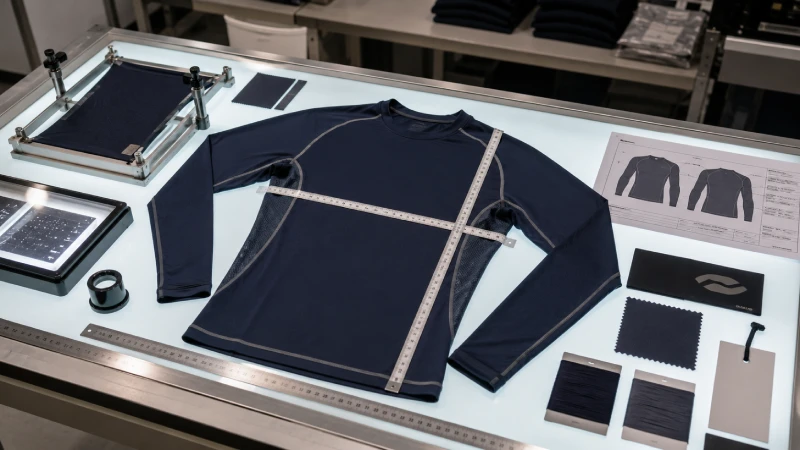
During the fitting session, test overhead arm movement, torso rotation, forward bending, running motion, and at least 15–30 minutes of continuous wear. Record problems by size rather than approving only one medium sample.
For repeatable wash evaluation, ISO 6330 specifies domestic washing and drying procedures for textile testing, including multiple machine and drying options. The buyer and laboratory should agree on the exact cycle, detergent, drying method, and number of washes.
For moisture-management claims, AATCC TM195 provides objective measurement and classification of liquid moisture-management properties in knitted, woven, and nonwoven fabrics. It is more useful than accepting a supplier’s unsupported statement that a material is “moisture wicking.”
Information to Include in Your RFQ
A detailed RFQ allows suppliers to quote the same product rather than making different assumptions.
Product and End Use
- men’s, women’s, youth, or unisex;
- running, gym, team sport, base layer, combat sport, or lifestyle use;
- short sleeve, long sleeve, sleeveless, or mock neck;
- cut-and-sew or seamless preference;
- target market and retail positioning.
Fit and Measurements
- body measurement chart;
- finished garment measurement chart;
- intended compression feel;
- approved reference garment;
- size range;
- fit-model details;
- acceptable measurement tolerances.
Fabric
- preferred composition;
- target GSM;
- stretch direction;
- recovery requirement;
- opacity requirement;
- moisture-management expectation;
- recycled or certified-material request;
- custom or stock color.
Construction and Branding
- raglan or set-in sleeve;
- panel layout;
- gusset requirements;
- flatlock or alternative seam;
- logo method and dimensions;
- heat-transfer neck label, woven label, or printed marking;
- hangtag, polybag, barcode, and carton requirements.
Commercial Details
- estimated quantity by color and size;
- sample quantity;
- destination;
- target delivery date;
- Incoterm;
- testing requirements;
- third-party inspection expectations;
- repeat-order forecast.
Relevant internal resources include how to prepare an apparel tech pack, custom logo printing for apparel, and private label packaging options.
MOQ, Sampling and Lead-Time Considerations
Published MOQs are often misunderstood because suppliers define them differently.
An MOQ may apply:
- to the total order;
- per style;
- per fabric;
- per color;
- per custom-dyed batch;
- per knitting program;
- per logo technique.
A factory offering 30 stock shirts with a logo is not necessarily offering 30 fully custom compression shirts.
MOQ and lead time usually increase when the order requires:
- custom-milled or custom-dyed fabric;
- a new seamless knitting program;
- multiple low-volume colors;
- broad size splits;
- new molds or specialist transfers;
- repeated fitting rounds;
- custom trims and retail packaging;
- laboratory testing;
- third-party inspection.
Do not compare supplier timing until you know when the clock starts. “Twenty days” may mean after deposit, fabric availability, approved lab dip, approved print strike-off, or final pre-production sample.
Common Supplier Red Flags
Be cautious when a supplier:
- Cannot explain the difference between compression fit and slim fit.
- Suggests the same pattern for fabrics with substantially different stretch and recovery.
- Promises a precise compression pressure but cannot describe the test protocol.
- Uses terms such as “medical,” “improves circulation,” or “prevents injury” without appropriate evidence.
- Cannot provide a relevant physical sample.
- Has no method for checking stretch recovery or garment growth.
- Does not explain how compression is graded across sizes.
- Quotes an MOQ without defining style, fabric, color, and size conditions.
- Has not tested the logo at full extension.
- Displays certification logos but will not provide certificate numbers or documents.
- Refuses a pre-production sample or independent inspection.
- Cannot identify whether it is quoting stock, ODM, or full OEM production.
OEKO-TEX STANDARD 100 concerns textiles tested for harmful substances. It does not, by itself, prove garment performance, factory quality management, labor compliance, or delivery reliability. The organization provides a Label Check tool through which certificate information can be reviewed.
FAQ
Quel est le MOQ typique pour les chemises de compression en marque blanche ?
Il n’existe pas de MOQ universel. Les exemples publics de ce guide vont de petites commandes sur stock à 300–500 pièces pour des produits sans couture nouvellement conçus. Le minimum réel dépend du vêtement : stock, ODM, OEM coupe-couture ou sans couture, ainsi que du tissu, des couleurs, du marquage et de la répartition des tailles.
La construction sans couture est-elle meilleure que la coupe-couture ?
Pas automatiquement. Le tricotage sans couture est utile pour les bordures intégrées, les zones de ventilation, la réduction de l’épaisseur des coutures et les structures épousant le corps. La construction coupe-couture peut offrir un meilleur contrôle sur les formes des panneaux, le blocage des couleurs, les combinaisons de tissus et certains placements d’impression. Choisissez selon le cahier des charges du produit.
Quel tissu est le meilleur pour les chemises de compression ?
Le polyester-élasthanne et le nylon-élasthanne sont des choix courants. Les mélanges de polyester sont souvent sélectionnés pour les produits d’entraînement légers et les performances de séchage, tandis que les mélanges de nylon peuvent offrir un toucher plus doux et une surface plus lisse. Comparez le poids, le module, l’élasticité, la mémoire de forme, l’opacité, le comportement à l’humidité et la durabilité plutôt que les pourcentages de fibres seuls.
Les coutures plates sont-elles requises ?
Aucun type de couture n’est obligatoire pour chaque chemise de compression. Les coutures plates peuvent réduire l’épaisseur, mais le confort dépend également de l’emplacement de la couture, du fil, de la tension, de l’extension de la piqûre et de la finition. Testez le vêtement fini en mouvement.
Comment dois-je confirmer la certification d’un fournisseur ?
Demandez le certificat complet et vérifiez l’entité légale, l’adresse de l’usine, la norme, la portée, l’organisme émetteur, l’accréditation, le numéro de certificat et la date d’expiration. Confirmez s’il s’applique à l’usine, au tissu, au composant ou au vêtement fini.
Dois-je approuver un échantillon avant la production ?
Oui. La production en série doit être basée sur un vêtement approuvé, un tableau de mesures, un échantillon de tissu, un standard de logo, une disposition d’étiquette, un cahier des charges d’emballage, une approbation de couleur et une fiche de tolérances écrite. Une photo ou un message informel ne constitue pas un standard de production suffisant.
Final Buyer Recommendation
Do not begin by asking ten manufacturers for their lowest unit price.
First decide whether the project is stock private label, ODM, full cut-and-sew OEM, or seamless. Then prepare one consistent RFQ and compare suppliers against the same product standard.
Shortlist two or three candidates and evaluate:
- communication quality;
- technical questions asked;
- fabric recommendations;
- fit-development process;
- sample accuracy;
- willingness to document tolerances;
- transparency about MOQ and timing;
- readiness for inspection and testing.
A supplier with the lowest initial quote may become the most expensive option if the fabric grows after wear, the sleeves are over-compressed, the logo cracks, or bulk grading differs from the approved sample.
Brands preparing a compression-shirt project can send Seetime Luxury the product type, intended activity, target quantity, fabric preference, size range, reference sample or tech pack, logo method, labels, packaging, destination market, and required delivery date. The team can review the development requirements and help identify which specifications should be confirmed before sampling.