
A buyer ordering all-over-print performance shirts does not need the same supplier as a decorator purchasing white polyester blanks. Both may appear in searches for sublimation T-shirt manufacturers, but their production control, artwork requirements, branding options and cost structures differ substantially.
The first sourcing decision is therefore not which company has the most impressive website. It is whether your project requires panel-based cut-and-sew production, decoration on finished blanks, a standardized private-label program or print-on-demand fulfillment.
This guide compares eight relevant production partners using information published on their official websites. It examines their sourcing models, stated capabilities, public MOQ information and likely buyer fit. Inclusion does not mean that Seetime has independently audited each facility or tested its products.
Quick Answer
The right sublimation T-shirt manufacturer depends on your order volume, garment specification and required level of customization. Brands developing proprietary fits, edge-to-edge artwork, custom fabrics and retail packaging should prioritize a full-package cut-and-sew manufacturer. Decorators that already operate sublimation equipment may be better served by a reliable polyester blank supplier, while small e-commerce sellers testing demand may prefer print-on-demand.
Three factors deserve particular attention: whether the supplier prints fabric panels before sewing, whether it can control fabric and garment construction, and what its MOQ applies to. A minimum may apply per design, fabric, color or product—not necessarily across the entire order.
The companies below are grouped by buyer fit rather than ranked as universally “best.”
Quick Comparison of Sublimation T-Shirt Suppliers
| Company | Country | Production model | Best for | Private label | Public MOQ | Main point to confirm |
|---|---|---|---|---|---|---|
| Seetime Luxury | China | OEM/ODM apparel production and sourcing | Custom product development across coordinated apparel categories | Available | Not publicly disclosed | Project-specific sublimation scope and quotation |
| dasFlow | USA | Full-package, cut-and-sew AOP manufacturer | USA-made private-label all-over-print apparel | Available | Not publicly disclosed | MOQ and current production schedule |
| Fabrion Manufacturing | Thailand | Factory-direct cut-and-sew manufacturer | Southeast Asian bulk production with published specifications | Available | Usually 50 pieces per design per garment color for stock fabrics and colors | Project-specific fabric and timeline |
| Goal Sportswear | China | Custom sportswear manufacturer | Sport-specific sublimated shirts | Confirm full scope | Not publicly disclosed | Private-label services and MOQ |
| Six Six Apparel | USA | Cut-and-sew custom producer | USA-made edge-to-edge sports and event apparel | Not publicly detailed | Not publicly disclosed | Sampling, packaging and commercial terms |
| The Sublimation House | USA | Custom apparel manufacturer | Sublimation combined with screen printing or embroidery | Confirm during quotation | Not publicly disclosed | Fabric development and labeling options |
| Royal Apparel | USA | Apparel manufacturer and wholesale blank supplier | USA-made polyester blanks and domestic custom production | Available | Described as low; exact number not published | Blank supply versus finished printing scope |
| Vapor Apparel | USA | Technical apparel supplier with private-label services | Outdoor and performance sublimation programs | Available | As low as 48 units per design, configuration-dependent | Custom-color minimums and current lead time |
Information was reviewed on official company websites on July 13, 2026. Commercial conditions can change, so buyers should reconfirm them during quotation.
Choose the Right Sublimation Production Model First
Cut-and-Sew All-Over Sublimation
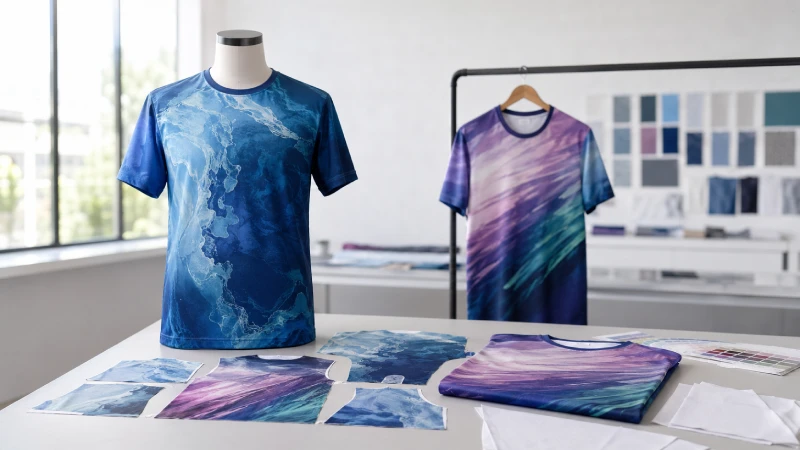
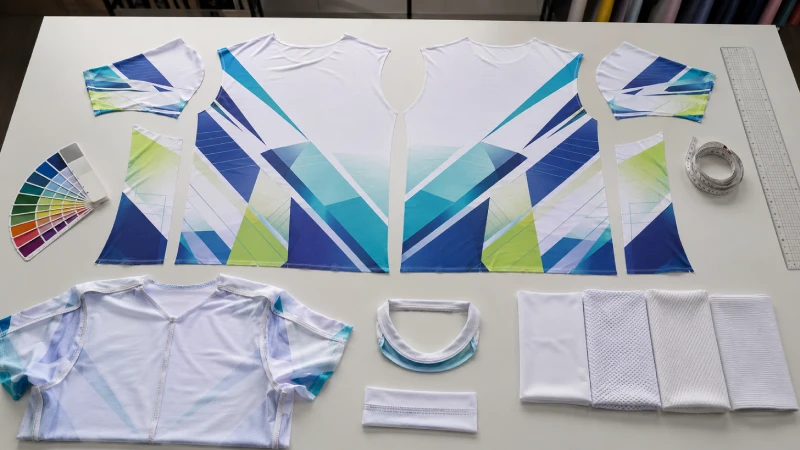
In this process, artwork is transferred onto white polyester fabric panels before garment assembly. The printed panels are then cut and sewn into the finished shirt.
This model is generally the better choice for:
- Edge-to-edge graphics
- Custom garment patterns and fits
- Team jerseys with names, numbers and sponsor marks
- Artwork extending across the front, back and sleeves
- Private-label retail collections
- Repeat programs requiring controlled specifications
Printing before sewing gives the manufacturer greater control over coverage, but it does not guarantee perfect alignment across every seam. Curved seams, size grading and normal sewing tolerances affect pattern continuity. The tech pack should identify which logos, stripes or graphic elements must align.
Sublimation on Finished Blanks
Finished white or light-colored polyester shirts can be decorated after sewing. This route is useful when the buyer wants standard sizing, faster setup or localized graphics rather than complete garment development.
It may also suit decorators that already own printing and pressing equipment. However, printing a finished garment can leave unprinted areas around seams, collars or underarms. Buyers have less control over fabric, pattern shape and construction because the blank has already been produced.
Print-on-Demand
POD is appropriate for validating artwork or selling individual units without inventory. It is not equivalent to full-package OEM production.
A POD platform normally offers less control over fabric sourcing, garment measurements, label design, packaging and production consistency. Once sales become predictable, brands should compare POD costs and limitations against a defined bulk-production program.
How We Selected These Companies
The selection focused on companies whose official websites show clear relevance to sublimation T-shirts or closely related sublimated tops. We considered:
- Evidence of sublimation printing or sublimation-ready garments
- Whether the company describes manufacturing, cutting, sewing or custom production
- Suitability for B2B buyers, brands, teams or distributors
- OEM, private-label or wholesale services
- Fabric and technical information
- Sampling and product-approval support
- Public MOQ or lead-time transparency
- Clarity about production location and sourcing model
Companies were not described as quality-verified because this review did not include factory audits, laboratory testing or sample orders. Where an official website does not disclose a commercial condition, it is identified as not publicly disclosed.
Marketplace listings, consumer brands and generic apparel companies without a clear sublimation service were excluded. POD platforms and blank distributors remain valid alternatives, but they should not be presented as interchangeable with cut-and-sew manufacturers.
Preparing a clear specification sheet before contacting suppliers reduces quotation differences and unnecessary sample revisions. Brands that need help evaluating fabric, construction, labels or packaging can discuss their requirements with Seetime’s apparel development team.
Eight Manufacturers and Production Partners to Consider
Seetime Luxury — Best for Coordinated OEM Apparel Development
Disclosure: Seetime Luxury publishes this guide and is included because its services match the selection criteria described above. Its inclusion is not an independent recommendation.
Based in China, Seetime supports custom T-shirt manufacturing, fabric sourcing, printing, sampling, private-label components and packaging. Its potential fit is broader than a supplier offering only standardized sublimation shirts: a brand may need sublimated performance tops alongside polos, hoodies or other custom sportswear manufacturing.
That broader coordination is useful when consistent branding must be applied across multiple product categories. Buyers should nevertheless request confirmation of the exact sublimation workflow, fabric choices, artwork-control process and which production operations apply to their order.
Seetime does not publicly state a universal MOQ or lead time for sublimation T-shirts. These should be established from the product specification, fabric, artwork, order breakdown and packaging requirements.
Strengths: Broader OEM/ODM coordination, fabric sourcing and private-label development.
Trade-off: Commercial and technical conditions require a project-specific quotation.
Best-fit buyer: A brand developing a coordinated private-label collection rather than purchasing a standard blank.
Official website: Seetime Luxury
dasFlow — Best for USA-Made Full-Package AOP
Florida-based dasFlow describes itself as a wholesale private-label manufacturer specializing in USA-made cut-and-sew and all-over-print apparel. Its published process begins with printing white fabric before laser cutting and sewing.
The company displays several performance materials, including polyester mesh, polyester-spandex, brushed polyester and recycled-polyester options. Its private-label services include printed or sublimated collar labels, buyer-supplied woven labels, hangtags, neck tape and individual fold-and-bag packaging.
This makes dasFlow relevant to brands that want domestic production with more control than a stock blank allows. Its website also states that screen printing and embroidery are handled through local partners rather than in-house, an important distinction for mixed-decoration programs.
The company does not publicly state a standard MOQ or universal production lead time on the reviewed page.
Strengths: Full-package USA production, AOP expertise and documented branding options.
Trade-off: Buyers must obtain current MOQ, pricing and scheduling information directly.
Best-fit buyer: US brands prioritizing domestic all-over-print manufacturing and retail-ready finishing.
Fabrion Manufacturing — Best for Factory-Direct Production in Thailand
Fabrion Manufacturing presents a factory-direct service for brands, teams, clubs, gyms and private-label buyers. Its official page clearly distinguishes cut-and-sew sublimation from decorating a finished blank.
Published fabric options include interlock polyester, microfiber polyester, birdseye mesh, mini mesh and polyester-spandex blends. Fabrion describes typical weights of approximately 140–180 GSM, with lighter structures intended for running and warm-weather wear and more structured fabrics for teamwear or repeated use.
Private-label options include printed neck labels, woven labels, hangtags, barcodes, individual bags and custom packaging. The company states that its usual MOQ for stock fabrics and colors is 50 pieces per design per garment color. It also states that standard production can typically be completed within 15 days after sample approval, subject to specifications and fabric availability.
These figures should be reconfirmed for each quotation.
Strengths: Detailed public information about materials, construction, MOQ and approval steps.
Trade-off: Custom fabric development or special materials may change minimums and timing.
Best-fit buyer: Brands seeking an Asian cut-and-sew partner with comparatively transparent starting conditions.
Goal Sportswear — Best for Sport-Specific Shirt Formats
China-based Goal Sportswear presents an extensive range of custom sublimated shirts, including running, golf, fishing, racing, bowling, crew and warm-up styles.
This category depth is relevant because different activities require different constructions. A fishing shirt may prioritize sun protection and long sleeves, while a running top needs lower weight and better moisture management. A bowling or golf shirt may require a collar, placket or different fit.
The company states that it works with moisture-wicking fabrics and supports multicolor artwork and logos. Its website publishes a production claim of 11–13 days after payment and design-proof approval. That is a company-stated figure, not an independently confirmed performance guarantee.
Goal Sportswear does not clearly publish a standard MOQ on the reviewed page. Buyers should also confirm private-label options, sampling stages, packaging and which operations are completed in-house.
Strengths: Broad range of activity-specific sublimated shirts.
Trade-off: MOQ and full private-label scope are not sufficiently detailed publicly.
Best-fit buyer: Teamwear or sports buyers needing an established shirt format for a particular activity.
Six Six Apparel — Best for USA Cut-and-Sew Shirts
Six Six Apparel states that it produces USA-made cut-and-sew sublimated shirts with edge-to-edge graphics. Its range includes T-shirts, jerseys, uniforms, hoodies, tanks and event textiles.
The company also refers to dry-fit, moisture-wicking and UV-protection fabric options. These properties are commercially relevant, but buyers should request the exact fabric composition, weight and applicable test method rather than accepting a performance term without a measurable specification.
Public information about MOQ, sampling, private labels, packaging and production timing is limited. These items should form part of the initial RFQ.
Strengths: Clear focus on USA-made cut-and-sew sublimation and full-color coverage.
Trade-off: Limited online disclosure of commercial and private-label conditions.
Best-fit buyer: A brand, team or event supplier that values domestic production and can confirm specifications directly.
The Sublimation House — Best for Mixed Decoration Programs
Based in Las Vegas, The Sublimation House offers cut-and-sew sublimation alongside screen printing and embroidery. Its website describes a workflow covering design setup, printing, pressing, cutting, sewing, finishing and quality checks.
The combination can benefit organizations purchasing multiple apparel types. A team program, for example, might use sublimation for performance shirts, screen printing for cotton event tees and embroidery for staff polos.
The company does not publicly state a standard MOQ or lead time. Its website also provides limited information about custom fabric development, graded patterns, labels and retail packaging. Buyers requiring a proprietary garment rather than a decorated existing style should clarify those points before sampling.
Strengths: Domestic production and access to several decoration methods.
Trade-off: Less public technical detail about fabrics and private-label development.
Best-fit buyer: US businesses, teams and organizations consolidating several decorated apparel products.
Royal Apparel — Best for USA-Made Polyester Blanks
Royal Apparel operates as both a US apparel manufacturer and a wholesale blank supplier. Its published sublimation option includes a white, 100% polyester T-shirt with side seams, shoulder taping, double-needle hems and a tear-away label.
This is particularly relevant to decorators. If a buyer already controls printing, purchasing a consistent polyester blank may be more efficient than commissioning a custom cut-and-sew garment.
Royal Apparel also states that custom production, custom sizing, relabeling, private labeling, sample production and international shipping are available. The company describes its minimums as low but does not publish an exact universal quantity.
Buyers must distinguish between the price and MOQ for inventory blanks and those for a custom-manufactured private-label program.
Strengths: USA-made blank availability with a route into custom production.
Trade-off: A standard white blank does not provide the same artwork coverage or construction freedom as panel-based AOP.
Best-fit buyer: Decorators and brands seeking domestic polyester blanks or a relatively standardized private-label product.
Vapor Apparel — Best for Outdoor Performance Programs
Vapor Apparel’s private-label program is oriented toward technical and outdoor products. The company offers sublimation-ready fabrics and garments, private-label and white-label services, heat-seal labels, hangtags, packaging and fulfillment support.
Its published minimum can be as low as 48 units per design, depending on configuration. The company states that turnaround can be as short as two weeks, although destination, garment quantity and embellishments affect timing. Custom colors require different conditions, including a stated minimum fabric run and additional development time.
Vapor also requires private-label orders to pass through sampling and approval. This structured approach suits brands using standardized technical products but may be less appropriate for buyers seeking unrestricted pattern development.
Strengths: Transparent program information, performance-focused products and relatively low stated starting quantities.
Trade-off: Custom colors and proprietary development may involve materially higher minimums than existing styles.
Best-fit buyer: Outdoor, fishing, sun-protection or performance brands using a structured private-label program.
Selecting Fabric for a Sublimated Shirt
Sublimation dye bonds most effectively with polyester. Increasing polyester content generally supports stronger color saturation, but composition alone does not determine performance.
A 100% polyester interlock may provide a smooth surface and sharp detail, while a birdseye mesh improves airflow but can visually break up small graphics. Polyester-spandex supports stretch, although the fabric must remain stable under transfer heat and retain adequate opacity when extended.
| Fabric | Advantages | Main checks |
|---|---|---|
| Polyester interlock | Smooth surface, good structure and detailed printing | Weight, warmth and snagging |
| Birdseye or mini mesh | Breathability and sportswear appearance | Fine-detail clarity and opacity |
| Microfiber polyester | Soft hand and relatively fine surface | Heat stability and dimensional change |
| Polyester-spandex | Stretch and closer athletic fits | Recovery, opacity and artwork distortion |
| Recycled polyester | Supports recycled-material product programs | Valid certification scope and transaction documentation |
Fabric whiteness also matters. Sublimation ink is transparent, so the substrate affects the final color. A warm or blue-tinted white can shift the appearance of light colors and skin tones.
Specifications should cover composition, knit structure, GSM, opacity, stretch, recovery, wicking, pilling, snagging and dimensional stability. Buyers using recycled materials should confirm the applicable certification rather than treating “recycled polyester” as a self-proving claim.
For product-safety requirements, the official OEKO-TEX STANDARD 100 explains how finished textiles and components are tested for harmful substances. Buyers can also consult Seetime’s guides to sportswear fabric manufacturers and polyester T-shirt manufacturers when comparing material and production routes.
Sublimation Sample Inspection Scorecard
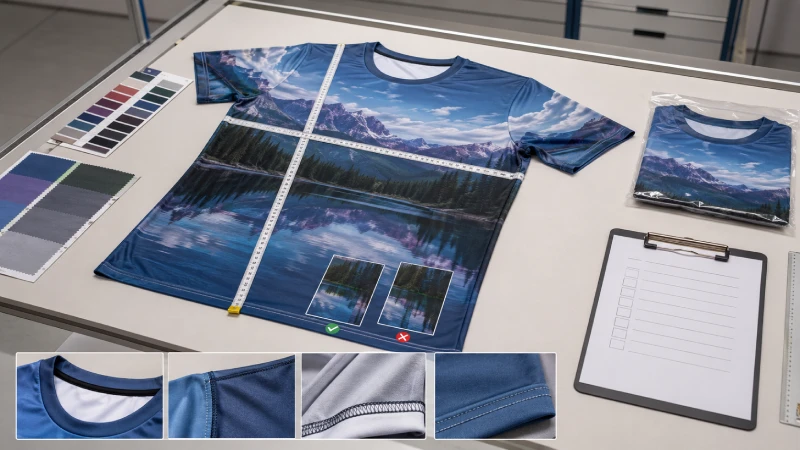
A digital mock-up cannot replace a physical sample. Use the following scorecard before approving bulk production.
Print and Color
- Compare the sample against agreed physical or digital color references under controlled lighting.
- Inspect gradients for banding.
- Check fine lines, small logos and text-like graphic elements for clarity.
- Look for ghosting caused by transfer-paper movement.
- Inspect folds and creases for unprinted white marks.
- Compare color between the front, back and sleeve panels.
- Check whether dark printed areas contaminate labels or lighter trims.
For formal testing, buyers can discuss protocols such as AATCC TM61 for accelerated laundering colorfastness with the manufacturer or nominated laboratory.
Artwork Placement
- Confirm logo position and scale.
- Check sleeve orientation.
- Inspect side-seam and shoulder relationships.
- Confirm names and numbers are centered.
- Review each size, not only the medium sample.
- Identify critical alignment points in the tech pack.
Artwork may need size-specific adjustments. Simply enlarging every element proportionally can make logos too large on extended sizes or change their visual relationship with seams.
Construction and Fit
- Measure chest, body length, shoulder and sleeve against the specification.
- Check neckline shape and recovery.
- Inspect overlock and coverstitch consistency.
- Look for skipped stitches and seam puckering.
- Check hem twisting after laundering.
- Test fabric opacity in normal movement and stretch positions.
- Confirm labels are correctly placed and comfortable.
A garment-level dimensional test can be specified using an appropriate method such as AATCC TM150, depending on the buyer’s market and testing program.
Repeat-Order Reference
Retain a sealed approval sample and record:
- Artwork version
- Color references
- Fabric code
- Measurement chart
- Label specifications
- Packaging instructions
- Approved placement tolerances
These records are more useful for repeat-order consistency than relying on product photos alone.
Common Defects and Their Likely Causes
| Defect | Possible cause | Corrective request |
|---|---|---|
| Ghosted image | Transfer paper moved during pressing | Correct paper fixation and provide a new sample |
| White crease | Fabric folded before or during transfer | Review fabric handling and press preparation |
| Panel shade variation | Heat, pressure, ink or fabric-lot inconsistency | Compare panels and document batch controls |
| Blurred details | Low-resolution artwork, textured fabric or excessive ink | Review file quality and request a print strike-off |
| Misaligned seams | Artwork not engineered around garment patterns | Mark critical match points and tolerances |
| Dye migration | Incompatible dyed trims or underlying materials | Test alternative trims and migration resistance |
| Glossy press marks | Excess heat or pressure | Adjust transfer settings for the selected fabric |
| Distorted graphics | Stretch and size grading not considered | Create size-specific artwork adjustments |
Not every defect originates at the factory. Incomplete files, unrealistic seam-matching demands and unspecified color references can also cause approval disputes.
MOQ, Sampling and Lead-Time Considerations
A manufacturer’s MOQ may apply per design, product, fabric, color or packaging configuration. Asking only “What is your MOQ?” can therefore produce a misleading answer.
A more useful set of questions is:
- Does the minimum apply to the total order or each artwork?
- Can sizes be combined within one minimum?
- Are personalized names and numbers treated as separate designs?
- Do stock and custom fabrics have different minimums?
- Is there a separate minimum for woven labels or printed packaging?
- Can multiple garment styles share the same fabric order?
Lead time should also be divided into stages:
- Specification and artwork review
- Fabric confirmation
- Print strike-off
- Fit or development sample
- Sample revision
- Pre-production approval
- Bulk manufacturing
- Inspection and packing
- International transport
A statement such as “15-day production” usually does not mean 15 days from the buyer’s first inquiry to warehouse delivery.
What to Include in Your RFQ
A useful sublimation T-shirt RFQ should include:
- Product type and intended use
- Target quantity by size
- Target-market sizing standard
- Fabric composition and preferred knit
- Target GSM
- Fit and measurement chart
- Editable artwork files
- Color references
- Critical artwork-alignment points
- Name and number requirements
- Neckline, seam and hem construction
- Label, hangtag and barcode requirements
- Individual packaging instructions
- Testing requirements
- Required sample type
- Delivery destination
- Target delivery date
- Expected repeat-order volume
These details make quotations more comparable. Without them, one supplier may quote a finished blank with limited decoration while another prices custom fabric printing, cutting, sewing and retail packaging.
Related Seetime content can support further research into sports shirt manufacturers, custom logo printing and sportswear manufacturers.
Supplier Red Flags
Treat the following as reasons for further investigation:
- The supplier will not explain where printing, cutting and sewing occur.
- “Any fabric can be sublimated” is presented without qualification.
- MOQ is quoted without defining whether it applies per design or color.
- Bulk production is proposed without a physical sample.
- The supplier cannot explain how colors will be approved.
- Perfect alignment across every seam is promised without discussing tolerances.
- Certifications are shown without certificate numbers, scope or validity checks.
- The quotation omits labels, packaging, testing or shipping terms.
- Production time starts before the specification and sample are approved.
- The factory will not confirm which services are outsourced.
Outsourcing is not automatically a problem. The risk is a lack of transparency about responsibility and quality control.
FAQ
ما أفضل قماش لتيشيرتات الطباعة التسامي؟
قماش البوليستر الأبيض أو الفاتح اللون ينتج عمومًا أقوى الألوان. قماش الإنترلوك الناعم يعمل بشكل جيد للرسومات التفصيلية، بينما الهياكل الشبكية قد تكون أفضل لتدفق الهواء. يعتمد الاختيار الصحيح على تفاصيل الطباعة، المناخ، الشفافية، التمدد، والنشاط المقصود.
هل يمكن طباعة التيشيرتات القطنية بالتسامي؟
صبغة التسامي التقليدية لا ترتبط بشكل دائم مع القطن بنفس طريقة ارتباطها مع البوليستر. التيشيرتات الغنية بالقطن قد تتطلب طبقة طلاء أو عملية نقل مختلفة. اسأل المورد لشرح العملية الدقيقة وأداء الغسيل المتوقع.
هل الطباعة الكاملة بالتسامي هي نفس طباعة التيشيرت الجاهز؟
لا. الإنتاج الكامل بقص وخياطة يطبع عادةً ألواح القماش قبل التجميع. طباعة التيشيرت الفارغ الجاهز توفر تغطية أقل وقد تترك مناطق بيضاء بالقرب من الدرزات أو الطيات.
ما هو الحد الأدنى الطبيعي لكمية الطلب لتيشيرتات الطباعة التسامي؟
لا يوجد حد أدنى عالمي لكمية الطلب. يعتمد ذلك على نموذج إنتاج المورد، توفر القماش، الملصقات المخصصة، تنوع التصاميم، والتغليف. اسأل ما هو الحد الأدنى المطبق وما إذا كان يمكن دمج المقاسات.
هل يجب الموافقة على عينة طباعة أولية أم عينة كاملة؟
لتصميم مهم تجاريًا، وافق على كلاهما عندما يكون ذلك ممكنًا. العينة الأولية تساعد في تقييم اللون والتفاصيل، بينما العينة الكاملة تكشف عن المقاس، البناء، الموضع، وعلاقات الدرزات.
هل يمكن أن تتطابق أنماط الطباعة بالتسامي تمامًا عبر كل درز؟
ليس دائمًا. شكل الثوب، الدرزات المنحنية، حركة القماش، وتفاوتات الخياطة الطبيعية تحد من التطابق الدقيق. حدد نقاط المحاذاة الأكثر أهمية واتفق على تفاوتات واقعية قبل الإنتاج.
Final Recommendation
Begin by classifying your project. Choose a cut-and-sew manufacturer for custom fit, edge-to-edge graphics and private-label control. Choose a polyester blank supplier when you already manage decoration and can use standard garment construction. Consider POD only when avoiding inventory is more important than product differentiation and unit cost.
Shortlist two or three suppliers, send each the same specification and compare more than price. Review the proposed fabric, sample stages, artwork control, MOQ definition, packaging scope and production timeline.
Buyers approaching Seetime should provide the product type, target quantity, size range, fabric preference, artwork, label and packaging requirements, target market, delivery destination and required date. This allows the apparel development team to evaluate the production route and prepare a more meaningful quotation.