Selecting compliant workwear for industrial use is not simply a matter of choosing garments that “look professional.” For overseas B2B buyers—procurement managers, brand owners, uniform program leads, and distributors—the decision directly affects worker safety, regulatory exposure, operational efficiency, and long-term supply stability.
This buying guide is designed to be category-agnostic, applying across workwear & safety apparel, as well as related categories such as headwear, T-shirts & polos, hoodies & sweatshirts, and sportswear-derived uniforms. Rather than focusing on specific SKUs, it provides a decision framework you can use when evaluating manufacturers, materials, and production strategies for compliant industrial workwear programs.
Understanding What “Compliant Workwear” Really Means
When buyers refer to compliant workwear, they often mean different things depending on industry, region, and risk profile. Before comparing products or suppliers, it’s critical to clarify what compliance covers in your context.
Compliance Goes Beyond Safety Labels
At a B2B procurement level, compliance typically includes:
- Regulatory compliance
Alignment with applicable standards (e.g. EN, ISO, ANSI, local labor or safety regulations). - Functional compliance
The garment performs its intended role under real working conditions (visibility, durability, protection, comfort). - Material compliance
Fabrics and trims meet chemical, environmental, or restricted-substance requirements (e.g. colorfastness, skin safety). - Program compliance
Consistency across bulk production, repeat orders, and multi-site deployment.
Understanding which of these apply to your project is the first step in choosing compliant workwear for industrial use.
Choosing Compliant Workwear for Industrial Use — Core Decision Framework
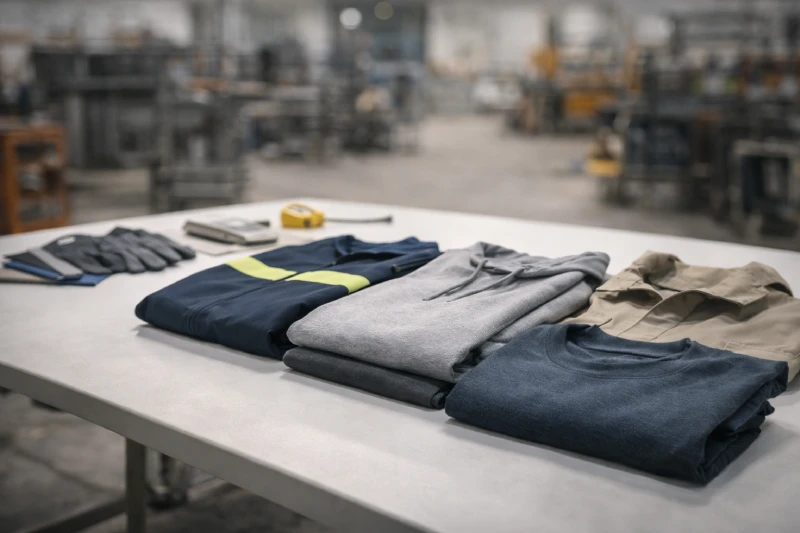
Regardless of category, effective industrial workwear selection follows a similar logic. The difference lies in how heavily each factor weighs depending on whether you are sourcing caps, base garments, or protective apparel.
Step 1 — Define the Work Environment and Risk Level
Start by mapping where and how the apparel will be used.
Key questions:
- Indoor, outdoor, or mixed environments?
- Exposure to heat, sparks, chemicals, or mechanical abrasion?
- High-visibility requirements (daylight, low light, night work)?
- Seasonal or climate variability?
Why this matters:
A cap used on a construction site may need visibility elements and sweat management, while a T-shirt used as an under-layer must prioritize breathability and skin comfort.
Step 2 — Identify Applicable Standards and Local Requirements
Different markets impose different expectations on industrial apparel.
Examples of requirement layers:
- Mandatory safety standards (e.g. high-visibility, flame resistance)
- Industry-specific guidelines (construction, logistics, manufacturing)
- Buyer or brand internal standards
- Import or destination market compliance
A common B2B mistake is assuming one “global standard” applies everywhere. In reality, compliance is often market-specific.
Step 3 — Translate Compliance into Material and Construction Choices
Once requirements are defined, compliance becomes a technical translation exercise.
Key material considerations:
- Fabric type (woven vs knit)
- Fiber composition (cotton, polyester, blends)
- Weight and durability
- Colorfastness and visibility retention
- Wash performance over lifecycle
Construction considerations:
- Stitch density and seam reinforcement
- Reflective tape placement (if applicable)
- Trims and accessories compatibility
- Size grading consistency for bulk orders
These choices apply across categories but vary in priority. For example, durability may outweigh comfort in outer workwear, while the opposite may be true for polos or base layers.
Comparing Compliance Priorities Across Apparel Categories
The table below illustrates how compliance considerations differ between common industrial apparel categories.
| Category | Primary Compliance Focus | Secondary Considerations |
|---|---|---|
| Workwear & Safety Apparel | Protection, standards alignment | Durability, visibility retention |
| T-Shirts & Polos | Comfort, skin safety | Colorfastness, uniform appearance |
| Hoodies & Sweatshirts | Warmth, layering compatibility | Weight control, logo placement |
| Sportswear / Activewear | Mobility, moisture control | Durability under repeated wash |
| Headwear & Caps | Visibility, fit security | Breathability, sweat management |
This comparison helps buyers avoid applying one-size-fits-all logic across very different product types.
For B2B buyers managing multi-category uniform programs, the key risk is applying the same compliance logic across fundamentally different apparel types. Base layers, outer garments, and accessories often share branding systems but should not share performance assumptions. Misalignment at this stage can lead to unnecessary cost increases or functional compromise without improving real-world compliance.
Customization Considerations in Compliant Workwear Programs
Customization is often essential in B2B uniform programs—but it introduces additional compliance and production variables.
Logo and Branding Methods
Different decoration methods interact differently with compliance requirements.
Common methods include:
- Embroidery
- Screen printing
- Heat transfer
- Woven or sewn labels
Key compliance questions:
- Does the branding method affect fabric performance?
- Will it reduce breathability or flexibility?
- Can it withstand industrial washing cycles?
- Does it interfere with reflective or protective zones?
For example, embroidery may be suitable for caps and polos, but inappropriate for garments requiring smooth protective surfaces.
Color Customization and Visibility Requirements
Color is not purely aesthetic in industrial use.
Buyers should confirm:
- Approved color ranges for compliance
- Long-term color stability after washing
- Consistency across production batches
- Compatibility with reflective materials
This is especially critical when managing multi-year or multi-site uniform programs.
Bulk Order Planning — MOQ, Lead Time, and Scale Risk
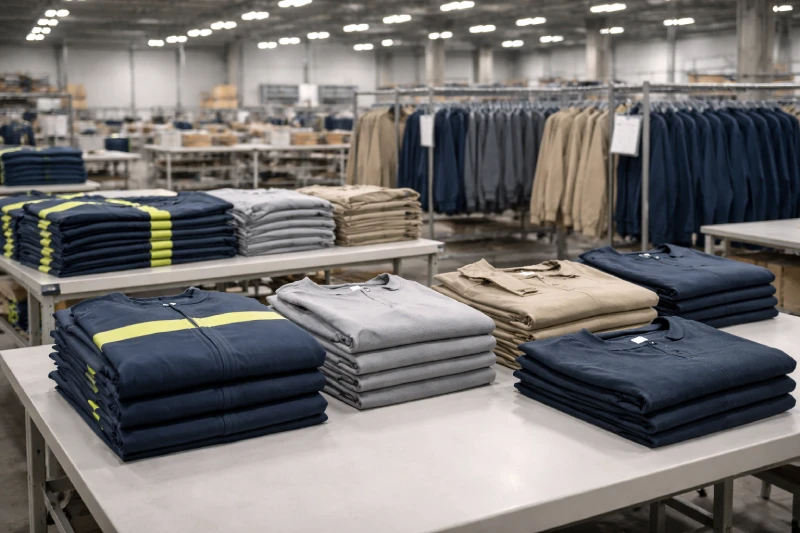
Industrial workwear is almost always ordered in bulk. Understanding how scale affects compliance is essential.
Minimum Order Quantity (MOQ)
MOQs vary by:
- Product category
- Fabric customization level
- Color and size breakdown
- Decoration method
Planning tip:
Lower MOQs may be available for simple garments (T-shirts, caps), while complex safety apparel often requires higher minimums due to material sourcing and setup costs.
Lead Time and Compliance Testing Cycles
Lead time is not only about production speed.
Typical timeline components:
- Material sourcing
- Sample development
- Compliance or performance testing
- Bulk production
- Final inspection and packing
Overseas buyers often underestimate the impact of sampling revisions and compliance validation on total lead time. In industrial programs, these early-stage delays typically have greater long-term impact than production speed, especially when future repeat orders must match the original compliance baseline.
Consistency Across Repeat Orders
For B2B buyers, compliance is not a one-off event.
Key consistency risks include:
- Fabric lot variation
- Color shade drift
- Sizing inconsistencies
- Trim or accessory substitution
Many compliance failures do not appear in the first shipment, but emerge during follow-up orders when material sourcing or process controls change. Evaluating a supplier’s ability to lock specifications across production cycles is therefore as critical as approving initial samples.
Supplier Evaluation Checklist for Compliant Workwear
Use the checklist below when assessing manufacturing partners.
Capability Checklist
- ☐ Experience across multiple apparel categories
- ☐ Understanding of industrial compliance requirements
- ☐ Clear material traceability
- ☐ Structured sampling and approval process
Production & Quality Checklist
- ☐ Stable MOQ and scaling options
- ☐ Defined lead time breakdown
- ☐ In-process and final inspections
- ☐ Repeat-order consistency controls
Communication Checklist
- ☐ Clear technical documentation
- ☐ Ability to explain trade-offs
- ☐ Transparent customization limits
- ☐ Project-based rather than SKU-based support
Common Pitfalls in Choosing Compliant Workwear for Industrial Use
Even experienced buyers encounter recurring issues:
- Over-specifying features that add cost without improving compliance
- Applying safety-grade expectations to non-protective garments
- Ignoring wash lifecycle performance
- Underestimating the impact of branding on garment function
- Selecting suppliers based only on sample quality, not bulk consistency
Avoiding these pitfalls often matters more than selecting the “best” fabric on paper.
Conclusion: A Project-Driven Approach to Compliant Workwear
Choosing compliant workwear for industrial use is best approached as a system decision, not a product decision. Across caps, garments, and safety apparel, the core logic remains the same:
- Define real working conditions
- Clarify compliance requirements
- Translate standards into materials and construction
- Plan for scale, customization, and repeatability
Manufacturers with multi-category experience are often better positioned to support this process, as they understand how compliance priorities shift across apparel types.
If you are planning an industrial uniform or workwear program and want to validate compliance requirements, customization options, or bulk production strategy, discussing your specific project parameters with an experienced manufacturer can help reduce risk and improve long-term consistency.