
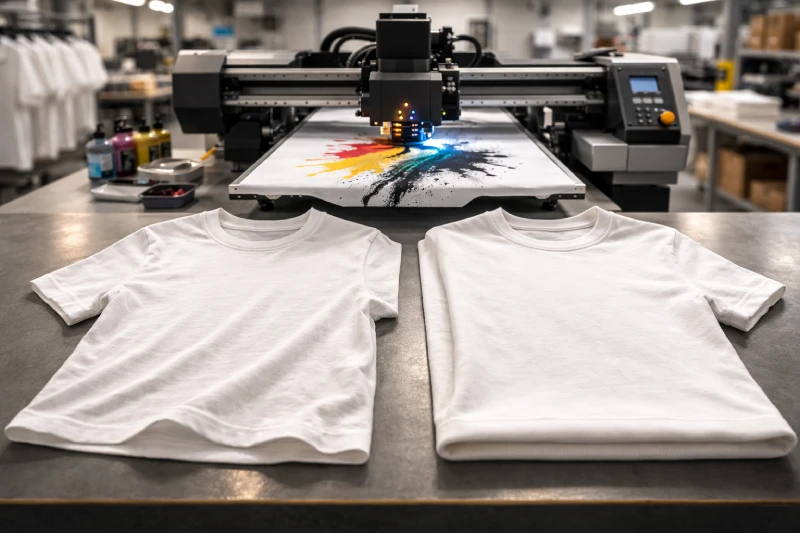
In DTG (Direct-to-Garment) printing, fabric selection is not just a sourcing decision — it is a print-quality decision. One of the most critical specifications in cotton T-shirt production is GSM, which stands for grams per square meter. GSM measures fabric weight and density, directly influencing how ink interacts with the garment surface.
For DTG printing, GSM affects ink absorption, color vibrancy, white underbase opacity, print sharpness, and long-term durability. A 180gsm cotton T-shirt behaves very differently from a 240gsm garment under the same printer settings. Likewise, fabric construction — such as ring spun cotton for DTG — can dramatically change the final print resolution.
This guide is written from a manufacturing and engineering perspective, designed specifically for brand owners, OEM buyers, and sourcing managers who need to choose between 180gsm vs 240gsm for DTG and build consistent, professional-quality apparel programs.
What Does GSM Mean in Cotton T-Shirts?
GSM (grams per square meter) measures the weight of fabric within one square meter of material. In cotton T-shirts, GSM indicates fabric density, thickness, and structural body. A higher GSM generally means a heavier and denser fabric, while a lower GSM results in a lighter and more breathable garment.
For DTG printing, GSM is not only about weight — it directly affects how ink sits on the fabric surface. Since DTG uses water-based pigment inks that penetrate into the fibers, fabric density and yarn compactness become critical variables in print clarity and color performance.
How GSM Is Measured in Knit Fabrics
In knit fabrics such as T-shirts, GSM is calculated by weighing a precisely measured square section of fabric and converting it to grams per square meter. Most cotton T-shirts are made using single jersey knit construction, which is lightweight and flexible. Double-knit fabrics are denser and heavier due to their interlocking structure, resulting in naturally higher GSM values.
In commercial production, slight GSM variation is normal. A tolerance of ±5% is common in bulk manufacturing, depending on yarn count, knitting tension, and finishing processes. This means a labeled 200gsm fabric may realistically range between 190–210gsm.
Why GSM Matters More for DTG Than Screen Printing
GSM plays a more critical role in DTG printing than in traditional screen printing because DTG ink is absorbed directly into the fabric fibers. Unlike plastisol ink in screen printing — which largely sits on top of the garment — DTG pigment disperses into the knit structure.
Lower GSM fabrics tend to allow greater ink spread, which can reduce edge sharpness and opacity. Higher GSM fabrics provide a denser fiber network, helping ink remain more concentrated and improving color consistency.
For brands prioritizing high-resolution artwork and white underbase stability, understanding GSM is essential.
Why Cotton Weight Directly Affects DTG Printing Quality
In DTG production, fabric weight is not just a comfort specification — it is a performance variable. Cotton GSM directly influences how ink penetrates, how pigment bonds to fibers, and how the final print withstands washing. From a manufacturing standpoint, two garments printed with identical artwork and machine settings can produce noticeably different results purely because of GSM differences.
Understanding this relationship helps brands avoid common quality issues such as dull colors, fuzzy edges, or weak white underbases.
Ink Absorption Behavior in Different GSM Fabrics
Lower GSM cotton fabrics (e.g., 160–180gsm) generally have a looser knit structure and more visible micro-gaps between yarns. When DTG ink is applied, it penetrates more deeply and spreads more easily within the fiber network. While this can create a softer hand feel, it may also reduce color density and edge precision.
Higher GSM fabrics (e.g., 220–240gsm) have a tighter knit and more compact yarn distribution. Ink remains more concentrated near the surface, resulting in stronger color saturation and improved print consistency. This is particularly important for complex graphics or gradients.
Fabric Density and Print Sharpness
Fabric density directly impacts print resolution. In lower-density fabrics, uneven yarn spacing can cause minor ink migration along fiber channels, softening fine lines or small text details.
In higher GSM cotton, yarns are packed more tightly together. This tighter structure creates a more stable printing surface, allowing pigment to deposit more uniformly. As a result, line edges appear sharper and image contrast improves.
For brands producing high-detail artwork or photo-realistic prints, higher GSM fabrics often provide more reliable results.
Opacity and White Underbase Interaction
When printing on dark garments, DTG typically uses a white underbase layer before applying colored inks. The effectiveness of this white layer is partially dependent on fabric weight.
Lower GSM fabrics may allow slight show-through or reduced opacity if the fiber density is insufficient to support the ink layer. Higher GSM cotton provides better structural support for the white underbase, improving coverage and color brightness on top layers.
For premium DTG applications — especially on black or deep-colored garments — GSM plays a critical role in achieving professional opacity and durability.
180gsm vs 240gsm for DTG: Which Should You Choose?
When sourcing cotton T-shirts for DTG printing, the comparison between 180gsm and 240gsm is one of the most common decision points. Both weights are widely used in commercial production, yet they serve different brand strategies, price tiers, and print performance expectations.
From a manufacturing perspective, the difference is not simply “light vs heavy.” It impacts ink hold capacity, opacity, durability, garment drape, and perceived value. Choosing the correct GSM depends on your target market, price positioning, and expected wash performance.

180gsm Cotton for DTG
Advantages
- Lightweight and breathable
- Lower fabric cost
- Suitable for high-volume production
- Comfortable for warm climates
At 180gsm, cotton T-shirts feel relatively light and flexible. For DTG printing, they provide acceptable ink absorption and reasonable color performance when artwork is not overly complex.
Potential Risks
- Slightly reduced opacity on dark garments
- Higher chance of minor ink spread
- Thinner hand feel, which may affect “premium” perception
Best For
- Promotional campaigns
- Event merchandise
- Summer collections
- Budget-focused bulk orders
For brands prioritizing cost efficiency and turnover speed, 180gsm remains a practical and scalable option.
240gsm Cotton for DTG
Advantages
- Denser surface structure
- Stronger ink hold capacity
- Improved white underbase opacity
- More structured, premium feel
- Higher dimensional stability after washing
At 240gsm, cotton fabric offers a thicker and more substantial hand feel. For DTG, this increased density supports sharper artwork, stronger color vibrancy, and better long-term durability.
Considerations
- Higher raw material cost
- Slightly heavier wearing experience
- Increased shipping weight for bulk export
Best For
- Premium streetwear brands
- Direct-to-consumer (DTC) labels
- Limited collections
- High-detail or large-format prints
For brands targeting elevated positioning, 240gsm often aligns better with premium pricing and long-term brand perception.
Side-by-Side Comparison
| Feature | 180gsm | 240gsm |
|---|---|---|
| Ink Hold | Medium | High |
| Opacity | Medium | Strong |
| Durability | Moderate | High |
| Premium Feel | Low–Medium | High |
| Cost Level | Lower | Higher |
Recommendation by Brand Type
- Streetwear brands: 220–240gsm is typically preferred for structure and perceived value.
- Premium DTC brands: 200–240gsm ensures better print stability and durability.
- Bulk merchandise programs: 180–200gsm balances cost and acceptable DTG performance.
There is no universally “better” option — only the right option for your product positioning. The key is aligning GSM with both print requirements and brand strategy.
What Is the Best GSM for DTG Printing?
There is no single “best” GSM for DTG printing — only the most suitable range based on artwork complexity, brand positioning, and target market. From a production stability standpoint, most professional DTG programs operate within a 180gsm–240gsm window.
For consistent commercial results, the most commonly selected range is 200–220gsm. This mid-weight category offers a balanced combination of ink control, surface smoothness, structural stability, and wearable comfort. It is heavy enough to support strong white underbase opacity, yet not overly thick for year-round wear.
Brands launching new collections often begin testing within this 200–220gsm range because it reduces risk while maintaining flexibility in pricing.
Lightweight vs Heavyweight DTG T-Shirts
Lightweight (160–180gsm) garments are ideal for summer collections, promotional merchandise, and high-volume campaigns. They offer breathability and lower material cost, but may sacrifice some opacity and long-term durability.
Midweight (200–220gsm) shirts provide improved ink concentration and better wash stability, making them suitable for growing DTC brands and structured retail programs.
Heavyweight (230–260gsm) garments deliver a premium hand feel and enhanced print density. They are typically used in fall/winter collections or elevated streetwear lines where fabric structure contributes to brand identity.
Ultimately, the best GSM for DTG is the one that aligns fabric performance with your product strategy, not just printing specifications.
Why Ring Spun Cotton Performs Better for DTG Printing
While GSM determines fabric weight and density, yarn construction determines surface quality. In DTG printing, surface smoothness directly impacts ink precision, color vibrancy, and fine-detail resolution. This is where ring spun cotton becomes a critical variable.

From an engineering standpoint, two T-shirts with identical GSM can produce different DTG results if their yarn spinning methods differ. The difference is most noticeable in image sharpness and surface consistency.
What Is Ring Spun Cotton?
Ring spun cotton is produced using a traditional ring spinning process, where cotton fibers are continuously twisted and thinned into a fine, compact yarn. This process aligns fibers more uniformly and removes short fiber fragments.
Compared to open-end (OE) cotton, ring spun yarns are:
- Finer and more compact
- Smoother to the touch
- More uniform in fiber distribution
- Lower in surface hairiness
This tighter fiber alignment creates a more stable and even printing surface.
Surface Smoothness and Print Resolution
DTG printing relies on precise ink droplet placement. If the fabric surface is uneven or fuzzy, micro-level ink diffusion can occur, softening edges and reducing detail clarity.
Ring spun cotton reduces surface fuzz (hairiness), allowing pigment to sit more evenly across the fabric plane. The smoother texture improves:
- Line sharpness
- Gradient transitions
- Small text clarity
- Overall print resolution
For brands producing high-resolution artwork or photographic designs, ring spun cotton significantly improves consistency.
Ring Spun vs Open-End Cotton for DTG
Open-end cotton is produced through a faster, more cost-efficient spinning method. While suitable for many applications, OE yarns tend to be thicker and slightly rougher in texture.
In DTG printing, open-end cotton may result in:
- Slightly muted color saturation
- Reduced edge definition
- Increased surface fuzz interaction with ink
Ring spun cotton, by contrast, offers better pigment concentration and visual crispness, particularly on detailed graphics.
Recommended Cotton Composition
For optimal DTG performance, manufacturers commonly recommend:
- 100% ring spun cotton for maximum print clarity
- Combed ring spun cotton for premium programs
Blends such as 95/5 cotton-spandex or cotton-poly mixtures can alter ink absorption behavior and may require adjusted pretreatment settings. While usable, they introduce additional print variables.
For brands prioritizing consistent quality and premium finish, 100% ring spun cotton remains the most reliable foundation for DTG production.
Pretreatment Compatibility Across Different GSM Levels
Pretreatment is a critical step in DTG printing, especially when working with dark garments that require a white underbase. While printer settings often receive the most attention, fabric GSM significantly influences how pretreatment solution behaves on the garment surface.
Lower GSM fabrics (such as 160–180gsm) tend to absorb pretreatment more quickly due to their relatively looser knit structure. This can be beneficial for penetration, but it also increases the risk of over-saturation if spray control is not precise. Excessive pretreatment may cause slight staining or uneven surface crystallization after curing.
Higher GSM fabrics (220–240gsm) provide a denser fiber matrix, which slows absorption and allows for more controlled surface distribution. However, they require more uniform spray application to ensure consistent white ink bonding across the print area.
For dark garments, white underbase performance becomes highly dependent on both GSM and pretreatment balance. Thicker fabrics generally support stronger underbase adhesion, but only when pretreatment is evenly calibrated.
From a production standpoint, GSM-specific pretreatment adjustment is essential to maintain color vibrancy, opacity, and wash durability.
How Manufacturers Select Cotton GSM for DTG Production
From a factory perspective, selecting the right GSM for DTG printing is not based on preference alone. It is a structured decision influenced by target market positioning, cost architecture, durability expectations, and production efficiency.
Experienced manufacturers evaluate GSM within a broader supply chain framework to reduce risk and ensure repeatable quality.
Target Market and Pricing Tier
The intended retail price significantly influences GSM selection.
- Entry-level promotional products often use 180gsm to maintain competitive cost structures.
- Mid-tier brands typically select 200–220gsm for balanced performance and perceived value.
- Premium and streetwear labels frequently move toward 230–240gsm to justify higher pricing and enhance garment structure.
Fabric weight directly impacts material cost, sewing efficiency, and freight weight — all of which affect final margin calculations.
Wash Durability Expectations
Heavier GSM fabrics generally provide better structural stability after repeated washing. Most DTG programs target shrinkage control within 3%–5% after standard wash testing.
Higher GSM cotton often demonstrates:
- Improved shape retention
- Better collar structure stability
- More consistent print integrity after laundering
If a brand promises long-term durability, selecting a higher GSM reduces post-sale quality claims.
Shrinkage and Fabric Stability Control
During bulk production, knitting tension, finishing processes, and pre-shrinking treatments influence final GSM consistency. Manufacturers account for potential variation (commonly ±5%) and adjust knitting specifications accordingly.
Higher GSM fabrics can be more forgiving in maintaining structural integrity during cutting and sewing, which improves overall production yield.
Production Line Compatibility
Not all production lines are optimized for extremely lightweight or heavyweight fabrics.
- Lightweight fabrics may require careful handling to prevent stretching during printing.
- Heavyweight fabrics demand stable platen pressure and curing control.
A well-matched GSM ensures smoother workflow across pretreatment, printing, curing, and finishing stages.
Ultimately, professional manufacturers select cotton GSM not just for print quality — but for operational stability and predictable large-scale performance.
Choosing the Right GSM for Your Brand Strategy
Selecting GSM for DTG printing should align with your brand positioning, price structure, and long-term product roadmap. Rather than chasing a “technically best” option, brands should apply a simple decision framework that balances cost, feel, and print performance.
Practical Decision Model
- Low-budget promotional campaigns → 180gsm
Suitable for events, giveaways, and short product cycles where price sensitivity is high and ultra-premium feel is not required. - Mid-market growing brands → 200–220gsm
Ideal for balanced programs. Offers reliable DTG performance, stronger opacity, and improved durability while maintaining reasonable production cost. - Premium streetwear or elevated DTC brands → 240gsm
Best for structured silhouettes, premium hand feel, and high-resolution prints. Supports stronger white underbase and long-term wash stability.
Real-World Scenarios
- A summer music festival merch line may prioritize breathability and volume → 180gsm.
- An emerging lifestyle brand targeting online retail may choose stability and quality perception → 220gsm.
- A premium urban label focusing on heavyweight silhouettes may standardize on → 240gsm.
When GSM aligns with brand identity and customer expectation, DTG quality becomes consistent, pricing becomes justified, and product returns decrease.
FAQs
What is the best GSM for DTG printing?
There is no single best GSM, but most professional DTG programs operate between 180gsm and 240gsm. The most stable and widely used range is 200–220gsm, offering balanced ink absorption, opacity, and durability.
Is 180gsm too thin for DTG?
180gsm is not too thin, but it may provide slightly lower opacity and structure compared to heavier fabrics. It works well for promotional or summer garments but may not deliver a premium feel.
Is 240gsm better for white underbase?
Yes. 240gsm cotton generally provides better density and structural support for white underbase layers, especially on dark garments, improving opacity and color vibrancy.
Does heavier cotton improve DTG durability?
In most cases, yes. Higher GSM fabrics tend to maintain structure better after washing, which helps preserve print integrity and reduce distortion over time.
Is ring spun cotton necessary for DTG printing?
While not strictly mandatory, 100% ring spun cotton significantly improves surface smoothness and print resolution. It is strongly recommended for premium or high-detail DTG designs.
What GSM do most DTG brands use?
Most commercial DTG brands use 200–220gsm cotton, as it offers a strong balance between print quality, comfort, durability, and cost control.