
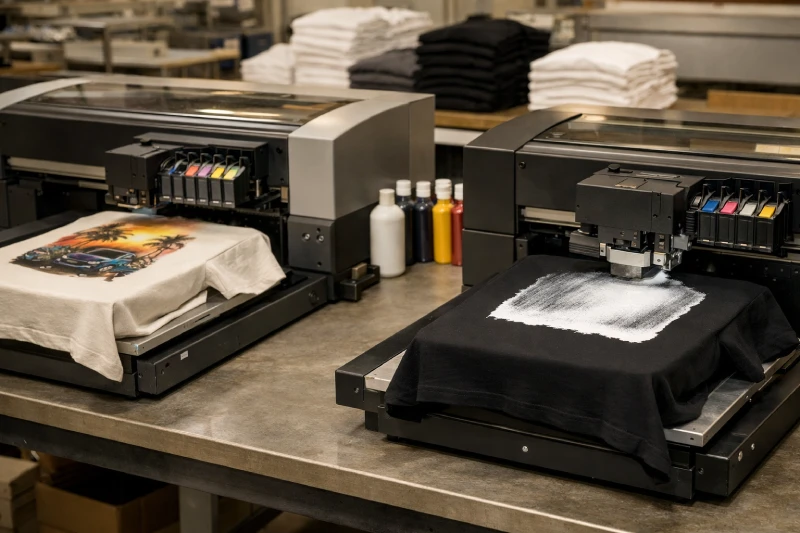
For apparel brands evaluating decoration methods, understanding DTG printing cost per shirt is essential for accurate pricing, margin planning, and production strategy. Unlike simplified retail pricing often advertised by print-on-demand platforms, real manufacturing cost depends on multiple technical and operational factors.
To see how cost fits into the broader DTG production system — including fabric selection, printing methods, and scalability — refer to our DTG T-shirt printing guide.
On average, DTG (Direct-to-Garment) printing costs range from $5 to $15 per shirt at the manufacturing level. However, this number varies significantly depending on garment quality, fabric type, GSM, artwork coverage, white underbase usage, pretreatment requirements, and — most importantly — order volume.
A 30-piece startup run will have a completely different cost structure compared to a 300-piece growth order or a 2,000-piece bulk production run. Ink consumption, labor efficiency, equipment amortization, and rejection rates all influence the final unit price.
In this guide, we break down DTG printing cost per shirt from a manufacturing perspective, helping apparel brands understand where the money goes — and how to optimize production decisions without compromising quality.
How Much Does DTG Printing Cost Per Shirt?
Typical DTG printing cost per shirt ranges from $5 to $15 per unit at the manufacturing level, depending on garment quality, artwork coverage, ink usage, and total order volume.
However, this range shifts based on production scale:
- Low-volume orders (1–50 pcs):
Unit cost is usually on the higher end, often $10–$15 per shirt, due to setup time, labor allocation, and limited efficiency. Equipment amortization weighs heavily in small runs. - Mid-volume runs (100–500 pcs):
Costs typically fall into the $7–$10 per shirt range. Labor batching improves, ink waste decreases, and setup costs are distributed across more units. - Bulk production (1,000+ pcs):
Well-optimized manufacturing environments may reduce costs to $5–$8 per shirt, depending on artwork complexity and fabric specifications.
Why Costs Vary Significantly
DTG printing is a variable-cost-heavy process. Unlike screen printing, there is no screen setup fee — but ink usage, white underbase density, pretreatment, and printing time directly affect cost per unit. A full-front, high-saturation graphic on a dark 220gsm cotton shirt can cost nearly double compared to a small chest logo on a light 160gsm tee.
Additionally, rejection rates (typically 2–5%), machine maintenance, and operator efficiency influence the real manufacturing cost.
Manufacturing vs Retail Pricing Differences
It is important to distinguish between manufacturing cost and retail or POD pricing.
Print-on-demand platforms often charge $18–$35 per shirt retail, which includes:
- Garment sourcing markup
- Platform fees
- Fulfillment handling
- Packaging and shipping
- Profit margin
In contrast, apparel brands working directly with manufacturers analyze DTG cost from a production-structure perspective — focusing on ink consumption, labor allocation, and volume efficiency.
Understanding this distinction allows brands to make informed decisions about pricing strategy, MOQ planning, and long-term margin sustainability.
DTG Printing Cost Breakdown Per Shirt (Manufacturing View)
From a manufacturing perspective, DTG printing cost per shirt is not a single fixed number — it is the result of multiple layered cost components. Understanding each element helps apparel brands evaluate quotations more accurately and identify optimization opportunities.
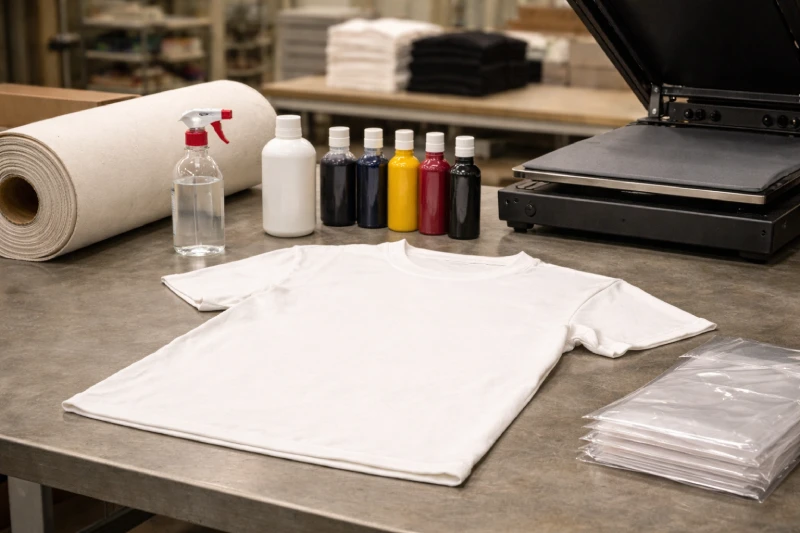
Below is a structured breakdown of the main cost drivers in DTG production.
1. Blank Garment Cost
The blank garment is often the largest cost component before printing even begins.
Basic cotton T-shirt vs premium ring-spun cotton
- Standard open-end cotton tees are typically more affordable but may have looser fiber structure and higher surface hairiness.
- Premium ring-spun cotton provides smoother surface finish, better ink absorption, and improved print sharpness — but at a higher base cost.
GSM impact (160gsm vs 220gsm vs 260gsm)
- 160gsm: Lightweight, lower material cost, common for promotional use.
- 220gsm: Balanced durability and structure, common for brand retail lines.
- 260gsm: Heavyweight premium positioning, higher yarn consumption and cost.
Higher GSM increases raw material cost and may slightly influence ink absorption behavior.
Fabric quality consistency
Inconsistent fabric density or surface treatment can cause color variation, misprints, or higher rejection rates — indirectly increasing per-unit cost.
Sourcing region influence
Garment sourcing from different regions (e.g., local mills vs imported blanks) affects price stability, MOQ requirements, and lead time, all of which impact total production economics.
2. Pretreatment Cost
Pretreatment is required primarily for dark garments, where a white underbase layer must adhere properly before color printing.
Why pretreatment is required
Without proper pretreatment, white ink bonding fails, resulting in dull colors or wash durability issues.
Chemical cost per unit
Pretreatment solution adds a small but measurable per-shirt chemical cost.
Labor and drying time
Application requires:
- Spray process
- Even coating control
- Heat pressing or tunnel drying
This adds labor allocation and machine time per piece.
Impact on rejection rates
Uneven pretreatment can cause staining or patchiness. Improper curing can increase waste percentage — often contributing to a realistic 2–5% rejection factor in production planning.
3. Ink Consumption Cost
Ink is a variable cost that changes significantly based on artwork and garment type.
Light shirts vs dark shirts
- Light garments require no white underbase.
- Dark garments require white underbase plus CMYK layers, increasing ink usage substantially.
White underbase usage
White ink is typically the most expensive ink component and often doubles ink consumption on dark shirts.
Full front print vs small chest logo
A 30cm x 40cm full-front graphic consumes significantly more ink than a 10cm logo.
Ink density and coverage %
Heavy saturation designs with high color density increase:
- Ink cost
- Printing time
- Curing time
Thus, artwork complexity directly affects cost per shirt.
4. Printing Time & Labor
DTG is a relatively time-sensitive process compared to high-speed screen printing.
Average printing time per shirt
Depending on coverage and resolution, printing may take:
- 1–2 minutes (light garment, small design)
- 3–5 minutes (dark garment, full front graphic)
Machine setup time
Even without screens, operators must:
- Load artwork
- Calibrate alignment
- Conduct test prints
Setup cost becomes significant in small batches.
Operator labor cost allocation
Labor cost is calculated based on:
- Hourly wage
- Machine supervision time
- Production throughput
Production throughput limitations
DTG machines have capacity limits. Slower throughput increases per-unit labor burden, especially in low-volume runs.
5. Equipment Amortization (High-Level)
DTG machines require significant capital investment.
Capital investment recovery
Industrial DTG equipment can cost tens of thousands of dollars. Manufacturers must distribute this cost across total production volume.
Maintenance allocation
Regular maintenance, calibration, and consumables (cleaning fluids, capping stations) add ongoing cost.
Head replacement cycle
Print heads have limited lifespan and are expensive to replace, contributing to long-term cost allocation.
Why small shops have higher per-unit cost
Lower production volume means slower capital recovery — resulting in higher cost per shirt compared to large-scale factories.
6. Quality Control & Rejection Rate
Quality control is often underestimated in cost calculations.
Misprint probability
Alignment errors, banding, or color deviation can lead to reprints.
Color inconsistency
Different fabric lots may absorb ink differently, affecting output consistency.
Fabric defects affecting ink adhesion
Oil contamination, uneven weave, or dye inconsistencies can cause print failure.
A realistic waste factor in professional DTG production is typically 2–5%, which must be factored into unit cost calculations.
7. Packaging & Finishing
Post-print handling also adds incremental cost.
- Folding
- Polybagging
- Label application (brand neck label or size label)
- Barcode & SKU integration
While individually small, these steps add labor minutes per unit — which becomes meaningful in bulk production.
8. Order Volume Impact on Cost
Order quantity significantly influences DTG unit economics.
Setup cost distribution
Smaller orders absorb higher setup cost per piece.
Labor batching efficiency
Larger runs allow continuous production flow, reducing idle time.
Production scheduling
Factories optimize machine utilization across large batches, improving cost efficiency.
In summary, DTG printing cost per shirt is a layered calculation — combining garment cost, ink usage, labor allocation, equipment amortization, quality control, and order volume dynamics. Understanding these components allows brands to interpret quotations with greater clarity and negotiate strategically.
Realistic DTG Cost Scenarios by Order Volume
To understand how DTG printing cost per shirt behaves in real production, it’s helpful to examine different order volume scenarios. The same design printed on the same garment can have very different unit economics depending on scale.
Below are three practical manufacturing scenarios apparel brands commonly encounter.
Scenario 1: Startup Test Order (30 pcs)
Typical cost range: $10–$15 per shirt
Small test runs are often the most expensive on a per-unit basis.
Why the cost is high:
- Setup time is distributed across very few pieces
- Artwork calibration and test prints consume ink
- Labor efficiency is limited
- Equipment amortization weighs heavily
For example, even if the actual print time is only 2–3 minutes per shirt, operators still need to prepare files, align garments, and conduct quality checks. These fixed activities do not scale down proportionally.
Additionally, pretreatment and white underbase usage on dark garments further increase variable cost. In small batches, there is minimal opportunity to optimize ink batching or workflow.
This type of order is ideal for:
- Design validation
- Market testing
- Influencer sampling
- Limited-edition drops
However, margins are typically tighter unless retail pricing is positioned accordingly.
Scenario 2: Growing Brand Order (300 pcs)
Typical cost range: $7–$10 per shirt
At this level, cost structure becomes more balanced.
Cost advantages compared to 30 pcs:
- Setup cost distributed over more units
- Continuous production flow improves labor efficiency
- Ink waste percentage decreases
- Equipment amortization weight reduces
Production scheduling becomes smoother. Operators can batch similar garments together, minimizing changeover time and pretreatment adjustments.
At 300 pieces, brands often begin to see improved cost stability while maintaining DTG’s flexibility — especially for multi-color designs or mid-sized fashion collections.
This range is common for:
- E-commerce restocks
- Seasonal launches
- Crowdfunded apparel lines
- Boutique wholesale orders
Margins become more predictable, allowing brands to price confidently.
Scenario 3: Established Brand (2,000+ pcs)
Typical cost range: $5–$8 per shirt
Large-scale production allows DTG to operate near its efficiency ceiling.
Optimization factors include:
- Streamlined workflow
- Lower ink waste through consistent batching
- Better garment sourcing leverage
- More efficient labor allocation
- Reduced per-unit equipment amortization
At this scale, production teams can plan long runs of identical artwork, maximizing throughput and minimizing downtime.
However, it is important to note that at higher volumes (especially above 1,000–2,000 pieces of the same design), screen printing may begin to approach or undercut DTG cost, depending on color count and artwork complexity. This is where break-even analysis becomes strategically important.
For established brands, DTG remains highly cost-effective when:
- Designs are complex and multi-color
- Frequent artwork changes are required
- SKU diversification is high
- Moderate-to-large but not ultra-mass production volumes are involved
Key Insight
DTG cost per shirt is not static — it is highly sensitive to order volume.
Small orders are setup-heavy.
Mid-volume runs are efficiency-balanced.
Large runs maximize workflow optimization.
Understanding this progression allows apparel brands to align production strategy with growth stage and margin targets.
What Affects DTG Printing Cost Per Shirt?
Beyond order volume, several technical and material variables directly influence DTG printing cost per shirt. For apparel brands, understanding these factors helps predict pricing differences and avoid unexpected cost spikes.
Below are the primary cost drivers that impact DTG unit economics.
Fabric Type
100% cotton vs cotton/poly blend
DTG printing performs best on 100% cotton, where natural fibers allow better ink absorption and color vibrancy. Cotton/poly blends can still be printed, but color accuracy and wash durability may vary.
Blended fabrics sometimes require:
- Additional pretreatment
- Adjusted curing parameters
- More careful quality control
These adjustments can slightly increase labor and rejection risk.
Ring-spun vs open-end cotton
Ring-spun cotton has:
- Smoother surface
- Finer fiber structure
- Better ink adhesion
Open-end cotton may be cheaper but can result in:
- More surface fuzz
- Slightly reduced print sharpness
- Increased ink absorption variability
Premium garments often cost more upfront but may reduce waste and improve consistency.
Garment GSM
Fabric weight (GSM) influences both cost and print behavior.
Thicker fabric ink absorption
Higher GSM fabrics (220gsm–260gsm) tend to:
- Provide more stable print surface
- Reduce garment movement during printing
However, they also:
- Increase blank garment cost
- May absorb slightly more ink depending on weave density
Stability during printing
Lightweight 160gsm garments are cheaper but can shift slightly during platen loading, potentially increasing alignment adjustments and operator time.
Light vs Dark Shirts
This is one of the biggest cost differences in DTG production.
White underbase requirement
Dark shirts require a white ink underbase before CMYK layers are applied. This:
- Doubles ink usage in many cases
- Increases printing time
- Requires pretreatment
Double pass printing
Some dense or highly saturated designs may require additional passes, further increasing time and ink cost.
Light-colored garments skip the underbase step, significantly reducing variable cost.
Artwork Coverage Size
Design size directly correlates with ink and time consumption.
Small logo vs full front graphic
- Small chest logo (10cm–12cm): minimal ink, short print time
- Full front graphic (30cm x 40cm): high ink usage, longer cycle time
Heavy saturation designs
Designs with:
- Large solid white areas
- High-density color blocks
- Complex gradients
Consume more ink and extend machine runtime.
Artwork optimization can significantly reduce cost without compromising design intent.
White Underbase Usage
White ink is typically the most expensive component in DTG printing.
Ink consumption multiplier
On dark garments, white underbase can account for:
- 40–60% of total ink cost
Reducing white coverage where technically possible can lower per-unit cost.
Print time increase
Underbase requires:
- Separate ink layer
- Additional curing stabilization
This adds time per shirt, especially in large runs.
Order Quantity
Order size influences how all above factors are distributed.
Setup amortization
File setup, alignment testing, and machine preparation are fixed costs that scale down per unit as volume increases.
Scheduling efficiency
Larger runs allow:
- Continuous workflow
- Reduced changeover
- Improved operator rhythm
Small runs amplify the impact of each variable cost component.
Summary
DTG printing cost per shirt is shaped by a combination of:
- Fabric selection
- Garment GSM
- Shirt color
- Artwork size and density
- White underbase usage
- Order quantity
For apparel brands, cost control begins at the design and product planning stage — not just at quotation review. Strategic choices in fabric, artwork, and batching can significantly influence final manufacturing economics.
DTG vs Screen Printing Cost Comparison
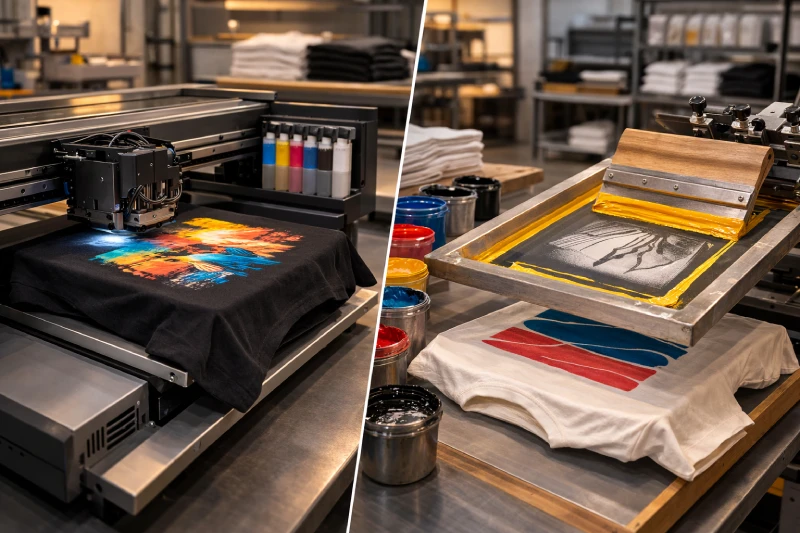
For apparel brands deciding between DTG and screen printing, cost comparison must be evaluated by order volume, artwork complexity, and production strategy — not just per-unit price alone.
While DTG eliminates screen setup fees, screen printing becomes increasingly cost-efficient at higher quantities. Below is a structured comparison.
Setup Cost Differences
Screen Printing:
- Requires physical screens for each color
- Setup includes screen coating, exposure, washing, and alignment
- Typical setup cost per color can range from $20–$50 (manufacturing level)
For a 4-color design, setup fees accumulate quickly before production even begins.
DTG Printing:
- No screen preparation required
- Digital file loaded directly into printer
- Minimal setup cost
This makes DTG especially attractive for:
- Low MOQ production
- Multi-color or gradient artwork
- Frequent design changes
Break-even Quantity Analysis
The key question is:
At what volume does screen printing become cheaper per unit than DTG?
While exact numbers vary by factory, a general manufacturing guideline is:
- Under 100–200 pcs: DTG is usually more cost-effective
- 300–500 pcs: Cost difference begins to narrow
- 1,000+ pcs (same design): Screen printing often becomes cheaper
This happens because screen printing has:
- High setup cost
- Low variable ink cost
- High production speed once running
In contrast, DTG has:
- Low setup cost
- Higher variable ink cost
- Slower per-unit print time
Thus, screen printing benefits from scale, while DTG benefits from flexibility.
Cost per Unit at Different Volumes
Below is a simplified manufacturing-level comparison (illustrative ranges):
50 pcs (multi-color design)
- DTG: $10–$14 per shirt
- Screen printing: $12–$18 per shirt (due to setup spread over small volume)
300 pcs (same design)
- DTG: $7–$10 per shirt
- Screen printing: $6–$9 per shirt
1,000 pcs (same design)
- DTG: $6–$8 per shirt
- Screen printing: $4–$6 per shirt
As volume increases, screen printing gains advantage due to:
- Faster cycle time
- Lower ink cost per unit
- Setup cost dilution
However, if artwork changes frequently or includes complex gradients, DTG may remain competitive even at mid-range volumes.
Strategic Consideration for Brands
DTG is ideal when:
- SKU diversity is high
- Artwork changes frequently
- Orders are under 300–500 pcs per design
- Multi-color or photo-quality prints are required
Screen printing is advantageous when:
- Design remains consistent
- Volume exceeds 1,000 pcs
- Solid color prints dominate
- Maximum unit margin is critical
The decision should not be based solely on per-shirt cost — but on flexibility, speed to market, SKU management, and long-term production planning.
DTG vs DTF Cost Comparison
As decoration technologies evolve, many apparel brands compare DTG (Direct-to-Garment) and DTF (Direct-to-Film) printing when analyzing cost per shirt. While both are digital methods and eliminate traditional screen setup, their workflow and cost structures differ in meaningful ways.
Understanding these differences helps brands choose the right solution for their production model.
Equipment & Workflow Differences
DTG Printing Workflow:
- Garment loading on platen
- Pretreatment (especially for dark shirts)
- Direct ink application onto fabric
- Heat curing
DTG prints directly onto the garment surface, which means each piece must be individually loaded and processed.
DTF Printing Workflow:
- Artwork printed onto transfer film
- Adhesive powder applied
- Film cured
- Transfer pressed onto garment
DTF separates printing and garment application into two steps, allowing films to be printed in batches before pressing.
From a workflow perspective:
- DTG is more streamlined for direct production.
- DTF offers batching flexibility for transfers.
Ink and Film Cost Differences
DTG Cost Structure:
- Water-based textile ink (CMYK + white)
- Pretreatment chemicals
- Higher white ink consumption on dark garments
DTF Cost Structure:
- Pigment ink
- PET transfer film
- Adhesive powder
DTF adds material cost for film and powder, but may use slightly less white ink compared to DTG in certain cases.
In many mid-volume scenarios:
- DTF unit cost can be comparable to or slightly lower than DTG
- However, additional transfer materials must be factored in
Cost differences depend heavily on:
- Design coverage
- Shirt color
- Production scale
Labor Intensity Comparison
DTG:
- Single-step garment printing
- Requires pretreatment and careful platen alignment
- Slower per-piece cycle time for dark garments
DTF:
- Two-step process (print + press)
- Heat pressing adds labor time
- Films can be prepared in bulk for later application
DTF may offer higher flexibility in scheduling but introduces an extra handling stage.
In smaller shops, labor allocation can make DTF slightly more labor-intensive per unit. In larger operations with automated powder shakers and curing systems, labor impact decreases.
Long-Term Cost Stability
DTG Advantages:
- No film inventory required
- Direct print feel (softer hand feel)
- Cleaner workflow for premium retail brands
DTF Advantages:
- Works well on a wider range of fabrics (including blends and synthetics)
- Lower dependency on fabric fiber content
- Strong opacity on dark garments
From a long-term perspective:
- DTG often aligns better with fashion brands focused on cotton garments and retail softness.
- DTF may be attractive for mixed-fabric programs and lower MOQ customization.
Cost Positioning Summary
At manufacturing level:
- Small runs (under 100 pcs): DTG and DTF are often similarly priced
- Mid-range (200–500 pcs): DTF may offer slight savings depending on workflow
- Larger runs (1,000+ pcs): Both may approach efficiency ceilings, and screen printing may re-enter comparison
Ultimately, the cost difference between DTG and DTF is usually narrower than between DTG and screen printing. The decision is often driven by fabric compatibility, brand positioning, and production flexibility rather than price alone.
When Is DTG Cost-Effective for Brands?
DTG printing is not always the cheapest option per shirt — but in many scenarios, it is the most strategically efficient. Cost-effectiveness should be evaluated not only by unit price, but by flexibility, speed, and inventory risk reduction.
Below are the situations where DTG delivers strong economic value for apparel brands.
Small Batch Fashion Drops
For limited releases or capsule collections, DTG eliminates the need for large minimum quantities.
Because there are:
- No screen setup fees
- No color limitations
- No high pre-production investment
Brands can launch 50–200 pieces per design without committing to large stock volumes. This reduces unsold inventory risk while preserving creative freedom.
Print-on-Demand (POD) Models
DTG is the backbone of most POD operations.
Since each garment can be printed individually without setup cost, brands can:
- Offer wide SKU diversity
- Test new designs continuously
- Produce only after receiving customer orders
This inventory-light model improves cash flow and minimizes warehousing cost.
Complex Multicolor Designs
Screen printing becomes expensive when artwork contains:
- High color counts
- Photorealistic gradients
- Detailed illustrations
DTG handles complex artwork without additional color setup fees. Whether the design uses 3 colors or 12 colors, the cost difference is driven primarily by ink coverage — not color separation.
For fashion-forward brands, this creative flexibility can justify slightly higher per-unit cost.
Low MOQ Testing
Emerging brands often need to validate:
- Market response
- Sizing distribution
- Pricing sensitivity
- Influencer campaign traction
DTG allows low-MOQ production without committing to 500+ pieces per design. Even if per-unit cost is higher, the reduced financial exposure makes it strategically cost-effective.
Sampling Stage Production
Before committing to bulk screen printing, brands may use DTG for:
- Pre-production samples
- Lookbook photography
- Buyer presentations
- Trade show display
DTG enables rapid sampling without screen preparation, accelerating development cycles.
Strategic Insight
DTG is most cost-effective when:
- Order quantities are moderate or low
- Design complexity is high
- SKU variety is important
- Inventory risk must be minimized
- Speed to market matters
For brands focused purely on maximizing margin at very high volumes, screen printing may eventually offer lower per-unit cost. But for agile brands prioritizing flexibility and controlled risk, DTG often provides superior overall economic value — even if the headline cost per shirt appears higher.
How to Reduce DTG Printing Cost Per Shirt Without Sacrificing Quality
Reducing DTG cost per shirt does not necessarily mean choosing cheaper materials or lowering print standards. Smart optimization at the design and production planning stage can significantly improve unit economics while maintaining retail-level quality.
Below are practical strategies apparel brands can implement.
Optimize Artwork Size
Print size directly affects:
- Ink consumption
- Printing time
- White underbase usage
Reducing a full 30cm x 40cm graphic slightly — for example to 28cm width — can lower ink coverage percentage without visibly changing design impact.
Strategic design adjustments such as:
- Reducing solid white blocks
- Avoiding unnecessary background fills
- Using negative space effectively
Can meaningfully reduce ink cost per unit.
Choose the Right Fabric
Selecting fabric strategically can lower cost and improve consistency.
For example:
- 100% cotton often prints more predictably than blends
- Smooth ring-spun cotton reduces surface irregularities
- Stable 200–220gsm garments balance quality and cost
Using overly heavy 260gsm garments may elevate blank cost without providing proportional value, unless brand positioning requires heavyweight construction.
Fabric stability also reduces misprints — lowering rejection rates.
Avoid Excessive White Underbase
White ink is typically the most expensive component in DTG printing.
To optimize:
- Avoid unnecessarily large white underbase areas
- Design with fabric color integrated into artwork
- Choose lighter garment colors when feasible
Printing on light shirts eliminates underbase entirely, reducing both ink and time.
Even partial design optimization on dark garments can lower white ink coverage percentage.
Increase Order Volume Strategically
Instead of placing frequent small orders, brands can:
- Consolidate SKUs
- Batch similar designs
- Plan seasonal production together
Increasing volume per design reduces:
- Setup impact
- Labor inefficiency
- Equipment amortization weight
Even moving from 50 pcs to 200 pcs can significantly lower cost per shirt.
Align Production Scheduling
Production efficiency improves when:
- Designs are printed consecutively
- Garment types are grouped
- Similar colors are batched
Frequent changeovers increase downtime and waste. Coordinating artwork and garment color strategically can improve throughput.
Brands working closely with manufacturers on scheduling often achieve better cost stability than those ordering sporadically.
Key Takeaway
DTG cost optimization is not about cutting corners — it is about intelligent planning:
- Design efficiency
- Fabric selection
- Volume strategy
- Workflow coordination
When brands integrate these considerations early in product development, DTG printing becomes not only flexible — but economically sustainable.
Strategic Manufacturing Perspective: Beyond Cost Per Shirt
While “DTG printing cost per shirt” is an important metric, experienced apparel brands evaluate production decisions from a broader manufacturing strategy perspective. Unit price alone does not determine profitability or long-term sustainability.
Below are key strategic considerations that go beyond headline cost.
Total Landed Cost Thinking
Focusing only on print cost can be misleading. Brands should evaluate:
- Blank garment cost
- Printing cost
- Packaging and labeling
- Shipping and fulfillment
- Customs and duties (if importing)
- Inventory holding cost
A slightly higher print cost may be offset by:
- Lower inventory risk
- Reduced unsold stock
- Faster time to market
Total landed cost — not just decoration cost — determines real margin.
Brand Positioning vs Margin
Heavier GSM, premium ring-spun cotton, and high-density prints increase production cost — but they also elevate perceived brand value.
Brands must align:
- Target retail price
- Customer expectation
- Product positioning
- Gross margin goals
Cutting cost excessively may compromise hand feel, durability, or print vibrancy, ultimately damaging brand perception.
Strategic cost control should protect brand integrity, not undermine it.
MOQ Planning Logic
MOQ decisions directly influence per-unit economics.
Instead of chasing the lowest possible MOQ, brands should analyze:
- Forecasted sell-through rate
- Cash flow capacity
- Design lifecycle duration
- Marketing calendar
Optimizing MOQ means balancing:
- Unit cost efficiency
- Inventory exposure
- Reorder flexibility
Well-planned volume increases often generate better long-term margin than repeatedly placing very small orders.
Long-Term Supplier Relationships
Consistent collaboration with a manufacturing partner can reduce cost variability over time.
Benefits include:
- Stable pricing agreements
- Improved production scheduling
- Reduced miscommunication
- Lower rejection rates through process familiarity
Suppliers who understand a brand’s fabric standards and artwork requirements can optimize workflow more efficiently than transactional vendors.
Quality Consistency vs Cheapest Price Trap
Chasing the lowest per-shirt cost may result in:
- Inconsistent fabric quality
- Higher misprint rates
- Color variation
- Poor wash durability
A 2–3% increase in rejection rate can eliminate any apparent savings from a cheaper quote.
Reliable quality reduces:
- Reprint cost
- Customer returns
- Brand reputation damage
Long-term profitability depends on consistency, not just cost minimization.
Final Strategic Insight
DTG printing cost per shirt is a tactical metric.
But successful apparel brands think strategically:
- Optimize total production economics
- Align cost with brand positioning
- Plan MOQ intelligently
- Build stable manufacturing partnerships
- Protect quality consistency
When viewed through this lens, DTG becomes not just a printing method — but a flexible production tool that supports scalable, margin-conscious brand growth.