

Introduction
DTG T-shirt printing, also known as Direct-to-Garment printing, is a digital apparel decoration method that prints water-based inks directly onto fabric using specialized inkjet technology. If you’ve ever wondered what is DTG printing on shirts, the simplest answer is this: it works much like a paper printer, but instead of paper, the design is printed directly onto a finished garment. This allows for high-detail artwork, smooth gradients, and full-color graphics without the need for screens or transfers.
Apparel brands choose DTG shirt printing for its flexibility, especially when producing small batches, samples, or limited-edition drops. Unlike traditional methods that require setup for each color or design, DTG enables on-demand production with minimal setup time. This makes it particularly attractive for startup brands, e-commerce sellers, and fashion labels testing new collections.
This guide focuses on the manufacturing side of DTG T-shirt printing — including fabric selection, cost structure, production workflow, and quality control considerations — helping apparel brands make informed production decisions rather than just design choices.
What Is DTG Printing on Shirts?
Definition of Direct-to-Garment (DTG) Printing
Direct-to-Garment (DTG) printing is a digital textile printing method that applies water-based pigment inks directly onto the surface of a finished garment. Unlike traditional decoration techniques that require screens, plates, or transfer films, DTG uses specialized inkjet print heads to deposit ink precisely onto fabric fibers.
The inks are absorbed into the garment and then heat-cured to ensure durability and wash resistance. Because the process is digitally controlled, DTG printing allows for highly detailed graphics, complex color blends, and photographic-quality artwork without additional setup for each color. This makes it especially suitable for multi-color designs and short production runs.
How DTG Printing on T-Shirts Differs from Traditional Methods
DTG printing differs from traditional methods such as screen printing in several fundamental ways:
- No screen setup: Screen printing requires separate screens for each color, while DTG prints directly from a digital file.
- Unlimited color capability: DTG can reproduce complex gradients and fine details without increasing setup complexity.
- Lower minimum order flexibility: Because there is minimal setup, DTG is more efficient for small batches.
- Fabric interaction: DTG inks bond directly with cotton fibers, producing a softer hand feel compared to thick ink layers in some traditional methods.
However, DTG may not always match the cost efficiency of screen printing for very large bulk orders due to per-unit ink and machine time costs.
Why DTG Shirt Printing Became Popular for Small Batch Brands
DTG shirt printing gained popularity alongside the rise of e-commerce, print-on-demand platforms, and independent apparel startups. Brands no longer needed to commit to hundreds of pieces per design. Instead, they could test new graphics, launch limited drops, or produce made-to-order collections with reduced inventory risk.
For emerging apparel brands, DTG offers three strategic advantages:
- Low MOQ flexibility for testing new designs
- Fast turnaround for samples and pre-launch campaigns
- Full-color freedom without color-based cost increases
As a result, DTG has become a core production method for brands prioritizing speed, design complexity, and controlled inventory management.
How DTG T-Shirt Printing Works (Step-by-Step)
Understanding the DTG production workflow helps apparel brands evaluate quality, turnaround time, and cost efficiency. While the process appears simple from the outside, professional DTG manufacturing involves multiple controlled stages to ensure print durability and consistency.
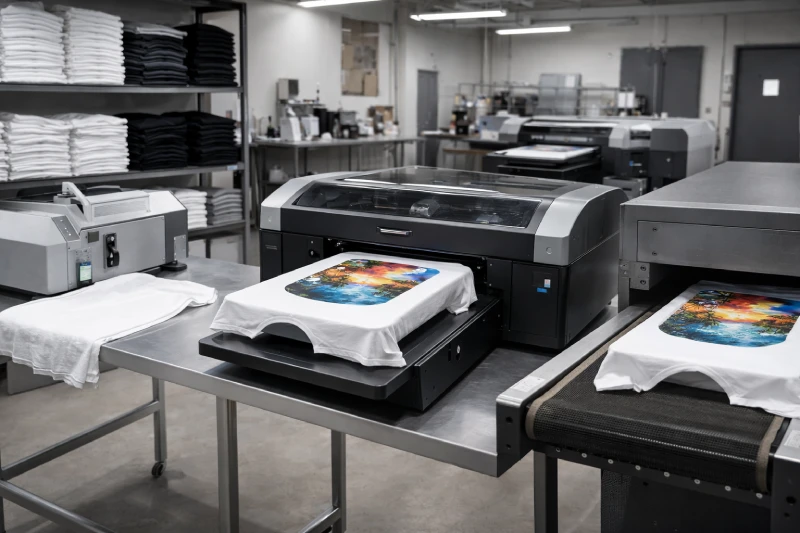
Garment Preparation & Pretreatment
Before printing begins, the garment must be properly prepared. For cotton-based shirts, this usually involves pretreatment, a liquid solution applied to the print area before ink deposition.
Pretreatment serves several critical functions:
- Helps white ink sit on top of dark fabrics
- Improves ink bonding with fibers
- Enhances color vibrancy
- Increases wash durability
After pretreatment, the garment is heat-pressed briefly to dry and flatten the surface. This step ensures an even print area and prevents ink bleeding during printing.
For dark garments, pretreatment precision is especially important because improper application can cause staining or inconsistent white underbase coverage.
Printing Process & Ink Application
Once the garment is loaded onto the platen, the DTG printer applies ink directly onto the fabric in layers.
For light-colored shirts:
- CMYK water-based inks are printed directly onto the fabric.
For dark-colored shirts:
- A white underbase is printed first.
- CMYK inks are layered on top to ensure color accuracy and opacity.
The digital file controls droplet placement, allowing for high-resolution detail, smooth gradients, and photographic effects. Print time varies depending on design size, color density, and printer model.
Curing & Finishing
After printing, the garment must be cured using a heat press or conveyor dryer. This step polymerizes the ink, locking it into the fabric fibers and ensuring wash resistance.
Typical curing temperatures range between:
- 160–180°C (320–356°F), depending on ink manufacturer guidelines.
Proper curing directly affects:
- Print durability
- Resistance to cracking or fading
- Overall hand feel
Undercuring can lead to premature fading, while overcuring may cause fabric discoloration.
Quality Control in DTG Production
Professional DTG manufacturing includes inspection at multiple stages:
- Pretreatment consistency check
- Color accuracy verification
- White underbase alignment (for dark garments)
- Wash testing samples (for bulk production)
Common issues monitored in quality control include:
- Banding lines
- Ink overspray
- Color shifts
- Uneven pretreatment marks
For apparel brands scaling production, consistent process control is essential to maintain print repeatability across batches.
Best Fabrics for DTG Shirt Printing
Fabric selection is one of the most critical decisions in DTG T-shirt printing. Because DTG inks are water-based and designed to bond with natural fibers, the garment composition directly impacts color vibrancy, wash durability, and overall print feel.
Choosing the best shirts for DTG printing significantly impacts final color vibrancy and durability. Brands looking for deeper fabric comparisons can explore our detailed guide on best t-shirts for DTG printing.
100% Cotton vs Cotton Blends
100% cotton is widely considered the best fabric for DTG printing. The natural fibers absorb water-based inks effectively, resulting in:
- Higher color vibrancy
- Better ink penetration
- Softer hand feel
- Improved wash durability
Cotton blends (such as 60/40 or 50/50 cotton-polyester) can still be used, but print brightness may decrease because polyester fibers do not absorb DTG inks in the same way. The higher the cotton percentage, the better the overall result.
For brands targeting premium-quality prints, 100% combed or ring-spun cotton remains the preferred choice.
Ring-Spun Cotton vs Open-End Cotton
Not all cotton fabrics perform the same in DTG production.
Ring-spun cotton features finer, smoother yarns. This creates:
- A more uniform print surface
- Better detail retention
- More consistent ink absorption
Open-end cotton, while often more affordable, has a rougher texture. This can result in:
- Slightly reduced print sharpness
- More visible fiber texture under large solid prints
For high-detail artwork or premium collections, ring-spun cotton is generally recommended.
Ideal GSM Range for DTG T-Shirts
Fabric weight also influences print performance. The ideal GSM (grams per square meter) for DTG T-shirts typically falls within:
- 160–220 GSM
Lightweight shirts below 150 GSM may show ink bleed-through or reduced opacity, especially with heavy designs. Heavier garments above 240 GSM provide better structure but may require slightly longer curing times.
For standard retail-quality DTG shirts, 180–200 GSM is often the optimal balance between comfort, durability, and print clarity.
DTG Printing on Black & Dark Shirts (White Underbase Explained)
Printing on black or dark-colored shirts requires an additional technical step: the white underbase.
Because DTG inks are not inherently opaque, a layer of white ink is printed first. This acts as a foundation, allowing CMYK colors to appear vibrant and accurate on dark fabric.
Key considerations for dark garment printing include:
- Proper pretreatment application
- Accurate white underbase alignment
- Controlled ink layering to avoid heavy hand feel
Without a well-calibrated white underbase, colors may appear muted or washed out. For brands producing dark collections, working with properly pretreated shirts for DTG printing is essential to maintain consistency and color integrity.
DTG Printing on Different Garment Types
While DTG is most commonly associated with T-shirts, the technology can be applied to various garment categories. However, each garment type presents different fabric, surface, and production considerations. Apparel brands should evaluate structure, thickness, and fiber composition before scaling beyond basic tees.
T-Shirts
T-shirts remain the most efficient and predictable garment for DTG printing. Their flat surface, stable fabric tension, and cotton-dominant composition make them ideal for consistent ink absorption and curing.
Standard crew neck cotton T-shirts (180–200 GSM) typically provide:
- Even pretreatment coverage
- Reliable white underbase performance
- Balanced hand feel after curing
- Stable repeatability across production batches
For most brands entering DTG production, T-shirts are the lowest-risk starting point.
Sweatshirts & Hoodies
Sweatshirts and hoodies can also be printed using DTG, but they introduce additional variables:
- Thicker fabric may require adjusted curing time
- Fleece interiors can trap moisture during pretreatment
- Seams and pocket areas limit printable surface
Because these garments are heavier (often 240–350 GSM), print placement precision becomes more critical. Ink saturation may need calibration to avoid an overly heavy feel on thicker materials.
Brands should also confirm that the fabric surface is sufficiently smooth. Brushed fleece with excessive texture may slightly reduce detail sharpness.
Heavyweight vs Lightweight Garments
Fabric weight impacts both print appearance and production efficiency.
Lightweight garments (below 160 GSM):
- Faster to print and cure
- Risk of ink show-through
- Lower structural stability during pretreatment
Heavyweight garments (220+ GSM):
- Better ink holdout
- More durable print surface
- Slightly longer curing time
- Higher garment cost
For premium streetwear collections, heavyweight cotton blanks often deliver stronger print presence and perceived product value.
Oversized & Streetwear Blanks
Oversized and streetwear silhouettes have become increasingly popular in DTG collections. These garments often feature:
- Dropped shoulders
- Wider body cuts
- Heavier cotton fabrics
- Boxy or relaxed fits
From a production standpoint, larger printable areas may increase print time and ink usage. Brands should factor this into cost calculations when offering large-format graphics.
Additionally, streetwear blanks frequently use higher GSM fabrics (220–260 GSM), which can enhance color depth but require careful curing to maintain softness.
When selecting non-standard garment types for DTG printing, testing samples before bulk production is strongly recommended to validate color accuracy, texture interaction, and wash durability.
DTG Printing Cost Per Shirt: What Brands Should Expect
One of the most common questions apparel brands ask is: how much does DTG printing cost per shirt? The answer depends on multiple production variables, including garment type, design coverage, ink usage, and order quantity. Unlike traditional methods with heavy upfront setup fees, DTG cost structure is largely variable and calculated per unit.
Understanding each cost component helps brands estimate margins more accurately and avoid unexpected production expenses.
Cost Components Breakdown
A professional DTG cost per shirt typically includes the following elements:
1. Blank Garment Cost
The base T-shirt price varies depending on fabric quality, GSM, and sourcing. Premium ring-spun cotton blanks cost more than standard open-end cotton.
2. Pretreatment Cost
Dark garments require pretreatment and white underbase preparation. This adds both material and labor cost per unit.
3. Ink Cost
Ink usage depends on:
- Design size
- Color density
- Whether white underbase is required
Large, high-saturation designs consume significantly more ink.
4. Labor & Setup
Although DTG does not require screen setup, each garment still requires loading, alignment, printing, unloading, and curing.
5. Waste Rate
Professional production accounts for a small percentage of:
- Misprints
- Color calibration tests
- Sample approvals
These indirect costs are factored into per-shirt pricing. For a full cost structure analysis including ink usage models and real production examples, see our detailed breakdown of DTG printing cost per shirt.
Why DTG Cost Per Shirt Varies by Order Size
DTG printing does not scale in the same way as screen printing. Because there are minimal setup costs, small orders are economically feasible. However, the per-unit cost does not drop dramatically as order quantity increases.
For example:
- 10 shirts vs 50 shirts may see slight efficiency improvement
- 50 shirts vs 500 shirts may not achieve major cost reduction
This is because each shirt still requires individual machine time and ink consumption.
For large bulk production (hundreds or thousands of units per design), screen printing often becomes more cost-efficient.
Hidden Cost Factors in DTG Production
Brands evaluating DTG printing cost per shirt should also consider hidden variables:
- Print coverage percentage (full front vs small chest print)
- Dark garment white ink consumption
- Artwork complexity and color density
- Garment rejection rate during QC
- Packaging and fulfillment (for on-demand models)
Additionally, oversized graphics or heavyweight garments increase ink usage and curing time, which can impact final pricing.
For accurate margin planning, brands should request cost breakdowns based on design size, garment color, and projected order volume rather than relying on generic per-shirt quotes.
DTG Printing Time Per Shirt & Production Capacity
Beyond cost, production speed is a critical factor for apparel brands — especially those operating on-demand models or limited edition drops. Understanding DTG printing time per shirt helps brands estimate lead times, daily output capacity, and scalability as order volume grows.
Unlike bulk-oriented printing methods, DTG production is based on per-garment machine time, which directly influences turnaround speed.
Average Print Time
The average DTG print time per shirt depends on several factors:
- Design size (small chest logo vs full-front graphic)
- Ink coverage density
- Whether a white underbase is required
- Printer model and resolution settings
As a general industry reference:
- Light garment (no white underbase): 2–4 minutes per shirt
- Dark garment (with white underbase): 4–8 minutes per shirt
This does not include pretreatment drying and curing time, which can add additional minutes depending on workflow setup.
Larger designs with heavy ink coverage increase print duration significantly. For a more detailed breakdown across different garment types and production setups, see our guide on DTG printing time per shirt.
Batch vs On-Demand Production
DTG is highly compatible with on-demand fulfillment because it does not require screen setup or color separation preparation.
On-Demand Model:
- Print only after customer order
- Lower inventory risk
- Slower per-unit throughput
- Ideal for e-commerce stores
Batch Production Model:
- Print small runs in scheduled production blocks
- Improved workflow efficiency
- Better color consistency within batch
- Suitable for seasonal drops or pre-orders
Brands choosing between these models should align printing speed with sales velocity and marketing strategy.
Scaling DTG for Growing Brands
Scaling DTG production requires strategic planning because output capacity is tied to machine count and operator efficiency.
To increase daily production capacity, manufacturers typically:
- Add additional DTG printers
- Optimize pretreatment workflow
- Implement conveyor dryers for faster curing
- Standardize garment types to reduce adjustment time
However, as order sizes grow into the hundreds per design, brands may need to evaluate whether DTG remains the most efficient method compared to alternative printing techniques.
For startup and mid-stage apparel brands, DTG offers flexibility and manageable production speed. For large-scale bulk orders, production capacity limitations should be carefully evaluated before committing to high-volume campaigns.
DTG vs DTF vs Screen Printing: Comparison Table for Apparel Brands
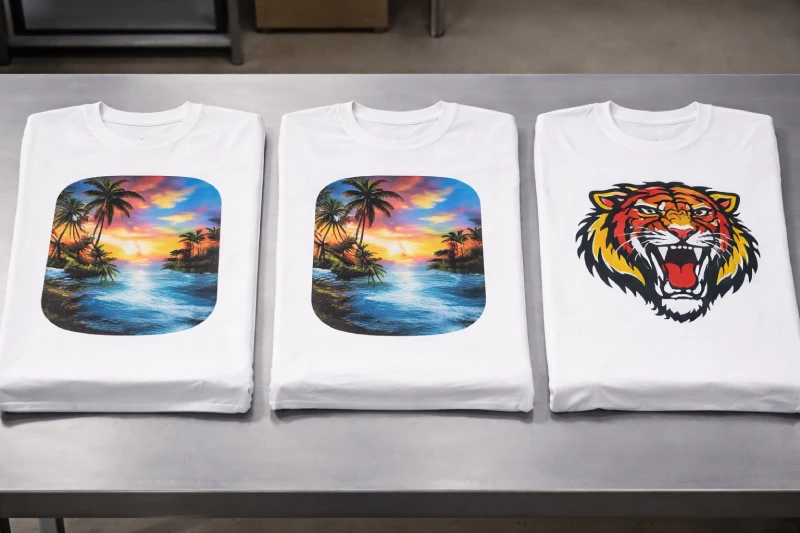
Choosing between DTG, DTF, and screen printing depends on order size, fabric type, cost structure, and design complexity. Below is a structured comparison to help apparel brands evaluate which method fits their production strategy.
Core Technical Comparison
| Comparison Factor | DTG Printing | DTF Printing | Screen Printing |
|---|---|---|---|
| Setup Cost | Very low | Low–moderate | High (screens per color) |
| Minimum Order | 1 piece possible | Small–medium runs | Best for 100+ pieces |
| Best Fabric | 100% cotton | Cotton, polyester, blends | Wide compatibility |
| Print Feel | Soft, absorbed into fabric | Slightly thicker transfer layer | Ink sits on surface |
| Color Capability | Unlimited colors | Unlimited colors | Best for limited solid colors |
| Gradient & Detail | Excellent | Very good | Limited for complex gradients |
| Large Volume Efficiency | Low | Medium | Very high |
| Dark Garment Handling | Requires white underbase | White ink layer on film | Opaque plastisol ink |
| Production Speed (Bulk) | Slower | Moderate | Fastest at scale |
Cost Structure Comparison
| Cost Factor | DTG | DTF | Screen Printing |
|---|---|---|---|
| Per-Shirt Cost (Small Orders) | Stable | Slightly lower than DTG in medium runs | High due to setup |
| Per-Shirt Cost (Large Orders) | Remains relatively stable | Decreases moderately | Drops significantly |
| Ink/Material Waste | Low | Film + powder waste | Screen setup waste |
| Artwork Complexity Impact | Minimal cost increase | Minimal cost increase | Higher cost with more colors |
When Each Method Makes Strategic Sense
| Production Scenario | Recommended Method |
|---|---|
| Startup brand with low MOQ | DTG |
| Print-on-demand eCommerce | DTG |
| Cotton & polyester mix collections | DTF |
| Medium batch streetwear drops | DTF or DTG |
| 500+ units per design | Screen Printing |
| Limited solid-color graphic | Screen Printing |
If you’re deciding between methods for a specific order size, review our in-depth comparison on DTG vs DTF shirt printing.
Strategic Insight for Apparel Brands
There is no universally “better” method.
- DTG is optimized for flexibility and small-batch design testing.
- DTF provides broader fabric compatibility.
- Screen printing dominates large-scale production efficiency.
For scalable brands, combining methods based on order volume and garment type often delivers the strongest operational balance.
DTG Design Guidelines for Apparel Brands
Strong artwork does not automatically guarantee strong print results. DTG printing translates digital files directly onto fabric, which means design preparation must follow technical constraints to avoid blurred details, ink oversaturation, or unexpected color shifts.
For apparel brands, understanding DTG design best practices helps reduce sampling revisions, minimize misprints, and ensure consistent production quality.
Minimum Font Size for DTG Printing
Small text can lose clarity when printed on fabric due to fiber texture and ink absorption.
Recommended guidelines:
- Minimum font size: 8–10 pt for simple sans-serif fonts
- Avoid ultra-thin serif fonts for small placements
- Increase size for dark garments with white underbase
Very small lettering may appear slightly fuzzy after curing and washing. For chest logos or tag-style prints, test samples are strongly recommended.
Minimum Line Thickness
Fine lines can break up during printing, especially on textured cotton fabrics.
Suggested minimum line thickness:
- 0.8–1.0 pt for light garments
- 1.2 pt or thicker for dark garments with underbase
Hairline strokes or intricate micro-details may not reproduce consistently across production batches.
High-Resolution Artwork Requirements
DTG relies on digital file precision. Low-resolution artwork will result in visible pixelation.
Recommended specifications:
- Minimum 300 DPI at actual print size
- File formats: PNG (transparent background), TIFF, or high-quality PSD
- Convert text to outlines before submission
- Use RGB color mode unless otherwise specified by manufacturer
Avoid scaling up low-resolution images — this reduces clarity and affects final print sharpness.
Color Saturation & Gradient Considerations
DTG handles gradients and full-color artwork well, but color management remains important.
Best practices:
- Avoid overly dark shadows that may absorb excessive ink
- Adjust mid-tone contrast for better vibrancy
- Test bright neon tones, as fabric absorption can slightly mute intensity
Dark garment printing with white underbase can alter perceived brightness. Brands should request color calibration samples for key brand colors.
Common Design Mistakes in DTG
Frequent issues that lead to production delays or inconsistent results include:
- Extremely small typography
- Thin outlines on dark garments
- Heavy solid blocks of ink covering large areas
- Ignoring garment color interaction
- Submitting low-resolution artwork
Design alignment with production capability is essential. Apparel brands that follow structured DTG printing best practices reduce sampling cycles and improve overall cost efficiency.
Advantages and Limitations of DTG Printing
DTG T-shirt printing offers strong flexibility and design freedom, but like any production method, it has technical boundaries. Apparel brands should evaluate both advantages and limitations before choosing DTG as a core manufacturing solution.
Understanding where DTG performs best — and where it does not — helps avoid mismatched production strategies.
Key Advantages
1. Low Minimum Order Quantity (MOQ)
DTG allows printing from a single piece. This makes it ideal for startups, sampling, and print-on-demand models.
2. Unlimited Color Capability
There is no additional setup cost per color. Complex artwork, gradients, and photographic images can be printed without color-based pricing increases.
3. Soft Hand Feel (On Cotton)
Because DTG ink absorbs into the fibers rather than sitting heavily on top, the final print often feels softer compared to thick ink layers used in traditional methods.
4. Fast Design Turnaround
Without screen setup, production can begin quickly after artwork approval.
5. Ideal for Design Testing
Brands can test new graphics without committing to large inventory quantities.
Technical Limitations
1. Best Performance on Cotton
DTG works most effectively on 100% cotton. High polyester content reduces ink absorption and color vibrancy.
2. Slower for Large Bulk Orders
Each shirt requires individual print time. For hundreds or thousands of pieces per design, production efficiency becomes limited.
3. White Ink Complexity on Dark Garments
Printing on black or dark shirts requires white underbase layers, increasing ink consumption and production time.
4. Higher Per-Unit Cost at Scale
Unlike screen printing, DTG per-unit cost does not significantly decrease as quantity increases.
5. Large Solid Ink Areas May Feel Heavier
Full-coverage prints can increase ink saturation, slightly affecting breathability.
When DTG Is NOT Recommended
DTG printing may not be the most suitable option when:
- Producing large bulk orders (500+ pieces per design)
- Printing primarily on high-polyester performance fabrics
- Designing with simple, limited solid colors at high volume
- Seeking the lowest possible per-unit cost for mass production
For apparel brands building scalable product lines, DTG is often best used strategically — for sampling, low-MOQ drops, and design testing — while alternative methods may handle high-volume production more efficiently.
When Should Apparel Brands Choose DTG Shirt Printing?
DTG shirt printing is not a universal solution for every production scenario. Its strength lies in flexibility, low inventory risk, and high design complexity. Apparel brands should evaluate order size, business model, and growth stage before selecting DTG as their primary printing method.
Below are the most common situations where DTG makes strategic sense.
Startup Brands & Low MOQ Collections
For new apparel brands, committing to large inventory quantities can create financial pressure and storage risk. DTG allows production from very small quantities — even single-piece runs — without high setup costs.
DTG is especially suitable when:
- Launching a new brand with limited capital
- Testing multiple graphic concepts simultaneously
- Running made-to-order business models
- Avoiding large upfront stock commitments
The ability to produce low MOQ collections makes DTG a practical entry point for emerging labels.
Sampling & Design Testing
Before committing to bulk manufacturing, brands often need sample validation. DTG enables:
- Quick prototype production
- Visual confirmation of color accuracy
- Testing of placement and sizing
- Small internal review batches
This reduces the risk of costly design errors before scaling into larger production methods such as screen printing.
Limited Edition Drops
Streetwear and online-first brands frequently release limited edition drops to create exclusivity and demand. DTG supports this model by allowing:
- Short-run production
- Fast turnaround after artwork finalization
- Minimal leftover inventory
- Flexible restock quantities based on demand
Because there is no screen setup requirement, designs can be updated frequently without major cost penalties.
Not Ideal for Large-Scale Bulk Orders
While DTG offers flexibility, it may not be the most cost-efficient method for:
- Large corporate uniform orders
- High-volume promotional campaigns
- 500+ pieces per single design
- Simple two-color graphics produced at scale
In these cases, screen printing often delivers lower per-unit cost and faster bulk throughput.
For apparel brands, the most effective production strategy may combine methods. DTG can handle early-stage growth, testing, and limited drops, while alternative printing techniques support large-scale expansion once demand becomes predictable.
Once a brand confirms DTG is the right method, the next decision is supplier capability. Production consistency, pretreatment control, and turnaround stability can vary significantly, so it is worth reviewing how to choose a reliable DTG printing partner before moving into larger runs.
FAQs
1. What is DTG printing on shirts?
DTG (Direct-to-Garment) printing is a digital printing method that applies water-based inks directly onto fabric using inkjet technology. The design is printed straight onto the garment surface and then heat-cured for durability. It is commonly used for high-detail, full-color graphics on cotton T-shirts.
2. Is DTG better than screen printing?
DTG is better for small batches, complex artwork, and low MOQ production. Screen printing is more cost-efficient for large bulk orders with simple color designs. The “better” option depends on order volume, fabric type, and production goals.
3. How long does DTG printing last?
When properly pretreated and cured, DTG prints can last 30–50+ washes without significant fading. Longevity depends on fabric quality, curing accuracy, and proper garment care (cold wash, inside-out, low heat drying).
4. Can DTG print on polyester?
DTG performs best on 100% cotton. It can print on cotton blends, but high-polyester fabrics may result in reduced color vibrancy and lower durability. For polyester-heavy garments, alternative methods such as DTF are often more suitable.
5. Does DTG crack or fade?
DTG prints typically do not crack like thick plastisol ink layers. However, improper curing, heavy ink coverage, or aggressive washing conditions can cause fading over time. Correct production and garment care significantly improve durability.
6. How much does DTG printing cost per shirt?
DTG printing cost per shirt varies depending on garment quality, design size, ink coverage, and order quantity. Small orders may have stable per-unit pricing, while large bulk runs may not see dramatic cost reductions compared to screen printing. Brands should request pricing based on specific artwork and volume for accurate budgeting.