

Selecting the right blank T-shirt is one of the most important decisions in Direct-to-Garment (DTG) printing. Even with advanced printers and high-resolution artwork, the final result ultimately depends on the garment itself. Surface texture, fiber composition, fabric weight, and structural stability all influence ink absorption, color vibrancy, and long-term durability. A poorly chosen blank can lead to muted colors, blurred edges, shrinkage after curing, or inconsistent results across bulk orders.
For brands managing product lines or scaling production, DTG decisions should be evaluated holistically. You can explore our complete DTG T-shirt printing guide for a structured breakdown of fabric selection, cost, and manufacturing considerations.
This guide focuses on the manufacturing variables that truly determine DTG performance: knit structure, yarn quality, GSM selection, color considerations, and production readiness. Rather than discussing printing techniques alone, we examine how garment engineering affects ink bonding, curing stability, and scalability in OEM production.
Designed for apparel brands, private label startups, and contract manufacturers, this guide provides a structured framework for selecting DTG-ready T-shirts that align with brand positioning, cost targets, and bulk manufacturing requirements. Whether you are sourcing wholesale blanks or developing a custom OEM program, understanding these fabric and construction fundamentals will help ensure consistent, commercial-grade print outcomes.
What Makes a T-Shirt Suitable for DTG Printing?
Not all T-shirts respond equally to Direct-to-Garment printing. While DTG technology relies on digital inkjet precision, the garment itself functions as the ink-receiving surface. Fabric structure, fiber composition, and dimensional stability directly influence print clarity, color intensity, and wash durability. Below are the core structural factors that determine whether a T-shirt is truly DTG-ready.
Surface Smoothness and Print Clarity
DTG printing performs best on smooth, tightly knitted surfaces. A finer knit structure creates a flatter print plane, allowing ink droplets to sit evenly and maintain edge definition. When the fabric surface is irregular or overly textured, ink disperses unevenly, reducing sharpness in detailed artwork.
Higher stitch density improves print resolution because:
- The surface has fewer gaps between yarns
- Ink penetration remains controlled
- Fine lines and gradients retain clarity
Ring-spun cotton single jersey fabrics typically provide superior smoothness compared to coarse open-end yarn constructions. For brands focusing on high-detail graphics or photographic prints, knit compactness becomes a critical selection criterion.
Absorption Behavior and Ink Bonding
DTG inks are water-based and rely on fiber absorption for bonding. Natural cotton fibers contain microscopic channels that allow ink to penetrate and anchor effectively. This results in better color saturation and improved wash fastness.
Synthetic fibers, such as polyester, behave differently:
- Lower absorbency
- Ink remains more on the surface
- Higher risk of fading or dye migration
Blended fabrics introduce variability because ink may bond unevenly across fiber types. For consistent commercial results, understanding fiber chemistry is as important as selecting the right printer settings.
Fabric Stability During Curing
After printing, garments undergo heat curing to set the ink. During this process, unstable fabrics may shrink, distort, or warp, affecting alignment and print durability.
Key stability considerations include:
- Pre-shrunk fabric processing
- Controlled compaction during knitting
- Heat tolerance of fibers
- Consistent dimensional stability across bulk production
Garments that shrink excessively or twist after curing can compromise print positioning, especially in large-scale OEM orders. Stable fabric construction ensures that artwork remains proportionally accurate and production remains predictable.
In summary, a DTG-suitable T-shirt combines smooth surface structure, strong ink absorption properties, and dimensional stability under heat. These structural fundamentals form the foundation for consistent, high-quality DTG output at commercial scale.
100% Cotton vs Cotton Blends for DTG
Fiber composition plays a decisive role in DTG print performance. While printing equipment and ink quality matter, the way fibers absorb and retain pigment ultimately determines color depth, edge definition, and long-term durability. For apparel brands and OEM buyers, understanding the structural differences between cotton types and blends helps reduce production risk and maintain consistent bulk results.
100% Ring-Spun Cotton (Recommended Standard)
Ring-spun cotton is widely considered the industry standard for DTG printing.
Compared to conventional open-end yarn, ring-spun yarn is:
- Finer and more compact
- Smoother on the surface
- More uniform in fiber alignment
This refined yarn structure creates a flatter print surface, allowing ink droplets to sit evenly and penetrate consistently. The result is:
- Sharper artwork detail
- Higher color vibrancy
- Softer hand feel after printing
- Improved wash durability
For brands prioritizing premium positioning, complex artwork, or photographic prints, 100% ring-spun cotton provides the most predictable and scalable DTG performance.
Open-End Cotton (Budget Alternative)
Open-end cotton is typically used in lower-cost blanks. The yarn structure is bulkier and less uniform, producing a slightly rougher fabric surface.
Characteristics include:
- Looser fiber arrangement
- Higher surface hairiness
- Reduced print precision
While DTG can still be applied, fine details and gradients may appear softer or slightly diffused. Open-end cotton can be acceptable for:
- Basic graphics
- Lower retail price points
- Promotional or entry-level programs
However, it is generally not recommended for high-resolution or color-intensive designs.
Cotton-Poly Blends
Cotton-poly blends introduce both cost efficiency and performance variability. Polyester fibers do not absorb water-based DTG ink in the same way cotton does. As a result:
- Color vibrancy may decrease
- Prints can appear slightly muted
- Wash fading risk increases
- Dye migration may occur under heat
Blends may be acceptable when:
- Artwork is minimal or less color-sensitive
- The garment targets athleisure or performance positioning
- Cost constraints outweigh maximum vibrancy
For full-color artwork, especially on dark garments requiring underbase layers, 100% cotton remains the safer commercial choice.
Fabric Comparison Overview
| Fabric Type | Print Sharpness | Color Vibrancy | Cost Level | OEM Suitability |
|---|---|---|---|---|
| 100% Ring-Spun Cotton | High | High | Medium | Excellent |
| Open-End Cotton | Moderate | Moderate | Low | Acceptable |
| Cotton-Poly Blend | Moderate–Low | Moderate | Low–Medium | Conditional |
For most apparel brands seeking stable DTG output and scalable OEM production, 100% ring-spun cotton remains the recommended foundation. Blends and open-end cotton can reduce cost, but they introduce variables that must be carefully evaluated against artwork complexity and brand positioning.
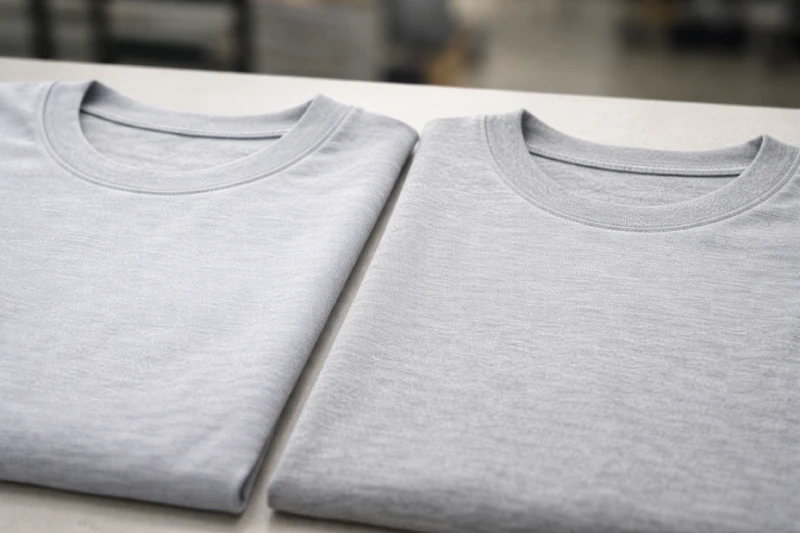
Best Fabric Weight (GSM) for DTG Printing
Fabric weight, measured in grams per square meter (GSM), influences not only garment positioning and retail perception, but also DTG print behavior. GSM affects ink absorption depth, color density, opacity, and overall structure stability during curing. Selecting the right weight depends on target market, artwork complexity, and price positioning.
Lightweight (140–160gsm)
Lightweight T-shirts are commonly used for summer collections, promotional programs, and budget-driven retail segments.
Advantages:
- Lower fabric cost
- Breathable and soft feel
- Suitable for minimalist graphics
Limitations:
- Higher transparency risk on light colors
- Less support for heavy ink saturation
- Greater potential for fabric distortion during curing
Because lightweight fabrics are thinner, ink may penetrate more deeply, sometimes reducing surface vibrancy. They can work well for small chest logos or simple line artwork, but are less ideal for dense full-front prints.
Midweight (180–220gsm)
Midweight fabrics represent the commercial sweet spot for DTG printing.
Benefits:
- Balanced structure and comfort
- Strong surface stability
- Better ink holdout and color vibrancy
- Lower distortion risk during heat curing
At this weight range, the fabric is thick enough to support heavier ink application without feeling overly dense. Most scalable private label DTG programs operate within this GSM range because it balances cost, durability, and print performance.
For brands seeking reliable bulk consistency, 180–220gsm provides a stable foundation for both light and dark garment printing.
Heavyweight (240gsm+)
Heavyweight T-shirts are often positioned as premium or streetwear-focused products.
Characteristics:
- Structured silhouette
- Higher opacity
- Enhanced durability
- Increased retail value perception
From a DTG perspective, heavyweight fabrics:
- Support dense ink layering
- Provide improved opacity for dark garments
- Reduce show-through issues
However, increased thickness can require adjusted curing parameters. Excessive heat or insufficient curing time may affect ink bonding if not calibrated properly in production.
Heavyweight garments are particularly suitable for brands targeting premium price points or limited-edition collections where garment structure is part of the brand identity.
GSM Comparison Overview
| GSM Range | Structure Stability | Ink Support | Market Positioning | OEM Scalability |
|---|---|---|---|---|
| 140–160gsm | Moderate–Low | Light | Entry / Promotional | High |
| 180–220gsm | High | Balanced | Core Retail | Excellent |
| 240gsm+ | Very High | Heavy | Premium / Streetwear | Strong |
In practical DTG production, midweight fabrics (180–220gsm) offer the most consistent results across artwork types and bulk manufacturing runs. Lightweight and heavyweight options can be strategically selected based on brand positioning and print complexity, but they require more deliberate production control.
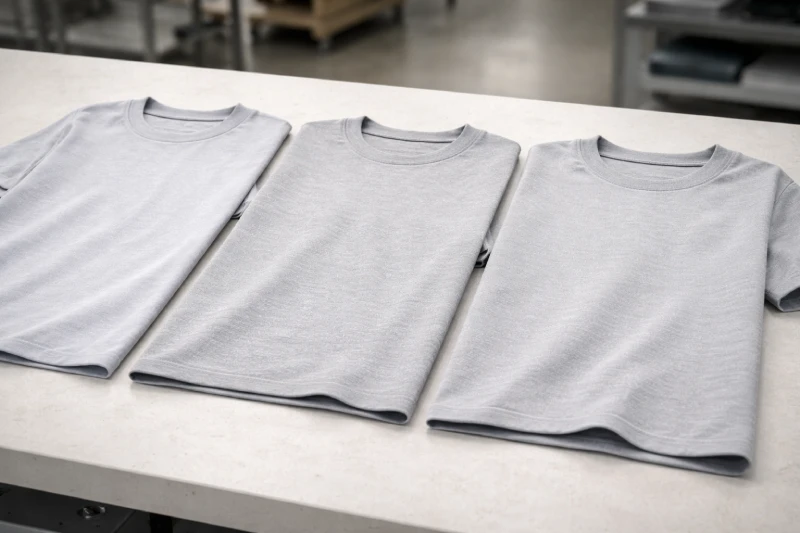
Color Considerations: Light vs Dark Shirts
Garment color significantly affects DTG production workflow, ink usage, and final print appearance. While fabric composition determines how ink bonds, garment color determines how ink layers must be constructed. For apparel brands planning bulk orders, understanding these differences helps forecast cost, production time, and design feasibility.
DTG on Light Garments
Printing on light-colored garments is generally more straightforward and cost-efficient.
Because the fabric base is already light, DTG printers can apply colored ink directly onto the garment without requiring a white underbase layer. This results in:
- Faster production time
- Lower ink consumption
- Softer hand feel
- Higher overall vibrancy
Without a white underbase, ink penetrates more naturally into cotton fibers, maintaining a smooth surface texture. For brands prioritizing breathable prints and minimalist designs, light garments offer both aesthetic and operational advantages.
Light colors are particularly suitable for:
- Pastel artwork
- Fine-line graphics
- High-volume production programs
DTG on Dark Garments
Dark garments require a white underbase layer beneath the colored artwork. This white foundation creates opacity and prevents the dark fabric from muting the design.
However, this additional step introduces:
- Increased ink usage
- Longer printing cycles
- Higher production cost
- More curing sensitivity
The underbase must be precisely calibrated. Too little white ink reduces vibrancy; too much can create a heavier print feel or cracking over time.
Brands using dark garments for bold, full-color artwork must account for these technical and cost implications during production planning.
In bulk OEM manufacturing, color selection directly impacts pricing structure and production throughput. Light garments typically provide greater efficiency, while dark garments offer stronger visual contrast but require more controlled processing. Choosing the right base color should align with artwork complexity, target margin, and brand positioning strategy.
Pre-Treatment and Production Readiness
Pre-treatment is a critical step in DTG printing, particularly for achieving strong color vibrancy and wash durability. While printers and inks receive much attention, inconsistent or poorly applied pre-treatment is one of the most common causes of production instability. For apparel brands working with OEM factories, understanding how pre-treatment is managed at scale is essential.
Factory Pre-Treated vs Printer Pre-Treated
There are two common approaches to pre-treatment:
1. Factory Pre-Treated Garments
Some manufacturers apply pre-treatment during garment production. This can create:
- More consistent chemical distribution
- Better integration with fabric structure
- Improved scalability for bulk orders
However, long storage times may affect treatment effectiveness if garments are not handled properly.
2. Printer-Level Pre-Treatment
Many DTG operations apply pre-treatment just before printing using spray machines.
Advantages include:
- Fresh application before printing
- Flexible adjustments for artwork type
- Lower inventory constraints
But risks include:
- Uneven spray coverage
- Operator inconsistency
- Surface staining or patchiness
For large OEM programs, consistency matters more than flexibility. Brands should evaluate which approach ensures stable repeatability across thousands of units.
Risks of Inconsistent Pre-Treatment
When pre-treatment is uneven or miscalibrated, common issues include:
- Dull or chalky color appearance
- Poor white underbase opacity
- Ink cracking after washing
- Uneven curing marks
In dark garment printing especially, under-treated areas may show reduced vibrancy, while over-treated zones can appear stiff or discolored.
These inconsistencies often become more visible in bulk production than in sampling stages.
How OEM Factories Ensure Print Stability
Professional OEM facilities typically implement:
- Controlled pre-treatment equipment calibration
- Standardized chemical dilution ratios
- Moisture and humidity control
- Fabric batch testing before mass production
In addition, reputable factories conduct wash tests and curing validation trials before approving bulk runs.
For apparel brands scaling DTG programs, production readiness is not only about selecting the right T-shirt — it is about ensuring that fabric preparation, chemical treatment, and curing processes are standardized and repeatable.
Reliable pre-treatment management directly impacts brand reputation, return rates, and long-term product consistency.
Construction Details That Impact DTG Results
Beyond fiber composition and fabric weight, garment construction plays a significant role in DTG performance. Structural elements such as knit type, collar recovery, seam positioning, and fabric finishing can all influence print consistency, surface stability, and long-term durability. For apparel brands operating at scale, these seemingly small details often determine whether production remains predictable across bulk runs.
Single Jersey vs Interlock
Single jersey is the most common knit structure for DTG-ready T-shirts. It provides:
- Smooth surface on the face side
- Lightweight to midweight flexibility
- Good ink absorption behavior
Because the face side is flatter and more uniform, single jersey fabrics typically produce sharper DTG detail.
Interlock fabric, by contrast, is thicker and double-knit. While it offers enhanced structure and opacity, it may present slightly more surface tension. In some cases, this can affect how ink penetrates during printing.
For most commercial DTG programs, high-quality single jersey remains the preferred choice due to its balanced structure and cost efficiency.
Rib Collar Stretch Recovery
The collar area may not always be printed, but its recovery performance affects overall garment perception and durability.
Poor rib elasticity can lead to:
- Collar deformation after curing
- Visible distortion near upper chest print zones
- Reduced retail quality perception
High-recovery rib construction ensures that the neckline maintains shape after repeated washing and heat exposure during curing. For premium DTG programs, collar stability contributes to product longevity.
Seam Placement and Print Zones
Seam positioning directly impacts printable surface area. Key considerations include:
- Avoiding side seams intersecting large print zones
- Ensuring flat chest area without panel distortion
- Maintaining symmetry across sizes
Tubular construction (without side seams) provides uninterrupted front panels, which can be advantageous for large graphics. However, well-constructed side-seam garments can also perform effectively if print zones are carefully planned.
Proper pattern grading across sizes ensures that artwork remains proportionally aligned in bulk production.
Fabric Compaction and Finishing
Compaction is a finishing process that stabilizes fabric dimensions before garment assembly.
Well-compacted fabrics offer:
- Reduced post-print shrinkage
- Improved shape retention
- More consistent bulk production results
Without proper compaction, garments may shrink after curing or first wash, altering print proportions.
For OEM manufacturing, consistent finishing standards across fabric batches are critical. Variations in compaction or finishing can create noticeable inconsistencies between production lots.
In DTG production, construction quality supports printing quality. Even when fabric composition is correct, structural instability can compromise results. Apparel brands seeking scalable DTG programs should evaluate knit structure, seam engineering, and finishing controls alongside fiber and GSM selection to ensure long-term production reliability.
Common Mistakes When Selecting T-Shirts for DTG
Many DTG quality issues originate not from the printer, but from garment selection decisions made before production begins. For apparel brands and private label programs, avoiding these common mistakes can significantly reduce reprints, returns, and margin loss.
Choosing Blends for Full-Color Artwork
Cotton-poly blends are often selected to reduce cost or achieve a specific hand feel. However, when used for high-resolution or color-intensive artwork, blends can create inconsistent results.
Common risks include:
- Reduced color vibrancy
- Uneven ink bonding across fiber types
- Increased fading after washing
- Higher risk of dye migration under heat
For designs requiring photographic detail or saturated color blocks, 100% ring-spun cotton remains the safer option.
Ignoring Shrinkage Tolerance
Shrinkage is frequently overlooked during garment sourcing. If fabric is not properly pre-shrunk or compacted, distortion may occur:
- After curing
- After first wash
- Across different size ranges
Even small dimensional changes can alter artwork placement or create subtle print cracking. Brands should confirm shrinkage percentages during sampling, not after bulk production.
Using Low-Density Knits
Lower stitch density fabrics may reduce material cost, but they also create:
- Rougher print surfaces
- Reduced edge definition
- Ink spread between yarn gaps
Low-density knits are particularly problematic for fine-line graphics and detailed typography. A tighter knit structure provides a more stable print plane and improves consistency in mass production.
Prioritizing Cost Over Surface Quality
Focusing exclusively on unit cost can lead to long-term quality compromises. Surface smoothness, yarn refinement, and finishing processes often determine print clarity more than small price differences per garment.
In bulk programs, inconsistent fabric quality can result in:
- Rejected production lots
- Increased quality control overhead
- Brand reputation risk
Cost efficiency should be evaluated alongside performance metrics, not in isolation.
For scalable DTG programs, garment selection should follow a technical evaluation framework rather than a purely price-driven approach. Avoiding these common sourcing errors helps ensure consistent color output, stable production, and reliable bulk fulfillment.
Wholesale & OEM Considerations for Apparel Brands
For apparel brands scaling DTG programs, garment selection is not only about print quality — it is about supply chain reliability. When transitioning from sampling to bulk production, factors such as MOQ, fabric batch consistency, and private label strategy directly influence cost control and long-term scalability.
MOQ and Production Planning
Minimum Order Quantity (MOQ) structures vary depending on whether brands source stock blanks or develop custom OEM programs.
Key considerations include:
- Fabric MOQ vs garment MOQ
- Colorway segmentation
- Size ratio planning
- Seasonal demand forecasting
Custom-developed fabrics often require higher initial MOQ due to dyeing and knitting batch requirements. However, this approach provides greater control over GSM, fiber composition, and finishing standards.
For growing brands, balancing flexibility and stability is essential. Smaller MOQs allow market testing, while standardized bulk programs improve cost efficiency over time.
Fabric Consistency Across Bulk Orders
One of the most critical OEM risks in DTG production is inconsistency between fabric batches.
Variations may occur in:
- Yarn quality
- Dyeing tone
- Shrinkage rate
- Surface smoothness
Even minor differences can affect ink absorption and curing behavior, leading to visible variation between production runs.
Professional OEM manufacturers implement:
- Fabric lot tracking systems
- Lab-dip color approval procedures
- Pre-production sampling
- Wash and curing validation testing
Brands should ensure that fabric specifications are clearly documented and locked before scaling bulk orders.
Private Label Strategy
For brands developing their own identity, private label production extends beyond printing artwork.
Strategic considerations include:
- Custom neck labels or tear-away tags
- Branded size labeling systems
- Consistent fit blocks across collections
- Standardized fabric specifications
Aligning DTG-ready garments with a long-term private label strategy helps maintain uniform quality across product lines.
Wholesale and OEM planning must integrate both garment engineering and operational stability. Apparel brands that treat fabric specification, MOQ structure, and batch control as strategic assets are better positioned to scale DTG programs without compromising print consistency or margin structure.
Decision Framework — How Brands Should Choose
Selecting the best T-shirt for DTG printing should not rely on a single variable such as fabric type or GSM. Instead, brands should evaluate garment choices through a structured decision framework that balances cost, artwork requirements, and long-term scalability.
Below is a practical checklist to guide sourcing decisions.
1. Target Price Point
Start with the intended retail positioning:
- Entry-level / promotional pricing
- Core retail range
- Premium / streetwear tier
Lower price targets may require open-end cotton or lightweight GSM, but brands must accept trade-offs in print sharpness and durability. Premium positioning typically justifies ring-spun cotton and midweight to heavyweight construction.
2. Artwork Complexity
Design characteristics directly influence fabric suitability.
Consider:
- Is the artwork photographic or highly detailed?
- Does it require strong color saturation?
- Will it be printed on dark garments requiring a white underbase?
Complex, full-color graphics perform best on smooth, tightly knitted 100% cotton fabrics with stable midweight structure.
Minimalist line art or small logos allow more flexibility in fabric selection.
3. Market Positioning
Garment feel and structure influence brand perception.
- Lightweight fabrics communicate casual or seasonal positioning.
- Midweight fabrics represent balanced everyday retail.
- Heavyweight fabrics align with premium, structured aesthetics.
Fabric choice should align with brand identity, not only printing performance.
4. Production Scale
Volume changes the risk profile.
For small runs:
- More flexibility in pre-treatment method
- Greater tolerance for slight variation
For bulk OEM programs:
- Fabric batch consistency becomes critical
- Pre-treatment standardization is required
- Shrinkage tolerance must be tightly controlled
As production scales, technical stability outweighs minor cost differences.
Quick Selection Checklist
Before confirming a DTG-ready T-shirt, brands should verify:
- Fiber composition: Preferably 100% ring-spun cotton
- GSM range: 180–220gsm for balanced performance
- Knit density: Smooth, tight single jersey
- Shrinkage rate: Pre-shrunk and compacted
- Pre-treatment compatibility: Tested for both light and dark prints
- OEM documentation: Locked specifications for bulk repeatability
A structured evaluation process reduces production uncertainty and ensures that garment selection supports both design goals and commercial scalability.
In DTG programs, the right T-shirt is not simply a blank canvas — it is a manufacturing foundation. Brands that align fabric engineering with business strategy achieve more consistent print quality, lower defect rates, and stronger long-term product reliability.
FAQs
What GSM is best for DTG printing?
For most commercial applications, 180–220gsm is considered the optimal range. Midweight fabrics provide enough structure to support ink density while maintaining comfort and retail versatility. Lightweight shirts (140–160gsm) can work for simple designs, while heavyweight garments (240gsm+) are often used for premium positioning but require careful curing calibration.
Is 100% cotton necessary for DTG?
While DTG can technically print on various fabrics, 100% ring-spun cotton delivers the most consistent results. Cotton fibers absorb water-based inks effectively, improving color vibrancy and wash durability. Blends can reduce cost but may compromise saturation and long-term performance, especially for full-color artwork.
Can DTG work on polyester?
DTG is not naturally optimized for polyester. Polyester fibers do not absorb water-based inks in the same way cotton does, which can lead to muted colors and reduced wash stability. Additionally, dye migration may occur during heat curing. Specialized inks or alternative printing methods may be more suitable for high-polyester garments.
Are heavyweight shirts better for DTG?
Heavyweight shirts can enhance opacity and provide strong structural stability, particularly for premium collections. However, they are not automatically “better.” Midweight fabrics often provide the most balanced combination of print clarity, comfort, and cost efficiency. The ideal choice depends on brand positioning and artwork requirements.
Do I need pre-treated shirts for DTG?
Yes. Proper pre-treatment is essential, especially for dark garments requiring a white underbase. Without consistent pre-treatment, prints may appear dull, crack prematurely, or show uneven curing marks. Whether applied at the factory or at the printer stage, pre-treatment must be standardized for scalable OEM production.
Discuss Your Apparel Sourcing Requirements
Whether you're launching a startup clothing brand, expanding a streetwear label, or looking for a reliable OEM apparel manufacturer, speaking directly with an experienced production team can help you avoid costly sourcing mistakes.
Talk With Our Manufacturing Team