
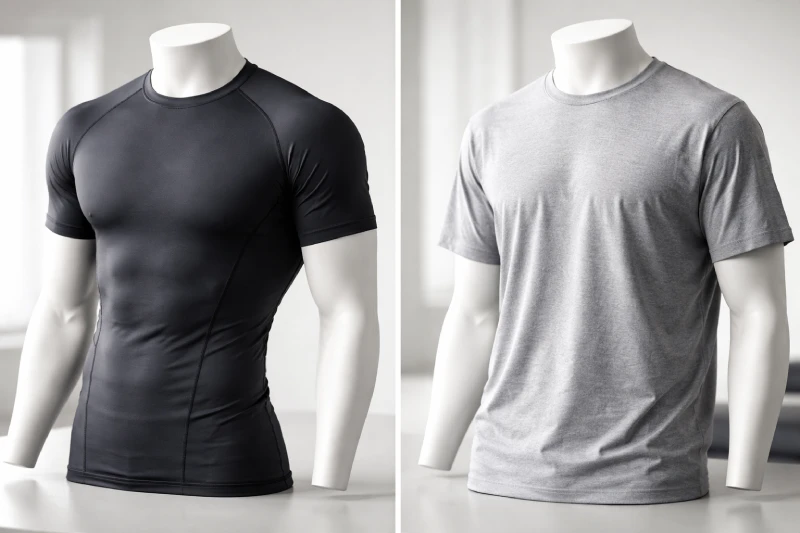
For overseas B2B buyers, choosing between compression fit and regular fit is not a styling preference—it is a functional, operational, and commercial decision that affects wearer performance, acceptance rates, customization feasibility, and long-term program cost.
When sourcing across multiple apparel categories—such as headwear, basic garments, activewear, and workwear—fit decisions should be made at a program level, not on a single product basis. This guide approaches the topic from a manufacturer’s perspective, helping procurement teams and brand owners evaluate fit choices using practical decision logic rather than consumer trends.
Understanding Compression Fit vs Regular Fit in Manufacturing Terms
What Compression Fit Means for B2B Production
In manufacturing, compression fit refers to garments engineered to apply controlled pressure to the body. This requires:
- High-elasticity fabrics (typically elastane or spandex blends)
- Precise pattern design and grading
- Tight tolerance control during cutting and sewing
- Greater sensitivity to size accuracy and fabric recovery
Compression fit is commonly applied in:
- Sportswear and activewear
- Performance base layers
- Training or recovery-related garments
From a supply-chain perspective, compression programs typically involve higher technical complexity and more stringent quality control.
What Regular Fit Represents in Bulk Apparel Programs
Regular fit prioritizes wearability, size tolerance, and scalability. It allows manufacturers to:
- Accommodate wider body-type variation
- Use broader fabric options
- Maintain stable production yields
- Reduce size-related rejection and replacement risk
Regular fit is standard for:
- T-shirts and polos
- Hoodies and sweatshirts
- Corporate uniforms
- Workwear and safety apparel
- Most headwear categories
For large-scale or multi-region distribution, regular fit is generally the lowest-risk baseline.
Fit Selection Is a Business Decision, Not a Design Preference
Rather than asking which fit is “better,” buyers should evaluate how the garment will be used.
Key questions include:
- What activities will the wearer perform?
- How long will the garment be worn per shift or session?
- Is performance enhancement required, or is comfort the priority?
- How controlled is the end-user population?
For example, a compression training top for a defined athlete group follows a very different logic than a promotional sports T-shirt distributed across multiple markets.
Key Decision Factors Buyers Should Evaluate
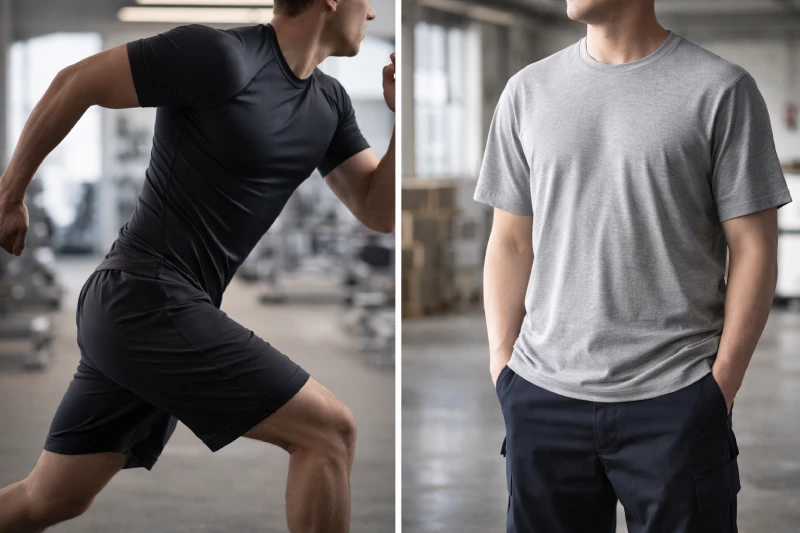
1. Wear Environment and Activity Intensity
| Consideration | Compression Fit | Regular Fit |
|---|---|---|
| High-mobility activities | Strong advantage | Acceptable |
| Long-duration wear | Can cause fatigue | More comfortable |
| Heat management | Requires advanced fabrics | Easier airflow |
| Layering compatibility | Limited | Highly compatible |
Manufacturer insight: In uniforms or workwear worn 8–12 hours daily, compression often increases wearer discomfort and return rates.
2. Size Range and Distribution Risk
Compression garments are significantly less forgiving in sizing.
Buyers should consider:
- Accuracy of available size data
- Number of sizes required
- Replacement and re-order risk
| Program Type | Recommended Fit |
|---|---|
| Athlete or team kits | Compression |
| Corporate uniforms | Regular |
| Multi-country distribution | Regular |
| Distributor resale programs | Regular or mixed |
3. Fabric Availability and Sourcing Stability
Compression fit relies on:
- High stretch recovery consistency
- Stable elastane ratios
- Controlled dye-lot performance
Regular fit allows:
- Cotton, poly-cotton, fleece, and woven blends
- Easier material substitution
- Lower risk during raw material shortages
From a manufacturing standpoint, compression fabrics often increase minimum order quantities (MOQ) due to sourcing and dyeing constraints.
Customization and Branding Considerations
Logo Application Compatibility
| Customization Method | Compression Fit | Regular Fit |
|---|---|---|
| Screen printing | Stretch ink required | Standard |
| Heat transfer | Specialized films | Widely compatible |
| Embroidery | Often unsuitable | Common |
| Reflective elements | Limited | Standard in workwear |
Compression garments require stretch-compatible branding solutions, which can increase unit cost and approval time.
Branding Placement and Distortion Risk
Logos applied to compression garments may visually distort when worn. Buyers should account for:
- Logo shape changes under tension
- Size-based proportion differences
- The need for multi-size wear testing
Regular fit garments provide more predictable branding outcomes, especially in large-scale programs.
Category-Specific Considerations Across Apparel Types
Headwear & Caps
Compression logic rarely applies directly to headwear. Instead, fit is managed through:
- Structural design (structured vs unstructured)
- Adjustability systems (snapback, velcro, flex-fit)
- Fabric recovery rather than body compression
From a B2B perspective, key concerns are:
- Head circumference tolerance
- One-size vs multi-size programs
- Impact of structure on embroidery and logo placement
Compression-style elasticity in caps affects comfort, not performance, and does not follow the same logic as garment compression.
T-Shirts & Polos
Regular fit dominates due to:
- Comfort expectations
- Broad size distribution
- Ease of customization
Compression may be suitable for:
- Performance inner layers
- Athletic or training-focused programs
Some buyers adopt a dual-fit strategy, offering a regular-fit primary garment with an optional compression base layer.
Hoodies & Sweatshirts
Compression fit is generally unsuitable.
Key priorities include:
- Ease of layering
- Fabric weight consistency
- Relaxed sizing tolerance for outerwear
Regular fit supports bulk efficiency and wearer acceptance.
Sportswear & Activewear
This is the primary category where compression fit is functionally justified, provided that:
- End users are clearly defined
- Accurate size data is available
- Performance benefits outweigh comfort trade-offs
A common B2B solution is compression base layers paired with regular-fit outer garments.
Workwear & Safety Apparel
Compression fit is rarely recommended due to:
- Long wear duration
- Heat retention risks
- Compliance and PPE layering requirements
Regular fit supports:
- Safety standards
- Reflective tape placement
- Consistent sizing across shifts and roles
MOQ, Lead Time, and Cost Implications
MOQ Differences
| Aspect | Compression Fit | Regular Fit |
|---|---|---|
| Fabric MOQ | Higher | Lower |
| Color flexibility | Limited | Broad |
| Size-specific MOQ | Common | Rare |
Lead Time Impact
Compression programs typically require:
- Extended sampling cycles
- Fit validation across sizes
- Wash and stretch recovery testing
Regular fit programs move more quickly from sample approval to bulk production.
Decision Checklist for B2B Buyers
Before finalizing fit specifications, confirm:
- ☐ Expected daily wear duration
- ☐ Activity intensity level
- ☐ Accuracy of size data
- ☐ Branding method compatibility
- ☐ Fabric sourcing stability
- ☐ Regional sizing standards
- ☐ Re-order and replacement strategy
If multiple factors remain uncertain, regular fit is usually the safer default.
Common Buyer Mistakes to Avoid
- Selecting compression fit for visual appeal rather than functional need
- Underestimating size-related rejection and replacement costs
- Ignoring logo distortion during actual wear
- Applying a single fit strategy across all apparel categories
- Skipping multi-size wear testing before bulk approval
These mistakes often result in delayed delivery, higher unit cost, or reduced wearer acceptance.
Practical Recommendation Framework
Compression fit is appropriate when:
- Performance directly affects outcomes
- Wearer groups are controlled and informed
- Size data is accurate and stable
- Branding is minimal or fully tested
Regular fit is recommended when:
- Program scale is large
- Wearer profiles vary widely
- Long-duration comfort is critical
- Compliance, safety, or layering is required
Many successful B2B programs adopt a mixed-fit approach, using compression selectively within a broader regular-fit framework.
Final Thoughts and Next Steps
Compression vs regular fit is not a binary choice—it is a strategic sourcing decision that should align with usage scenarios, risk tolerance, and supply-chain realities.
Early alignment on fit strategy helps manufacturers and buyers:
- Reduce revision cycles
- Control MOQ and lead time
- Ensure branding stability
- Improve long-term reorder consistency
If you are planning a bulk apparel program across one or multiple categories, discussing fit strategy early allows for better technical alignment before sampling and production planning.
We invite B2B buyers to share their project requirements and usage scenarios so fit decisions can be evaluated accurately at the program level.