
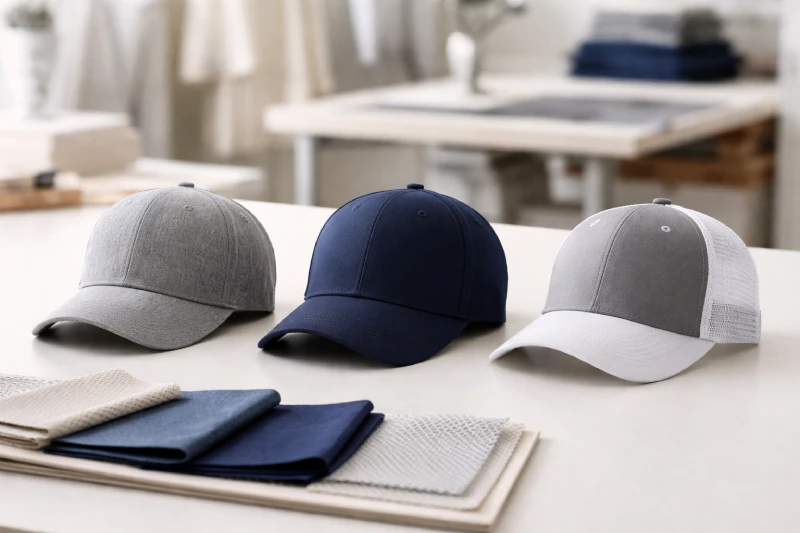
Selecting the right material for caps is a strategic sourcing decision, especially for overseas B2B buyers managing bulk orders across multiple apparel categories. While cotton, polyester, and mesh caps may appear similar at first glance, their performance, cost structure, customization compatibility, and long-term durability can vary significantly.
For procurement managers, brand owners, corporate uniform buyers, and distributors, the right choice depends less on trend and more on application, branding requirements, climate conditions, and supply chain considerations.
This guide provides a practical decision framework to help you determine which material is better suited for your bulk order project — and how that decision integrates with broader apparel sourcing strategies.
Understanding Cotton vs Polyester vs Mesh Caps in Bulk Orders
When comparing cotton vs polyester vs mesh caps for bulk orders, buyers should evaluate five core dimensions:
- Fabric performance
- Brand positioning
- Customization compatibility
- Cost efficiency at scale
- Supply chain stability
Each material serves different operational and branding objectives.
Material Overview at a Glance
| Factor | Cotton Caps | Polyester Caps | Mesh Caps (Trucker Style) |
|---|---|---|---|
| Breathability | Moderate | Moderate to high | High (vented panels) |
| Moisture Management | Low | High | High |
| Structure | Soft to semi-structured | Structured | Structured front + mesh back |
| Print Compatibility | Excellent | Good (depends on coating) | Good (front panel only) |
| Embroidery Compatibility | Excellent | Excellent | Excellent (front only) |
| Durability | Moderate | High | High |
| Cost Range (Bulk) | Medium | Medium to Low | Medium |
| Best Use Cases | Lifestyle brands, retail | Sports, promotions, uniforms | Outdoor, events, active sectors |
Cotton Caps for Bulk Orders: When Natural Feel Matters
Cotton caps are widely used in lifestyle and brand-driven projects. They provide a soft hand feel and a classic appearance.
Key Advantages
- Natural fiber appeal
- Strong compatibility with embroidery and screen printing
- Suitable for fashion brands and premium merchandise
- Stable dyeing performance
Procurement Considerations
- Cotton absorbs moisture and may retain sweat
- Can shrink slightly depending on fabric treatment
- Less suitable for high-intensity outdoor use
- Requires attention to fabric GSM and weave density
Ideal Use Scenarios
- Retail fashion brands
- Corporate gifts
- Lifestyle merchandise
- Indoor event distribution
For buyers also sourcing cotton T-shirts or hoodies, cotton caps offer material consistency across product lines, which can strengthen brand cohesion.
Polyester Caps for Bulk Orders: Performance and Durability Focus
Polyester caps are commonly selected for sportswear, promotional campaigns, and performance-driven environments.
Key Advantages
- Lightweight and moisture-wicking
- High durability under frequent washing
- Shape retention over time
- Cost-efficient at scale
Procurement Considerations
- Fabric texture may appear more technical
- Print methods may require heat transfer or sublimation compatibility
- Colorfastness should be verified for outdoor exposure
Ideal Use Scenarios
- Sports teams
- Activewear brands
- Large-scale promotional events
- Uniform programs requiring durability
For buyers managing sportswear & activewear categories, polyester caps integrate seamlessly into performance-focused collections.
Mesh Caps (Trucker Caps): Ventilation and Outdoor Utility
Mesh caps typically combine a structured front panel (cotton or polyester) with ventilated mesh back panels.
Key Advantages
- Superior airflow
- Structured silhouette
- Popular for outdoor and industrial use
- Distinctive aesthetic in lifestyle and workwear segments
Procurement Considerations
- Limited print area (front panel only)
- Mesh quality affects durability
- Requires reinforced stitching for bulk orders
Ideal Use Scenarios
- Outdoor events
- Logistics and construction sectors
- Agricultural or field teams
- Promotional giveaways in warm climates
For buyers sourcing workwear & safety apparel, mesh caps often complement uniforms used in hot environments.
Decision Framework: How to Choose the Right Cap Material
Instead of asking “Which is better?”, B2B buyers should ask:
- What environment will the caps be used in?
- What branding method is required?
- What is the expected lifecycle?
- What price tier is targeted?
- Are other apparel categories being sourced simultaneously?
Step 1: Define Usage Conditions
| Environment | Recommended Material |
|---|---|
| Indoor retail | Cotton |
| High-temperature outdoor | Mesh or Polyester |
| Sports & performance | Polyester |
| Corporate office merchandise | Cotton |
| Industrial / field use | Mesh or Polyester |
Step 2: Align with Branding Method
| Customization Method | Best Material |
|---|---|
| 3D Embroidery | Cotton / Polyester |
| Flat Embroidery | All three (front panel for mesh) |
| Screen Printing | Cotton |
| Heat Transfer | Polyester |
| Sublimation | Polyester only |
Caps differ from garments because the front panel structure affects embroidery density and print clarity. Buyers should confirm:
- Panel stiffness
- Backing fabric support
- Stitch density limits
- Logo size constraints
Step 3: Evaluate Bulk Order Economics
Bulk cap orders are typically influenced by:
- Fabric cost fluctuations
- Accessory components (buckles, snaps, sweatbands)
- Packaging requirements
- Logo application complexity
Polyester may offer slightly lower cost at higher volumes, but customization method can significantly impact total cost.
For overseas buyers, always confirm:
- MOQ per color
- MOQ per design
- Mixed-size flexibility (less relevant for adjustable caps)
- Sample lead time
- Production lead time (usually 20–35 days depending on order size)
Bulk Ordering Considerations Across Apparel Categories
Many buyers source caps alongside T-shirts, hoodies, sportswear, or workwear. Coordination across categories improves efficiency.
Fabric Strategy Alignment
- Cotton caps + cotton T-shirts = cohesive retail collection
- Polyester caps + sportswear = performance consistency
- Mesh caps + workwear = functional alignment
Color Matching
Different fabrics absorb dye differently. Cotton and polyester may not match exactly under certain lighting. For uniform programs, request lab dips or bulk fabric swatches for approval.
Logo Scaling Differences
Embroidery on caps requires different stitch mapping than flat garments. Buyers should:
- Provide vector artwork
- Approve embroidery digitizing sample
- Confirm logo placement dimensions
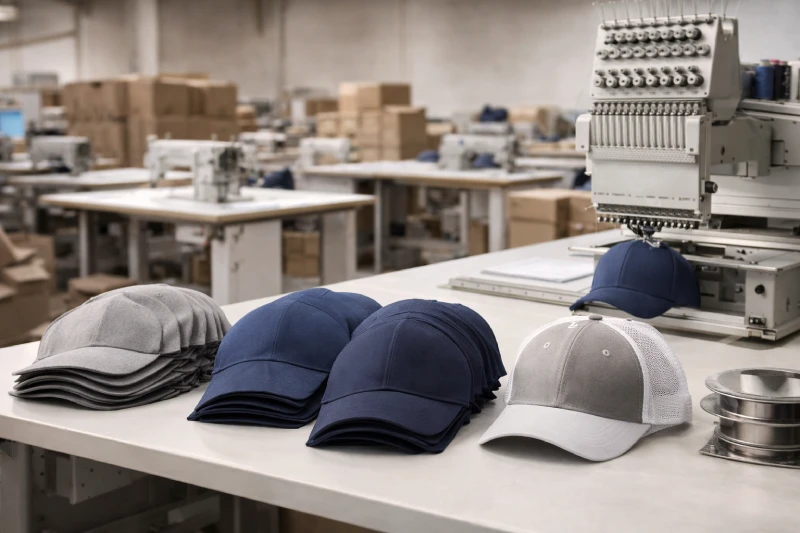
Lead Time and Production Planning for Cap Bulk Orders
Caps often require specialized production steps:
- Panel cutting
- Crown stitching
- Eyelet reinforcement
- Sweatband insertion
- Brim shaping
- Logo application
- Final assembly and inspection
Compared to T-shirts or hoodies, caps involve more structural components, which can impact lead time.
Typical Timeline (Bulk Orders)
| Stage | Estimated Duration |
|---|---|
| Sampling | 5–10 days |
| Material preparation | 5–7 days |
| Production | 15–25 days |
| Quality inspection | 2–3 days |
Buyers should confirm peak season capacity, especially for promotional projects tied to fixed event dates.
Quality Control Checklist for Overseas Buyers
Before confirming bulk production, request:
- Fabric composition certification
- Color fastness testing
- Stitch density review
- Brim stiffness test
- Logo adhesion test (for heat transfer)
- Packaging confirmation
For mesh caps, inspect:
- Mesh elasticity
- Stitch reinforcement at panel junctions
- Snapback durability
Common Mistakes in Bulk Cap Sourcing
- Choosing material based on price alone
- Ignoring customization compatibility
- Not testing sample under real usage conditions
- Overlooking climate factors
- Failing to align caps with broader apparel collection strategy
Caps may appear simple, but structural details influence brand perception and long-term durability.
Quick Selection Summary
If your priority is:
- Premium retail feel → Cotton
- Performance & durability → Polyester
- Ventilation & outdoor use → Mesh
- Cost efficiency at high volume → Polyester
- Brand storytelling consistency → Align with garment fabric
There is no universally “better” material — only better alignment with project requirements.
Final Thoughts: Making the Right Material Decision for Bulk Orders
When evaluating cotton vs polyester vs mesh caps for bulk orders, the decision should be based on application logic, brand positioning, and operational considerations — not just material preference.
Professional sourcing requires:
- Clear usage definition
- Customization feasibility analysis
- Bulk cost modeling
- Production timeline planning
- Cross-category alignment
For overseas B2B buyers managing multi-product programs, a coordinated material strategy across caps, T-shirts, hoodies, sportswear, and workwear can significantly improve supply chain efficiency and brand consistency.
Discuss Your Project Requirements
If you are planning a bulk cap order — whether as a standalone project or as part of a larger apparel program — we welcome the opportunity to review your specifications, customization methods, and timeline requirements.
Our technical team can provide material recommendations, sampling guidance, and production planning support tailored to your market and distribution model.
Feel free to share your project brief to begin a structured evaluation discussion.
Discuss Your Apparel Sourcing Requirements
Whether you're launching a startup clothing brand, expanding a streetwear label, or looking for a reliable OEM apparel manufacturer, speaking directly with an experienced production team can help you avoid costly sourcing mistakes.
Talk With Our Manufacturing Team