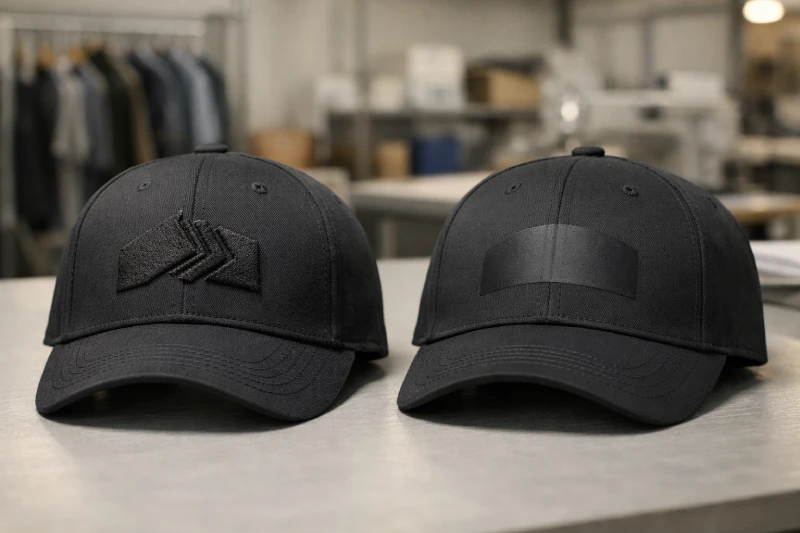
For procurement managers and brand owners sourcing custom headwear, selecting the right logo application method is a strategic decision. The choice between embroidery and printing affects product positioning, cost structure, production feasibility, durability, and long-term brand perception.
While this guide focuses on caps, the decision logic applies broadly across Headwear & Caps, T-Shirts & Polos, Hoodies & Sweatshirts, Sportswear & Activewear, and Workwear & Safety Apparel. Understanding the technical and commercial differences between embroidery and printing enables buyers to make informed decisions aligned with branding goals and operational realities.
Understanding Custom Logo Options for Caps: Embroidery vs Printing
At a manufacturing level, logo decoration methods fall into two primary categories:
- Embroidery – Stitching thread directly into fabric using automated embroidery machines.
- Printing – Applying ink or transfer-based graphics onto fabric surfaces.
Both methods are widely used across apparel categories, but their suitability depends on fabric type, intended usage, design complexity, order quantity, and target market positioning.
The key is not “which method is better,” but rather which method is more appropriate for your project objectives.
Core Decision Factors for B2B Buyers
When evaluating custom logo options for caps, buyers should assess five core dimensions:
- Brand positioning and perceived value
- Fabric compatibility and product structure
- Logo complexity and visual requirements
- Order volume, MOQ, and cost efficiency
- Durability and usage environment
Each factor carries different weight depending on whether you are sourcing promotional caps, retail headwear collections, corporate uniforms, or industrial safety apparel.
Embroidery for Caps: When It Makes Strategic Sense
1. Brand Perception & Premium Positioning
Embroidery is typically associated with:
- Structured and premium headwear
- Corporate uniforms
- Long-term brand assets
- Retail-quality merchandise
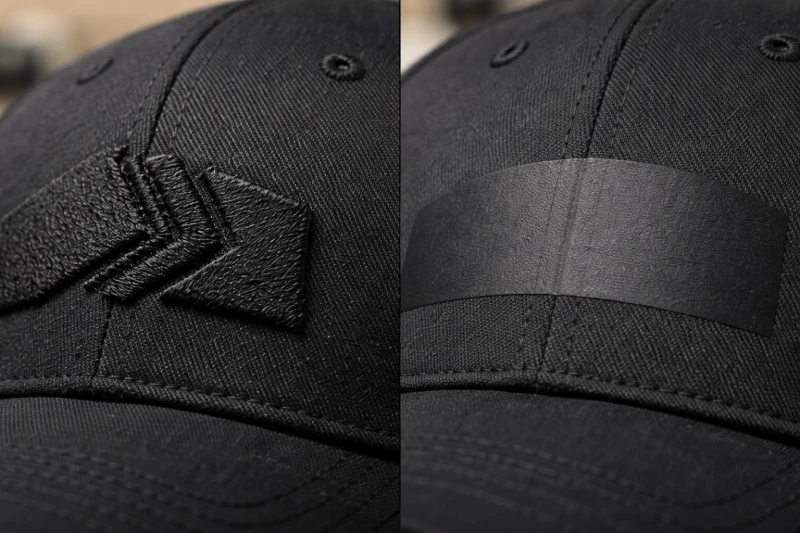
The dimensional texture of stitched logos provides durability and visual depth. For corporate buyers and distributors, embroidery often aligns with higher perceived product value.
2. Structural Compatibility (Especially Important for Caps)
Caps differ from flat garments because they have:
- Curved panels
- Structured front buckram (in many styles)
- Limited printable area
Embroidery performs well on:
- Structured baseball caps
- Trucker caps (front panel)
- Heavy cotton twill or canvas materials
- Workwear caps
However, embroidery may be less suitable for:
- Ultra-light performance fabrics
- Thin technical mesh panels
- Stretch sports caps with minimal structure
3. Logo Design Suitability
Embroidery works best for:
- Text-based logos
- Emblems and badges
- Limited color counts
- Medium to bold line weights
Less suitable for:
- Photo-realistic graphics
- Fine gradients
- Very small detailed artwork
For apparel beyond caps (e.g., hoodies, polos), embroidery also works well for chest logos and sleeve branding, especially in corporate programs.
Printing for Caps: Strategic Applications
1. Complex Graphics & Color Flexibility
Printing offers advantages for:
- Multi-color graphics
- Photographic designs
- Large artwork areas
- Detailed brand illustrations
On caps, printing is often used for:
- Flat-brim fashion caps
- Promotional event headwear
- Limited edition collections
Across garments (T-shirts, sportswear, hoodies), printing provides greater flexibility for bold front-panel graphics and creative design layouts.
2. Fabric Sensitivity Considerations
Certain cap materials require careful selection:
- Polyester performance fabrics may require sublimation or heat transfer.
- Stretch fabrics may not support dense embroidery without distortion.
- Lightweight running caps are often better suited to print applications.
In activewear and sportswear categories, printing is often preferred due to:
- Lightweight construction
- Breathability requirements
- Flexibility under movement
Embroidery vs Printing: Comparative Overview
| Evaluation Factor | Embroidery | Printing |
|---|---|---|
| Perceived Quality | Premium, textured | Clean, graphic-driven |
| Durability | Very high (thread-based) | Depends on print method |
| Fabric Stress | Adds weight & density | Minimal structural impact |
| Design Complexity | Limited gradients | High detail capability |
| Minimum Order Quantity | Often moderate | Can be lower (depending on method) |
| Setup Cost | Digitizing required | Screen setup or transfer preparation |
| Best For | Corporate, uniforms, retail caps | Promotions, fashion graphics, sportswear |
Category-Specific Considerations Beyond Caps
Although this guide centers on caps, buyers sourcing across categories should note the following differences:
Caps vs T-Shirts & Polos
- Caps have curved surfaces; embroidery must be digitized carefully.
- T-shirts allow larger print areas and flexible placement.
- Polos commonly use embroidery for chest logos in corporate settings.
Caps vs Hoodies & Sweatshirts
- Hoodies support both embroidery (chest/sleeve) and large back prints.
- Thick fleece fabric can support heavier embroidery.
- Printing allows oversized designs not feasible on caps.
Caps vs Sportswear & Activewear
- Technical fabrics may resist heavy stitching.
- Printing (heat transfer, sublimation) often preferred for stretch garments.
- Moisture-wicking materials require compatible inks.
Caps vs Workwear & Safety Apparel
- Workwear demands durability.
- Embroidery offers long-term resilience in industrial settings.
- High-visibility garments may require specific print compliance.
Bulk Orders, MOQ & Production Planning
For overseas B2B buyers, decoration method impacts operational factors:
1. MOQ Implications
- Embroidery typically requires a digitizing file setup.
- Small runs may incur higher per-unit cost due to machine time.
- Printing (especially digital methods) may allow lower MOQ flexibility.
However, for large-volume procurement, embroidery can become cost-efficient due to machine scalability.
2. Lead Time Considerations
Embroidery lead time may increase due to:
- Digitizing approval process
- Sampling for stitch quality
- Machine scheduling
Printing lead time may vary depending on:
- Color count (screen printing)
- Transfer preparation
- Curing and drying cycles
When planning multi-category orders (caps + polos + hoodies), coordination across decoration methods should be integrated into timeline forecasting.
3. Sampling & Pre-Production Validation
Professional B2B sourcing should include:
- Physical sample approval
- Logo placement confirmation
- Stitch density review (for embroidery)
- Wash testing (for printing)
- Color fastness validation
Skipping sample validation often leads to costly rework in bulk orders.
Cost Structure: What Buyers Should Evaluate
Rather than focusing only on unit price, buyers should evaluate:
- Setup fees (digitizing or screen preparation)
- Per-stitch cost (embroidery)
- Per-color cost (screen printing)
- Artwork complexity impact
- Reorder efficiency (file retention)
For long-term corporate programs, embroidery files can be reused across categories, improving cost predictability.
Decision Checklist for Procurement Teams
Before finalizing decoration method, confirm:
Logo & Branding
- Is the brand positioned as premium or promotional?
- Does the logo include gradients or fine detail?
- Will the logo scale across multiple garment types?
Fabric & Construction
- Is the cap structured or soft?
- Does the garment use technical stretch fabric?
- Will stitching distort lightweight material?
Operational Planning
- What is the required MOQ?
- What is the total project timeline?
- Will this be a recurring order?
End-Use Environment
- Is the product used in high-wear conditions?
- Is frequent washing expected?
- Does the garment require regulatory compliance?
Long-Term Strategy: Standardizing Decoration Across Categories
For distributors and brand owners managing multiple product categories, consistency matters.
If embroidery is chosen for caps, consider whether:
- Polos and hoodies should use the same stitch file.
- Workwear programs require identical logo presentation.
- Retail collections need differentiated decoration styles.
Standardization reduces complexity and improves supplier alignment.
Risk Mitigation in Overseas Manufacturing
When sourcing internationally, buyers should:
- Confirm embroidery machine capabilities (head count, cap frames).
- Verify print method suitability for fabric type.
- Review factory quality control procedures.
- Request detailed production workflow explanations.
Transparent communication at the manufacturing stage significantly reduces misalignment.
Conclusion: Making the Right Custom Logo Decision
Selecting between embroidery and printing is not a design preference—it is a strategic sourcing decision.
Embroidery typically supports premium positioning, durability, and corporate uniform programs. Printing provides greater design flexibility, lighter weight application, and creative freedom—especially for promotional or sports-focused products.
The optimal choice depends on:
- Brand positioning
- Fabric structure
- Order volume
- Usage environment
- Multi-category integration strategy
For procurement managers and brand owners managing international supply chains, early technical consultation prevents costly revisions later in production.
Discuss Your Project Requirements
If you are evaluating custom logo options for caps or planning a broader multi-category apparel program—including headwear, T-shirts, hoodies, sportswear, or workwear—our technical team can provide structured input based on your design, volume, and timeline requirements.
We welcome the opportunity to review your artwork, material selection, and bulk order parameters to help you determine the most appropriate decoration method for your project objectives.
Discuss Your Apparel Sourcing Requirements
Whether you're launching a startup clothing brand, expanding a streetwear label, or looking for a reliable OEM apparel manufacturer, speaking directly with an experienced production team can help you avoid costly sourcing mistakes.
Talk With Our Manufacturing Team