
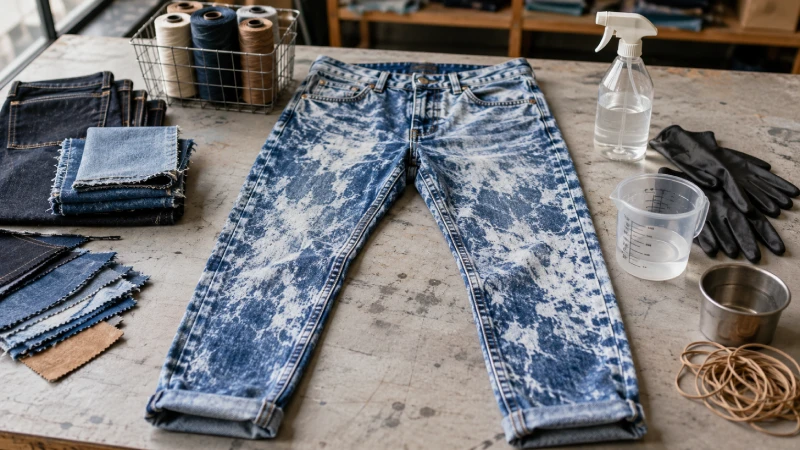
Acid wash jeans are one of the easiest ways to turn a plain pair of denim jeans into a bold, vintage-inspired fashion piece. Whether you want a subtle faded look, a strong black-and-white contrast, or an 80s-style marbled effect, acid washing can give denim a unique surface texture that looks worn, expressive, and personalized.
At home, acid washing usually involves using diluted bleach to remove color from selected areas of denim. The process is creative, but it also requires preparation and safety. Bleach can damage fabric if it is used too strongly or left on too long, and it should always be handled carefully.
This guide explains how to acid wash jeans step by step, what materials you need, how to control the final pattern, common mistakes to avoid, and when professional acid wash denim production is a better choice than DIY.
What Are Acid Wash Jeans?
Acid wash jeans are denim jeans with a faded, cloudy, speckled, or marbled appearance. The effect is created by removing color from the surface of the denim in an uneven way. Instead of a smooth and uniform wash, acid wash denim has stronger visual contrast, giving the jeans a vintage, streetwear, or retro look.
The style became especially popular in the 1980s, but modern acid wash jeans are no longer limited to one fashion era. Today, they are used in casualwear, streetwear, oversized denim, women’s straight-leg jeans, men’s relaxed-fit jeans, black denim, and private label fashion collections.
The final look depends on several factors, including the original denim color, fabric composition, bleach concentration, application method, and processing time. Blue jeans may turn light blue or pale grey, while black jeans may fade into grey, brown, orange, or high-contrast white depending on the dye.
Can You Acid Wash Jeans at Home?
Yes, you can acid wash jeans at home, especially if you are working on an old pair of jeans or experimenting with a personal DIY project. The basic process is simple: prepare the jeans, apply diluted bleach, wait for the color to change, rinse thoroughly, and wash the jeans separately.
However, the results are not always predictable. Different denim fabrics react in different ways. A pair of 100% cotton jeans may fade more clearly, while stretch denim may be more sensitive because elastic fibers can be affected by harsh chemicals. The original dye also matters. Some black jeans fade beautifully into grey, while others may turn brown or orange.
DIY acid washing is best for one-off creative projects. If you are a fashion brand, retailer, distributor, or bulk buyer, professional acid wash production is usually the better option. A controlled factory wash process can help achieve repeatable patterns, consistent sizing, better fabric safety, and commercial-level quality across multiple pieces.
Tools and Materials You Need
Before you start, prepare all tools and materials in advance. This helps you work more safely and avoid uneven results caused by rushing.
You will need:
- A pair of jeans
- Household bleach
- Cold water
- Rubber gloves
- Protective eyewear
- Old clothes or an apron
- A spray bottle or plastic bucket
- Measuring cup
- Plastic sheet, tarp, or outdoor work surface
- Mild detergent
- Washing machine or large rinse basin
You can also prepare optional tools for pattern control:
- Rubber bands
- Sponge
- Brush
- Clips or ties
- Plastic wrap
- Pumice stone
Each tool creates a different effect. A spray bottle gives a random, misted fade. A sponge allows you to target specific areas such as the thighs, knees, seams, and pockets. Rubber bands create a tie-dye effect, while twisting or scrunching the jeans creates a more natural marbled pattern.
If this is your first time acid washing jeans, choose a pair that you do not mind damaging. It is also a good idea to test the bleach solution on a hidden area or a scrap piece of denim before applying it to the full garment.
Safety First: What to Know Before Using Bleach
Bleach can create great visual effects on denim, but it must be handled carefully. Always work in a well-ventilated area, preferably outdoors. Wear rubber gloves and protective eyewear to avoid skin and eye contact. You should also wear old clothes because bleach can stain or damage other fabrics.
Never mix bleach with vinegar, ammonia, acids, or other household cleaners. Mixing bleach with other chemicals can create dangerous fumes. Use bleach only with water, and keep the solution away from children, pets, food surfaces, and delicate flooring.
Do not use full-strength bleach directly on jeans unless you are highly experienced and willing to risk fabric damage. A diluted solution gives you more control and reduces the chance of weakening the denim.
Also remember that bleach continues to affect fabric while it remains on the surface. Do not walk away after applying it. Watch the color change closely, and rinse the jeans as soon as the effect becomes strong enough. Leaving bleach on too long can make denim brittle, rough, or unevenly damaged.
How to Acid Wash Jeans Step by Step
Step 1: Choose the Right Jeans
Start with medium or dark denim because the acid wash effect will be more visible. Blue jeans, black jeans, grey jeans, and dark indigo jeans usually work best. Light-wash jeans may not show enough contrast.
If possible, choose 100% cotton denim. Cotton denim usually reacts more clearly to bleach and gives a more traditional acid wash effect. Stretch jeans can still be acid washed, but they require extra caution because bleach may weaken the stretch fibers.
For your first attempt, avoid expensive designer jeans. Choose an old pair or a low-risk pair so you can experiment without pressure.
Step 2: Wash and Dry the Jeans First
Wash the jeans before acid washing them. This removes dirt, oils, softeners, and surface treatments that may block the bleach from working evenly. After washing, dry the jeans completely or leave them slightly damp depending on the effect you want.
Dry jeans usually create stronger contrast because the bleach sits more directly on the surface. Slightly damp jeans can produce a softer, more blended effect.
Step 3: Prepare the Bleach Solution
Mix bleach with cold water in a spray bottle or plastic bucket. For better control, start with a diluted solution instead of using strong bleach. A weaker mixture may take longer to change the color, but it is safer for beginners and reduces the risk of over-processing the denim.
If you want a dramatic acid wash effect, you can apply more solution gradually instead of starting too strong. It is easier to add more fading than to reverse bleach damage.
Clearly label your spray bottle if you are using one, and do not reuse it for other household purposes.
Step 4: Arrange the Jeans for the Desired Pattern
Lay the jeans flat if you want more control over where the fading appears. This method works well if you want to lighten the thighs, knees, pockets, or lower legs.
For a random vintage effect, twist or scrunch the jeans before applying bleach. You can use rubber bands to hold sections in place. This creates areas where the bleach reaches the fabric strongly and other areas where the denim stays darker.
For a tie-dye acid wash effect, fold, twist, or bind the jeans tightly with rubber bands before spraying. For a more natural worn look, keep the jeans flat and apply bleach mainly to high-wear areas.
Step 5: Apply the Bleach Solution
Apply the bleach solution slowly. If you are using a spray bottle, start with a light mist and build the effect gradually. Do not soak the jeans immediately. Too much bleach can create harsh patches and weaken the fabric.
Focus on areas where jeans naturally fade, such as the front thighs, knees, pocket edges, seams, and lower leg openings. If you want both sides treated, flip the jeans carefully and repeat the process on the back.
For a more controlled look, use a sponge or brush to apply bleach to specific areas. This is useful when you want a subtle vintage fade instead of a bold all-over acid wash.
Step 6: Wait and Watch the Color Change
After applying bleach, watch the jeans closely. The color may begin changing within a few minutes. Dark denim can shift quickly, and black jeans may fade through several tones before reaching the final color.
Do not leave the jeans unattended. The longer bleach stays on the fabric, the stronger the effect becomes. Stop earlier than you think you need to, because the jeans may look slightly different after rinsing, washing, and drying.
If the effect is too light, you can always repeat the process later. If the effect is too strong, it cannot be undone.
Step 7: Rinse Thoroughly
Once the color looks right, rinse the jeans immediately with cold water. Rinse until most of the bleach is removed and the water begins to run clearer. Be careful not to splash the rinse water onto other clothing or surfaces.
This step is important because leftover bleach can continue damaging the fibers. Take your time and make sure the jeans are rinsed well before putting them into the washing machine.
Step 8: Wash and Dry the Jeans
Wash the acid washed jeans separately with mild detergent and cold water. Do not wash them with other garments during the first wash. This prevents bleach residue or loose dye from affecting other clothes.
After washing, air dry the jeans if possible. Heat from a dryer may add extra stress to already treated fabric. Once the jeans are fully dry, check the final pattern, color, and texture.
How to Create Different Acid Wash Effects
Classic 80s Acid Wash Look
For a classic 80s acid wash effect, aim for strong contrast and an uneven marbled pattern. Scrunch or twist the jeans, apply bleach in random areas, and allow some sections to fade more than others. This look works especially well on straight-leg, relaxed-fit, and vintage-style jeans.
Subtle Vintage Fade
For a more wearable everyday look, apply bleach lightly to selected areas. Focus on the thighs, knees, pocket edges, seams, and hems. Avoid covering the entire garment. The goal is to make the jeans look naturally aged rather than heavily bleached.
Black Acid Wash Jeans
Black acid wash jeans can create a bold streetwear look, but they are less predictable. Depending on the dye, black denim may fade to grey, white, brown, or orange. Always test a hidden area first. If the color reaction looks good, continue with a gradual application.
Tie-Dye Acid Wash Jeans
To create tie-dye acid wash jeans, twist or fold the denim and secure sections with rubber bands. Spray bleach unevenly over the raised areas. After rinsing and washing, the jeans will show a more graphic, high-contrast pattern.
Common Mistakes When Acid Washing Jeans
Using Too Much Bleach
One of the most common mistakes is using bleach that is too strong. This can remove too much color too quickly and damage the fabric. Start with a diluted solution and build the effect slowly.
Leaving Bleach on Too Long
Do not wait for a perfect color without checking the fabric. Bleach can weaken denim if it remains too long. Watch the jeans closely and rinse as soon as the color looks strong enough.
Skipping the Test Patch
Every pair of jeans reacts differently. A small hidden test can help you see how the dye responds before you treat the full garment.
Treating Stretch Denim Too Aggressively
Stretch jeans often contain elastane or spandex. These fibers can be sensitive to bleach. Use a weaker solution, shorter processing time, and gentle washing if you are acid washing stretch denim.
Expecting Factory-Level Consistency
DIY acid wash is creative but unpredictable. If you need the same wash effect across many pairs of jeans, home washing is not the right method. Professional denim washing is designed for repeatable results.
How to Care for Acid Wash Jeans After Washing
After acid washing, proper care can help your jeans last longer. Wash them inside out with cold water and mild detergent. Avoid harsh detergents, repeated bleaching, and high heat drying.
For the first few washes, wash the jeans separately to prevent any remaining dye or chemical residue from affecting other clothing. Air drying is usually better than machine drying because it is gentler on the fabric.
Acid washed jeans already have a distressed surface effect, so they should not be treated too aggressively after washing. Avoid heavy scrubbing, excessive ironing, or repeated chemical treatments. With careful care, your acid wash jeans can keep their look while staying wearable.
DIY Acid Wash vs Professional Acid Wash Production
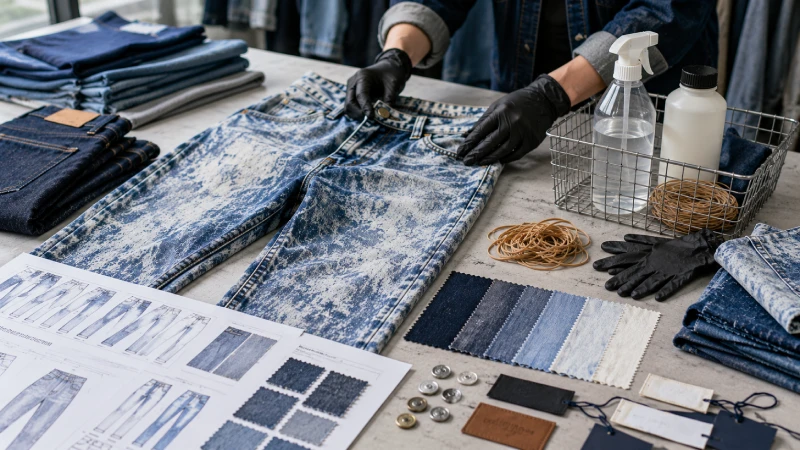
DIY acid washing is a good option for personal projects. It is affordable, creative, and easy to try at home. However, it has clear limits. The pattern may be uneven, the color may not turn out as expected, and the fabric may become damaged if the bleach is too strong.
Professional acid wash production is different. It is designed for brands, retailers, and bulk buyers who need consistent quality. In professional denim development, the wash effect is usually tested through samples before bulk production begins. This allows the buyer to confirm the fabric, fit, color level, pattern intensity, trims, labels, and packaging.
| Factor | DIY Acid Wash | Professional Acid Wash Production |
|---|---|---|
| Best For | Personal projects and one-off denim experiments | Brands, retailers, distributors, and bulk buyers |
| Result Control | Low to medium | High |
| Pattern Consistency | Difficult to repeat | Developed through sampling and controlled production |
| Fabric Safety | Depends on user skill and bleach control | Managed through professional wash testing |
| Scalability | One pair at a time | Suitable for bulk production |
| Branding Options | Limited | Labels, trims, embroidery, printing, hangtags, and packaging |
| Cost Efficiency | Good for one pair | Better for commercial denim programs |
For a single pair of jeans, DIY is often enough. For a commercial denim collection, professional production is usually more reliable. Brands need consistency across sizes, repeatable wash standards, stable stitching quality, and controlled finishing. They may also need custom buttons, rivets, leather patches, embroidery, printed logos, woven labels, hangtags, and packaging.
This is where working with a custom acid wash jeans manufacturer becomes valuable. Instead of treating each pair by hand, brands can develop a complete acid wash denim program from sample approval to bulk production.
When Should Brands Choose Custom Acid Wash Jeans?
Brands should consider custom acid wash jeans when they need more than a one-time DIY result. If you are developing a retail denim line, streetwear collection, private label project, or promotional fashion program, controlled production is important.
Custom acid wash jeans are useful for many product directions, including black acid wash jeans, women’s straight-leg acid wash jeans, men’s relaxed-fit jeans, baggy denim, vintage-style jeans, high-waisted jeans, and seasonal denim collections.
A professional denim jeans manufacturer can help with fabric selection, pattern development, size grading, washing tests, trims, labels, and quality control. This is especially important when the same wash effect must be repeated across different sizes and production batches.
For private label brands, custom production also supports logo patches, embroidery, printed details, branded buttons, hangtags, care labels, and retail packaging. This turns acid wash jeans from a simple DIY style into a complete commercial product.
Conclusion
Acid washing jeans is a creative way to refresh denim and create a vintage, marbled, or high-contrast look. With the right tools, safety preparation, and careful bleach application, you can transform an old pair of jeans into a unique DIY fashion piece.
The key is control. Start with diluted bleach, test the fabric first, apply the solution gradually, and rinse thoroughly once the color changes. Avoid using too much bleach or leaving it on too long, especially with stretch denim.
For personal use, DIY acid washing can be fun and affordable. For fashion brands, retailers, and private label buyers, professional acid wash production is a better choice. It offers better consistency, safer fabric handling, controlled wash development, and full customization from fit and fabric to labels, trims, and packaging.
If you are planning a denim collection, working with a private label jeans production partner can help you turn acid wash denim ideas into retail-ready products with consistent quality.
FAQ
Can I acid wash jeans without bleach?
The classic acid wash effect usually involves bleach or professional wash processing. Some dyeing and fading methods can create a worn look, but they may not create the same high-contrast acid wash texture.
Can you acid wash black jeans?
Yes. Black jeans can create a strong acid wash effect, but the final color depends on the dye. Some black denim turns grey or white, while other fabrics may fade into brown or orange tones.
How long should bleach stay on jeans?
There is no single fixed time. It depends on the denim color, fabric type, bleach strength, and desired result. Watch the color closely and rinse once the effect is visible enough.
Will acid washing damage jeans?
It can. Bleach may weaken denim if it is too strong, left on too long, or used repeatedly. Dilution, short processing time, and thorough rinsing help reduce damage.
Can I acid wash stretch jeans?
Yes, but be careful. Stretch denim can be more sensitive because elastic fibers may react poorly to harsh chemicals. Use a gentle approach and test first.
Are acid wash jeans still in style?
Yes. Acid wash jeans remain popular in vintage fashion, streetwear, festival outfits, casual denim collections, and 80s-inspired looks.
Can I order custom acid wash jeans in bulk?
Yes. OEM/ODM denim manufacturers can produce custom acid wash jeans with selected fabric, fit, wash level, trims, labels, logos, and packaging for bulk orders.
Discuss Your Apparel Sourcing Requirements
Whether you're launching a startup clothing brand, expanding a streetwear label, or looking for a reliable OEM apparel manufacturer, speaking directly with an experienced production team can help you avoid costly sourcing mistakes.
Talk With Our Manufacturing Team