Selecting caps for outdoor, promotional, and work environments requires more than choosing a style or color. For B2B buyers—procurement managers, brand owners, uniform planners, and distributors—the decision must balance functionality, branding objectives, cost control, and supply chain stability.
This guide explains how to select caps for outdoor, events, and work environments using a structured procurement framework. While the focus is on caps, many of the selection principles also apply across apparel categories such as T-shirts, hoodies, sportswear, and workwear.
Define the Primary Use Environment First
Before reviewing materials or decoration methods, clarify where and how the caps will be used.
1. Outdoor Promotional Events
Typical scenarios:
- Trade shows
- Festivals
- Brand activations
- Sports events
Key requirements:
- UV protection
- Breathability
- Lightweight structure
- High logo visibility
- Cost control for bulk distribution
In event-driven environments, caps often function as high-volume promotional items. Durability matters, but price-per-unit and print clarity are usually primary drivers.
2. Outdoor Operational Use (Construction, Logistics, Field Work)
Typical scenarios:
- Construction sites
- Road maintenance
- Agriculture
- Warehousing
Key requirements:
- Sun protection
- Sweat absorption
- Structural durability
- Compatibility with safety helmets (if required)
- Color consistency with uniform program
In work environments, caps become part of a broader uniform system and must align with safety apparel standards and company branding.
3. Corporate or Hospitality Settings
Typical scenarios:
- Retail staff
- Hospitality teams
- Brand ambassadors
- Tourism operations
Key requirements:
- Clean silhouette
- Color accuracy
- Premium appearance
- Long-term wear comfort
In these settings, caps represent brand image rather than promotional distribution.
Decision Tip:
Always map cap selection to environment type before discussing fabric or decoration.
How to Select Caps for Outdoor, Events, and Work Environments: Core Evaluation Framework
When B2B buyers ask how to select caps for outdoor, events, and work environments, the answer lies in five structured evaluation dimensions:
- Fabric & Performance
- Construction & Fit
- Branding & Customization
- Durability & Lifecycle
- Supply Chain & Commercial Factors
Let’s examine each.
Fabric Selection: Performance vs. Cost Balance
Fabric determines comfort, durability, and perceived quality.
Common Cap Fabric Options
| Fabric Type | Advantages | Typical Use | Considerations |
|---|---|---|---|
| Cotton Twill | Natural feel, good structure | Events, retail | Less moisture-wicking |
| Polyester | Lightweight, moisture control | Sports, outdoor work | May feel less premium |
| Cotton-Poly Blend | Balanced comfort & durability | Uniform programs | Mid-range pricing |
| Performance Mesh | High breathability | Outdoor events, sports | Structure may be softer |
| Ripstop or Technical Fabric | Tear resistance | Construction, logistics | Higher cost |
For event giveaways: Lightweight cotton or blended fabrics often balance cost and brand appearance.
For outdoor labor: Performance polyester or technical blends may be more suitable due to moisture control and durability.
Cross-Category Insight
The same logic applies to T-shirts, hoodies, and sportswear:
- Cotton for comfort and brand softness.
- Polyester for performance and durability.
- Blends for cost-performance balance.
Construction & Structural Design
Caps differ significantly from garments in structural engineering.
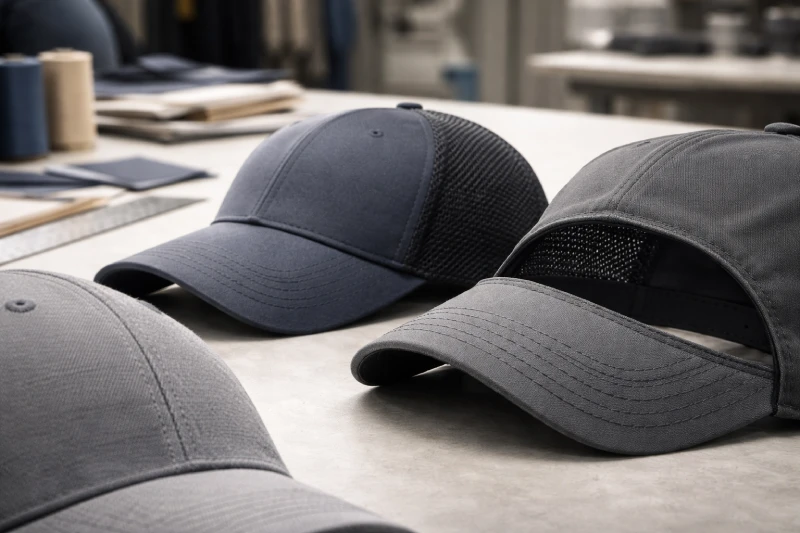
Key Structural Elements to Evaluate
- Panel construction (5-panel vs 6-panel)
- Crown height
- Brim curvature
- Stitch density
- Reinforcement at stress points
- Inner sweatband quality
- Closure system (snapback, metal buckle, Velcro)
For work environments, reinforced stitching and durable closures are critical.
For promotional events, visual consistency and front panel stiffness (for logo display) may be more important.
Fit & Adjustability
Unlike garments that rely on size grading (S–XXL), caps typically use:
- One-size adjustable
- Fitted sizing (for premium programs)
Uniform buyers often prefer adjustable systems for simplified inventory control.
Branding & Customization Considerations
Customization is central in B2B cap production.
Common Decoration Methods
| Method | Suitable For | Advantages | Limitations |
|---|---|---|---|
| Embroidery | Corporate logos | Premium appearance, durable | Higher cost per unit |
| Screen Printing | Promotional runs | Cost-effective for volume | Limited dimensional effect |
| Heat Transfer | Event graphics | Detailed logos | May affect durability |
| 3D Puff Embroidery | Streetwear & brand image | Strong visual impact | Higher minimums |
Logo Placement Logic
Caps offer limited surface compared to T-shirts or hoodies. Placement areas include:
- Front panel (primary)
- Side panel
- Back panel
- Brim
Workwear programs often require compliance markings or reflective elements, which must be coordinated with safety apparel.
Cross-Category Comparison
| Category | Decoration Flexibility |
|---|---|
| Caps | Limited but high-visibility focal point |
| T-Shirts | Large print area |
| Hoodies | Multiple zones (chest, sleeve, back) |
| Workwear | May require compliance markings |
For caps, precision in logo scaling and panel structure is critical to avoid distortion.
Durability & Lifecycle Planning
Procurement decisions should factor expected lifecycle.
Short-Term Use (Events)
- 1–3 days of use
- Focus on branding exposure
- Cost efficiency prioritized
Mid-Term Use (Retail & Promotions)
- Repeated wear
- Appearance retention matters
- Moderate durability required
Long-Term Use (Workwear Programs)
- Daily use
- Wash resistance
- Colorfastness
- Structural retention
Unlike hoodies or work jackets, caps often experience heavy sun exposure and sweat concentration in the headband area. Sweatband quality significantly impacts lifespan.
MOQ, Bulk Ordering & Production Planning
Caps often have different minimum order quantities compared to garments.
Typical Considerations
- MOQ for standard caps: lower than fully customized garments
- MOQ for custom fabric or special trims: higher
- Sampling timeline: 7–14 days
- Bulk production lead time: 20–40 days depending on complexity
Factors Influencing Lead Time
- Custom fabric development
- Embroidery complexity
- Multi-location branding
- Color matching requirements
- Packaging customization
For multi-category orders (e.g., caps + T-shirts + hoodies), coordination across production lines becomes essential to align shipment timing.
Cost Structure: What Drives Pricing
Cap pricing typically depends on:
- Fabric type
- Panel construction complexity
- Decoration method
- Quantity scale
- Packaging requirements
- Compliance testing (if required)
Unlike T-shirts, caps involve more structural sewing steps and often higher embroidery labor intensity.
Bulk Order Cost Logic
| Order Volume | Cost Impact |
|---|---|
| 500–1,000 pcs | Standard bulk pricing |
| 3,000+ pcs | Better cost efficiency |
| 10,000+ pcs | Optimized decoration pricing |
Distributors should evaluate forecast stability before committing to higher volumes.
Compliance & Regional Requirements
For work environments, compliance may extend beyond appearance.
Potential requirements:
- High-visibility color standards
- Reflective trims
- Flame resistance (rare but possible)
- Regional textile compliance testing
For sportswear or activewear caps, moisture management and UV protection claims may require laboratory validation.
Procurement teams should verify certification requirements before production approval.
Checklist: Structured Cap Selection for B2B Buyers
Before finalizing an order, confirm:
Environment
- Indoor or outdoor?
- Promotional or operational use?
- Daily wear or short-term event?
Performance
- Breathability needed?
- Moisture-wicking required?
- UV exposure level?
Branding
- Embroidery or print?
- Logo placement defined?
- Color matching standards?
Commercial
- MOQ acceptable?
- Lead time aligned with project timeline?
- Packaging requirements confirmed?
Supply Chain
- Multi-category coordination needed?
- Compliance testing required?
- Reorder forecast estimated?
Differences Between Caps and Other Apparel Categories
Understanding category differences helps avoid procurement mistakes.
| Factor | Caps | T-Shirts | Hoodies | Workwear |
|---|---|---|---|---|
| Structural complexity | High | Low | Medium | Medium-High |
| Decoration space | Limited | Large | Large | Medium |
| Sizing complexity | Low | High | High | High |
| Sweat concentration | High (headband) | Medium | Medium | Medium |
| UV exposure impact | High | Medium | Medium | Medium |
Caps require more attention to structural consistency and logo precision, while garments demand more focus on fabric weight (GSM), size grading, and wash stability.
Risk Management in Cap Procurement
Common risks include:
- Logo distortion on curved panels
- Inconsistent brim shape
- Color variation between production batches
- Weak closures
- Delays due to embroidery bottlenecks
Mitigation strategies:
- Request pre-production samples
- Approve embroidery mockups
- Confirm Pantone references
- Align shipment schedules early
For large uniform programs, pilot runs can reduce rollout risk.
Strategic Approach for Multi-Category Apparel Buyers
Many buyers source caps alongside T-shirts, hoodies, sportswear, or workwear.
A strategic approach includes:
- Centralized brand color management
- Shared fabric tone coordination
- Unified decoration standards
- Consolidated shipping
- Rolling forecast planning
Caps often act as entry-level promotional items, while hoodies or workwear represent higher investment pieces. Balancing category mix improves overall cost efficiency.
Conclusion: Align Product Logic with Project Objectives
Understanding how to select caps for outdoor, events, and work environments requires structured evaluation rather than style-based decisions.
B2B buyers should assess:
- Functional environment
- Fabric performance
- Structural integrity
- Branding requirements
- MOQ and lead time
- Compliance considerations
- Long-term procurement strategy
Caps may appear simple, but in professional uniform and promotional programs, they require careful technical and commercial planning.
If you are planning a cap program for outdoor promotions, corporate uniforms, or operational teams—and possibly integrating multiple apparel categories—our manufacturing team can review your project requirements and provide structured production guidance aligned with your timeline and budget.
Discuss Your Apparel Sourcing Requirements
Whether you're launching a startup clothing brand, expanding a streetwear label, or looking for a reliable OEM apparel manufacturer, speaking directly with an experienced production team can help you avoid costly sourcing mistakes.
Talk With Our Manufacturing Team