For overseas B2B buyers, understanding lead time & MOQ considerations for custom hoodies is critical to planning seasonal launches, corporate uniform rollouts, and distributor replenishment cycles. While hoodies are often used as the reference category, the underlying logic applies across multiple apparel types — including caps, T-shirts, polos, sportswear, and workwear.
This guide provides a structured decision framework to help procurement managers, brand owners, and uniform buyers evaluate timelines, minimum order quantities (MOQ), and customization complexity across apparel categories — from lightweight headwear to heavyweight fleece garments.
Understanding Lead Time & MOQ Considerations for Custom Hoodies
Before placing a bulk apparel order, buyers should evaluate two interconnected variables:
- Minimum Order Quantity (MOQ) – the minimum production volume required per style, color, or size range.
- Lead Time – the total time from order confirmation to shipment readiness.
These two factors are influenced by:
- Product category (cap vs hoodie vs safety jacket)
- Fabric type and weight
- Customization method
- Supply chain structure (stock fabric vs custom dyeing)
- Production seasonality
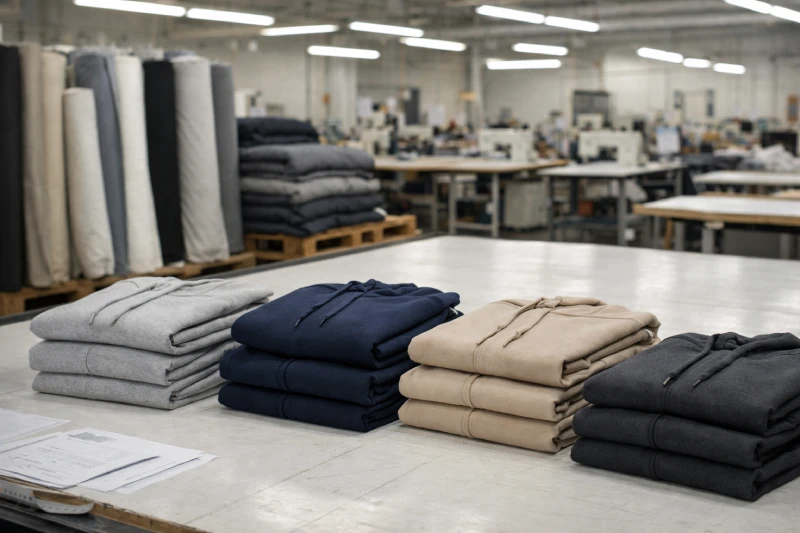
Hoodies are typically more complex than T-shirts or caps due to fabric weight, fleece processing, and construction steps (ribbing, pockets, lining), which often results in higher MOQs and longer lead times.
However, the same evaluation logic applies across all apparel categories.
What Determines MOQ Across Apparel Categories?
MOQ is rarely a fixed number across all products. It depends on production efficiency and material allocation.
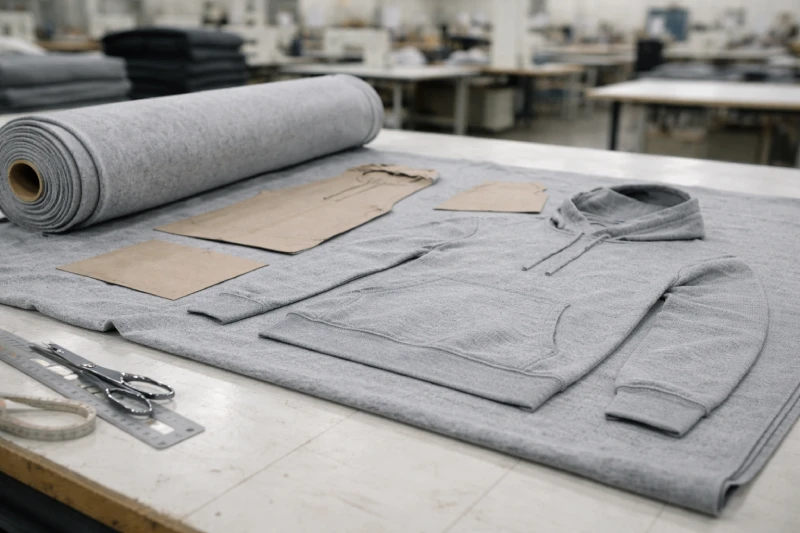
1. Fabric-Based MOQs (Common for Hoodies, T-Shirts, Workwear)
Garments made from knitted or woven fabric often have MOQs tied to:
- Fabric dye lot minimums
- Color consistency requirements
- Fabric mill production runs
- Size ratio planning
For example:
| Category | Typical MOQ Drivers | Complexity Level |
|---|---|---|
| T-Shirts & Polos | Fabric color lot | Low–Medium |
| Hoodies & Sweatshirts | Fleece dye lot + rib matching | Medium–High |
| Workwear & Safety Apparel | Specialized fabric + trims | High |
| Sportswear & Activewear | Performance fabric sourcing | Medium–High |
Heavier garments like hoodies often require larger fabric commitments, which increases MOQ per color.
2. Accessory-Based MOQs (Common for Caps & Headwear)
Headwear often has different MOQ logic:
- Embroidery setup cost
- Structured panels or molds
- Specialty closures
- Custom trims
Because caps use less fabric per unit, MOQs can sometimes be lower than fleece garments. However, complex embroidery or patch applications may increase minimum requirements.
3. Customization-Driven MOQs
Customization type can significantly impact MOQ:
- Screen printing: may require a minimum per color
- Embroidery: digitizing and machine setup cost
- Custom labels and packaging
- Private color matching
For custom hoodies, additional features like:
- Custom drawcords
- Branded eyelets
- Specialty ribbing
- Washed or garment-dyed finishes
can raise the minimum volume required to make production viable.
How Lead Time Is Structured in Custom Apparel Production
Lead time is not a single block of time — it is a sequence of stages.
Typical Production Timeline (Custom Hoodies as Example)
| Stage | Typical Duration | Notes |
|---|---|---|
| Design confirmation & tech pack approval | 3–7 days | Depends on clarity of specs |
| Sampling | 7–14 days | May vary for complex trims |
| Fabric sourcing / dyeing | 10–20 days | Longer for custom colors |
| Bulk production | 20–35 days | Depends on order size |
| Final inspection & packing | 3–7 days | Includes QC checks |
Total production lead time: 35–60 days for fully customized hoodies.
Lead Time Differences by Category
| Category | Typical Lead Time Range | Key Risk Factors |
|---|---|---|
| Headwear & Caps | 25–40 days | Embroidery capacity |
| T-Shirts & Polos | 25–45 days | Fabric dye lot |
| Hoodies & Sweatshirts | 35–60 days | Fleece production |
| Sportswear & Activewear | 30–55 days | Performance fabric sourcing |
| Workwear & Safety Apparel | 45–75 days | Compliance materials |
Workwear and safety apparel often require longer timelines due to reflective tape sourcing, certification labels, and testing requirements.
Customization Level vs Production Time
Buyers should evaluate how customization depth impacts timelines.
Low Customization
- Stock fabric colors
- Standard sizing
- Basic logo print
- Woven label only
Result: Shorter lead time, lower MOQ.
Medium Customization
- Custom fabric colors
- Multiple print placements
- Embroidery + print combination
- Private packaging
Result: Moderate lead time increase.
High Customization
- Fully custom color dye
- Special trims
- Washed or treated fabric
- Pattern modifications
- Compliance testing (for safety apparel)
Result: Longer development + production time.
For custom hoodies, custom fleece dyeing alone can add 10–15 days.
Bulk Order Planning Framework for Overseas Buyers
When planning international procurement, buyers should consider:
1. Sales or Deployment Deadline
- Retail seasonal launch?
- Corporate event?
- Uniform rollout?
- Distributor replenishment cycle?
Work backward from required delivery date, factoring in:
- Production lead time
- Ocean or air freight transit time
- Customs clearance
2. Shipping Mode Impact
| Shipping Mode | Transit Time | Suitable For |
|---|---|---|
| Air Freight | 5–10 days | Urgent replenishment |
| Sea Freight | 20–40 days | Bulk uniform orders |
| Express | 3–7 days | Small pilot runs |
Hoodies are bulkier and heavier than T-shirts or caps, making sea freight more cost-efficient for large orders.
3. MOQ vs Budget Strategy
Buyers must align MOQ with:
- Forecasted demand
- Storage capacity
- Cash flow planning
- Style lifecycle
Higher MOQs may reduce per-unit cost but increase inventory risk.
Risk Management in Lead Time Planning
Experienced procurement teams account for:
- Fabric mill delays
- Peak production season (Q3–Q4 for winter items)
- Holiday shutdowns
- Sampling revision cycles
Custom hoodies for winter retail are often produced during peak periods. Placing orders early reduces capacity risk.
Comparing Ready Stock vs Fully Custom Production
| Production Type | MOQ | Lead Time | Flexibility |
|---|---|---|---|
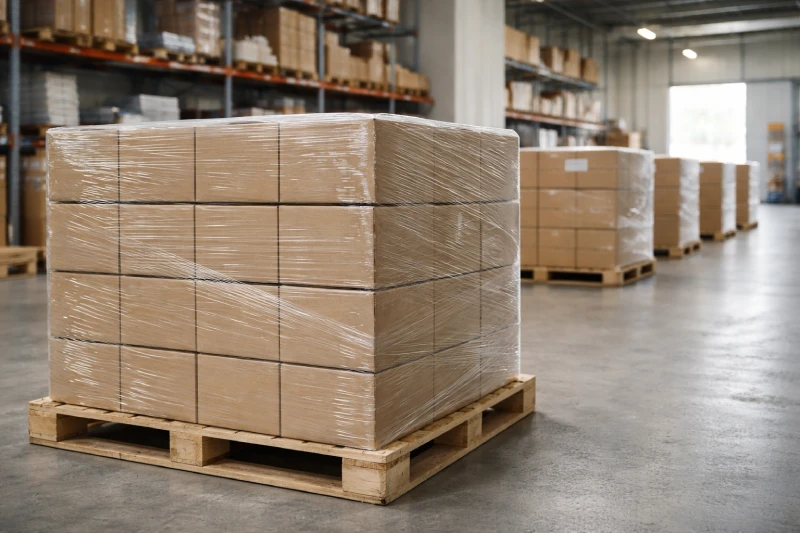
| Ready stock with logo print | Low | Short | Limited color choice |
| Semi-custom (stock fabric) | Medium | Moderate | Moderate |
| Fully custom production | Higher | Longer | Maximum control |
The right choice depends on brand positioning and project scale.
Key Questions Buyers Should Ask Manufacturers
A practical checklist before confirming order:
- What is the MOQ per color and per size?
- Is MOQ based on fabric lot or total order quantity?
- What is the confirmed production timeline?
- Does sampling time count within total lead time?
- What are peak season capacity constraints?
- Can partial shipment be arranged?
- Are there compliance testing requirements (for safety apparel)?
Clear communication at this stage prevents later timeline disruptions.
Seasonal and Category-Specific Considerations
Winter Products (Hoodies, Sweatshirts)
- Longer production time due to heavier fabric.
- Higher risk of peak season overload.
- Recommend earlier planning cycle.
Lightweight Apparel (T-Shirts, Polos)
- Faster production.
- Lower freight cost.
- Easier replenishment cycles.
Headwear & Caps
- Faster cutting and assembly.
- Embroidery capacity may affect schedule.
Workwear & Safety Apparel
- Additional compliance verification.
- Certification labeling requirements.
- Higher coordination complexity.
Understanding these category-specific differences helps buyers forecast more accurately.
Strategic Recommendations for Overseas B2B Buyers
- Finalize technical specifications early.
- Confirm MOQs before design freeze.
- Allow buffer time for sampling revisions.
- Plan logistics in parallel with production.
- Avoid last-minute winter hoodie orders during peak season.
- Balance MOQ savings against inventory risk.
- Request milestone production updates.
Structured planning reduces uncertainty and improves supply chain reliability.
Conclusion: Aligning MOQ and Lead Time With Your Project Goals
Managing lead time & MOQ considerations for custom hoodies — and other apparel categories — requires a systematic approach. MOQ is not simply a number; it reflects material allocation and production efficiency. Lead time is not a single date; it is a coordinated sequence of development, sourcing, and manufacturing steps.
Whether sourcing hoodies, caps, sportswear, or workwear, overseas buyers benefit from early planning, clear specifications, and realistic production scheduling.
If you are evaluating a custom apparel project across multiple categories, we welcome a discussion to review your volume expectations, customization requirements, and delivery timeline to determine the most suitable production structure for your needs.
Discuss Your Apparel Sourcing Requirements
Whether you're launching a startup clothing brand, expanding a streetwear label, or looking for a reliable OEM apparel manufacturer, speaking directly with an experienced production team can help you avoid costly sourcing mistakes.
Talk With Our Manufacturing Team