For overseas procurement teams sourcing custom hoodies and related apparel categories, selecting the right logo placement and printing options for hoodies is not simply a design decision. It affects brand visibility, production cost, decoration durability, compliance, and delivery timelines.
Whether you are sourcing hoodies for retail distribution, corporate uniforms, promotional campaigns, or safety projects, this guide provides a structured decision framework applicable across:
- Headwear & Caps
- T-Shirts & Polos
- Hoodies & Sweatshirts
- Sportswear & Activewear
- Workwear & Safety Apparel
1. Start With End-Use: Define the Functional Objective
Before selecting logo placement or printing methods, clarify the intended application.
Key Questions for Procurement Teams
- Is the garment for retail resale, corporate uniforms, or promotional distribution?
- Will it be used indoors, outdoors, or in industrial environments?
- Is the logo intended for high visibility or subtle branding?
- Are there regulatory or safety marking requirements?
- What is the expected garment lifecycle?
Category Considerations
| Category | Typical Branding Objective | Key Considerations |
|---|---|---|
| Hoodies & Sweatshirts | High-impact brand visibility | Large print areas, thicker fabrics |
| T-Shirts & Polos | Everyday brand presence | Fabric weight affects print absorption |
| Headwear & Caps | Front-facing logo dominance | Limited print area, curvature issues |
| Sportswear & Activewear | Performance branding | Stretch compatibility |
| Workwear & Safety Apparel | Identification & compliance | Reflective / durable markings |
Hoodies, due to heavier fabrics and larger surface areas, allow for more flexible logo placement compared to caps or fitted activewear.
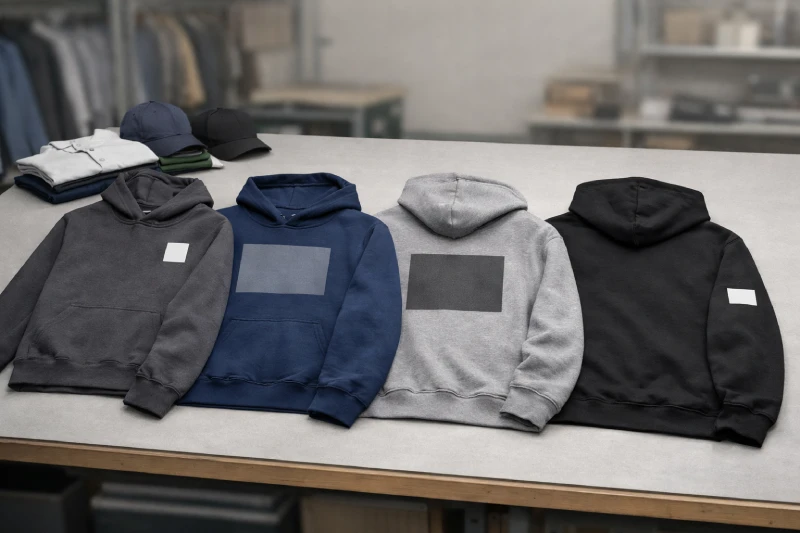
2. Common Logo Placement Options for Hoodies
Understanding placement zones is essential when planning bulk custom hoodie production.
Front Chest (Center or Left Chest)
- Most common for corporate uniforms
- Suitable for embroidery, screen printing, or heat transfer
- Balanced visibility without overpowering the garment
Best for: Corporate buyers, distributors, event merchandise.
Full Front Print
- Large brand statement
- Typically screen printed or DTG
- Higher ink usage → affects cost in bulk orders
Best for: Retail brands, promotional campaigns.
Back Print (Upper Back or Full Back)
- Often combined with small chest logo
- Ideal for event identification or team branding
Best for: Project contractors, sports teams, corporate events.
Sleeve Print or Embroidery
- Secondary branding area
- Good for subtle brand reinforcement
- Limited size area
Hood or Side Panel Placement
- Unique placement option
- Requires precision in production alignment
- Slightly higher complexity in bulk manufacturing
3. Comparing Printing & Decoration Methods
Selecting the appropriate decoration method impacts durability, MOQ, and lead time.
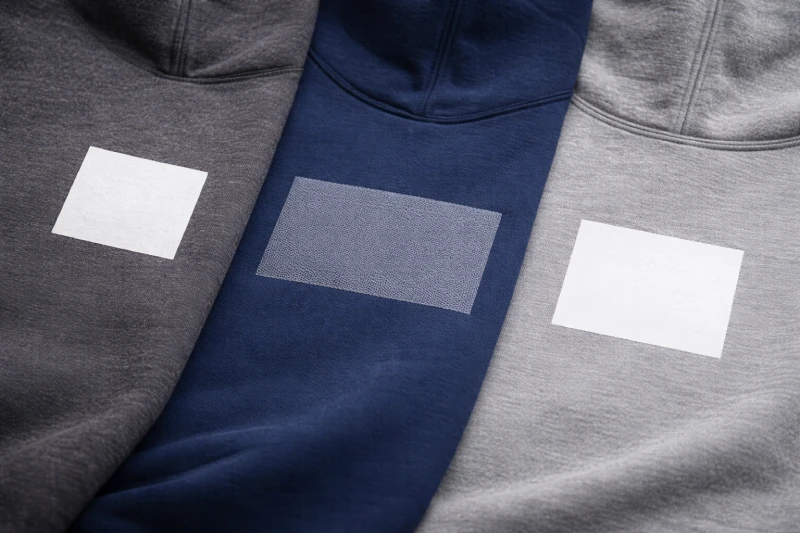
Overview Comparison Table
| Method | Suitable For | MOQ Impact | Durability | Cost Efficiency in Bulk |
|---|---|---|---|---|
| Screen Printing | Large orders | High setup | High | Very efficient |
| Embroidery | Premium branding | Moderate | Very high | Mid-range |
| Heat Transfer | Complex logos | Low–medium | Moderate | Flexible |
| DTG (Direct-to-Garment) | Multi-color artwork | Low | Moderate | Small runs |
| Reflective Printing | Safety apparel | Moderate | High | Project-based |
Screen Printing
- Ideal for large-volume hoodie orders
- Strong color opacity on fleece and heavyweight cotton
- Setup costs spread across high quantities
Best for: Distributors and retail brands placing bulk orders.
Embroidery
- Adds perceived value and durability
- Suitable for chest logos on hoodies and polos
- Thickness of hoodie fabric supports stable stitching
Category difference:
On caps, embroidery is often primary method due to structured panels. On activewear, embroidery may affect stretch performance.
Heat Transfer & Vinyl
- Flexible for multi-color logos
- Good for lower MOQ projects
- Suitable for sportswear and lightweight fabrics
Consideration: On fleece hoodies, adhesion quality depends on fabric composition.
DTG Printing
- Suitable for detailed artwork
- Works best on cotton-based hoodies
- More efficient for small batch custom orders
Not typically recommended for high-volume distributor projects due to slower production speeds.
4. Fabric Type & Its Impact on Logo Printing
Fabric composition directly influences printing compatibility.
Hoodie Fabric Examples
- 100% Cotton Fleece
- Cotton/Polyester Blends
- Performance Polyester
- Brushed Interior Sweatshirt Fabric
Fabric vs Decoration Compatibility
| Fabric Type | Screen Print | Embroidery | Heat Transfer | DTG |
|---|---|---|---|---|
| 100% Cotton | Excellent | Excellent | Good | Excellent |
| Cotton Blend | Very Good | Excellent | Good | Good |
| Polyester | Good | Good | Excellent | Limited |
| Stretch Performance | Limited | Caution | Good | Limited |
For sportswear & activewear, stretch recovery must be considered before selecting heavy ink prints.
For workwear & safety apparel, reflective transfers or high-durability prints are often required.
5. Bulk Order Considerations: MOQ, Cost Structure & Lead Time
Logo placement and printing methods directly influence production planning.
MOQ Implications
- Screen printing requires higher MOQs due to setup.
- Embroidery can support medium MOQs.
- DTG or heat transfer allow lower MOQs but higher per-unit costs.
For multi-category projects (e.g., hoodies + caps + polos), decoration consistency must be evaluated across different materials.
Cost Drivers in Logo Customization
- Number of print locations
- Number of colors
- Logo size
- Fabric type
- Packaging requirements
Example: A hoodie with chest + back + sleeve prints significantly increases production time compared to single-placement embroidery.
Lead Time Factors
| Factor | Impact on Timeline |
|---|---|
| Artwork complexity | Pre-production sampling |
| Pantone color matching | Dye and ink adjustment |
| Multiple decoration methods | Additional workflow |
| Large volume orders | Extended production scheduling |
Standard bulk production lead time for customized hoodies typically ranges between 20–35 days depending on order size and complexity.
6. Cross-Category Differences Buyers Should Consider
When sourcing across multiple apparel categories, decoration logic changes.
Caps vs Hoodies
- Caps have limited flat surface areas.
- Embroidery is dominant on structured caps.
- Printing curved surfaces requires specialized equipment.
Activewear vs Sweatshirts
- Activewear fabrics stretch.
- Heavy ink prints may crack under tension.
- Heat transfer methods are often preferred.
Workwear & Safety Apparel
- May require:
- Reflective logos
- High-visibility standards
- Compliance labeling
- Durability under industrial washing must be tested.
7. Quality Control & Sampling Process
Before confirming bulk production, B2B buyers should request:
Pre-Production Checklist
- Digital mockup approval
- Physical sample with correct placement
- Color matching confirmation
- Wash test verification (if required)
- Measurement tolerance confirmation
Sampling ensures alignment between brand guidelines and manufacturing capability.
8. Decision Framework for Procurement Teams
When evaluating logo placement and printing options for hoodies, use this structured approach:
Step 1: Define Objective
Brand visibility vs subtle uniform identification.
Step 2: Select Placement
Chest, back, sleeve, or combination.
Step 3: Match Decoration Method to Fabric
Consider durability, stretch, and finish.
Step 4: Evaluate Volume Strategy
Balance MOQ with cost efficiency.
Step 5: Confirm Lead Time Alignment
Coordinate with campaign or delivery deadlines.
9. Risk Mitigation in Overseas Manufacturing
For international B2B buyers, additional considerations include:
- Clear technical artwork files (vector format preferred)
- Standardized measurement references
- Consistent logo scaling across garment sizes
- Packaging and labeling requirements
- Intellectual property protection
A structured communication process minimizes delays and quality inconsistencies.
10. Final Considerations for Large-Scale Apparel Programs
For distributors, corporate buyers, and contractors managing multi-category sourcing programs:
- Standardize logo size ratios across categories.
- Align color matching standards (Pantone reference).
- Plan phased delivery if combining hoodies with other apparel types.
- Consolidate decoration methods where possible to optimize cost.
Consistency across hoodies, caps, polos, and safety apparel strengthens brand presentation and simplifies supply chain coordination.
Conclusion: Align Logo Strategy With Production Reality
Selecting the right logo placement and printing options for hoodies requires balancing design intent, fabric compatibility, bulk production efficiency, and long-term durability.
For overseas B2B buyers managing apparel programs across multiple categories, a structured approach ensures cost control, brand consistency, and timely delivery.
If you are planning a custom hoodie or multi-category apparel project, our technical team can review your artwork, intended application, and volume requirements to provide practical manufacturing guidance tailored to your program objectives.
We welcome the opportunity to discuss your project specifications and support your sourcing strategy.
Discuss Your Apparel Sourcing Requirements
Whether you're launching a startup clothing brand, expanding a streetwear label, or looking for a reliable OEM apparel manufacturer, speaking directly with an experienced production team can help you avoid costly sourcing mistakes.
Talk With Our Manufacturing Team