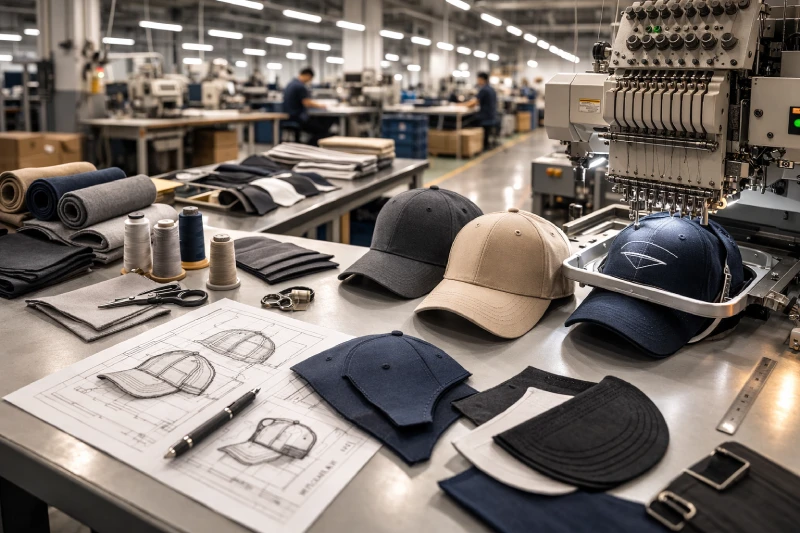
MOQ & Lead Time Guide for Custom Caps Manufacturing
For overseas B2B buyers, understanding MOQ (Minimum Order Quantity) and lead time is essential when planning custom headwear programs. Whether you are sourcing promotional caps, retail collections, corporate uniforms, or distributor inventory, MOQ and production timelines directly affect pricing, inventory strategy, and go-to-market schedules.
Although this guide focuses on custom caps manufacturing, the decision logic applies across multiple apparel categories such as T-shirts, hoodies, sportswear, and workwear. The goal is to help procurement managers and brand owners make structured, risk-aware sourcing decisions.
Understanding MOQ in Custom Caps Manufacturing
What Does MOQ Mean in a B2B Context?
In custom caps manufacturing, MOQ refers to the minimum production quantity required per style, color, or customization configuration. Unlike retail purchasing, MOQ is not arbitrary — it is influenced by:
- Material procurement thresholds
- Fabric dye lot requirements
- Decoration setup costs
- Production line efficiency
- Packaging and logistics batching
MOQ is typically calculated per design per color, and in some cases, per size run (if applicable).
Why Caps Often Have Different MOQ Structures Than Garments
Caps differ structurally from garments such as T-shirts or hoodies in several ways:
| Factor | Caps | Garments (T-Shirts, Hoodies, Workwear) |
|---|---|---|
| Size Variability | Usually one size (adjustable) | Multi-size grading required |
| Structural Components | Panels, visor, inner sweatband | Full garment cutting & sewing |
| Decoration Area | Smaller but often structured | Larger print zones |
| Pattern Complexity | 5-panel, 6-panel, curved/flat brim | Simpler body blocks but more fabric consumption |
| Inventory Risk | Lower due to one-size format | Higher due to size mix |
Because caps typically have a single size, MOQ may be lower per style compared to garments that require full size ratios (S–XXL). However, structured caps with embroidery may require higher MOQ due to decoration setup costs.
Key Factors That Influence MOQ
MOQ in custom caps manufacturing is not fixed across projects. It varies depending on:
1. Fabric Type and Color Customization
- Stock fabrics → Lower MOQ
- Custom-dyed fabrics → Higher MOQ (due to dye lot minimums)
- Technical or performance fabrics → Often higher thresholds
For example:
- Cotton twill stock colors: Lower entry quantity
- Custom pantone fabric dyeing: Requires bulk yardage
This logic also applies across T-shirts, sportswear, and workwear.
2. Decoration Method
Decoration significantly impacts MOQ.
| Decoration Method | MOQ Impact | Reason |
|---|---|---|
| Flat embroidery | Medium | Digitizing + machine setup |
| 3D embroidery | Higher | Foam setup + machine time |
| Screen printing | Medium to high | Screen plate cost |
| Heat transfer | Lower | Flexible setup |
| Woven patch | Higher | Patch production minimum |
Structured embroidery on caps may require higher minimums than basic chest print on T-shirts.
3. Custom Components
Fully custom caps (custom visor shape, metal buckle, custom lining print) increase complexity.
If your project includes:
- Custom trims
- Custom labels
- Private packaging
- Retail hangtags
MOQ may increase to justify component production.
4. Category Differences in MOQ Expectations
Different apparel categories follow different MOQ logic:
| Category | Typical MOQ Sensitivity | Notes |
|---|---|---|
| Headwear & Caps | Medium | Influenced by embroidery setup |
| T-Shirts & Polos | Lower | Easier to scale due to standard body blocks |
| Hoodies & Sweatshirts | Medium to high | Higher fabric consumption |
| Sportswear & Activewear | Higher | Performance fabrics, compression patterns |
| Workwear & Safety Apparel | Higher | Compliance requirements + special materials |
Buyers should align MOQ expectations with product complexity and compliance requirements.
Understanding Lead Time in Custom Caps Manufacturing
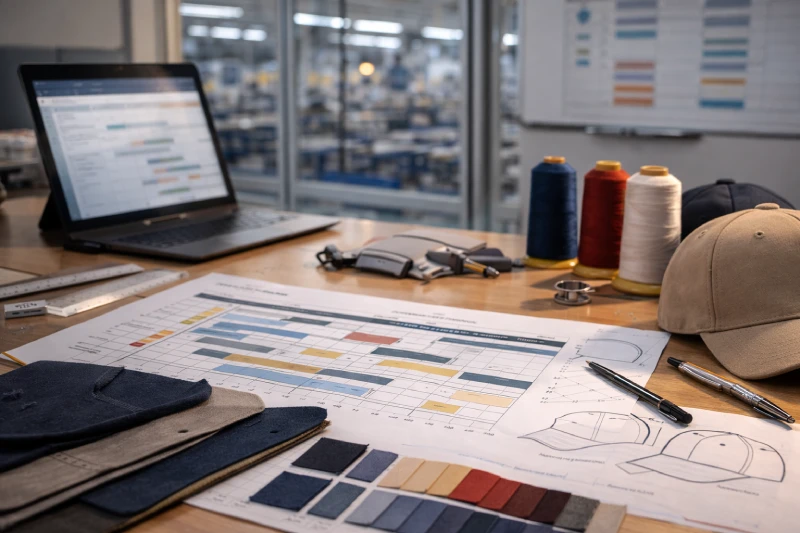
Lead time consists of multiple phases. Buyers often focus only on production days, but total project timeline includes:
- Sampling
- Material sourcing
- Production
- Quality inspection
- Packaging
- International shipping
Standard Lead Time Structure
| Phase | Typical Duration |
|---|---|
| Development & Sampling | 7–14 days |
| Bulk Material Preparation | 5–10 days |
| Production | 20–35 days |
| Final Inspection & Packing | 3–7 days |
| Export & Shipping | Depends on Incoterms |
For fully customized caps, total project cycle may range between 30–60 days, depending on complexity.
What Causes Lead Time Variations?
1. Level of Customization
Stock blank caps with logo embroidery move faster than:
- Fully custom panel structures
- Performance sports caps with moisture-wicking fabric
- Safety caps requiring reflective or compliance features
2. Order Quantity
Higher volumes may extend production days but reduce per-unit cost. Smaller trial runs may move faster if materials are readily available.
3. Seasonality
Peak seasons (Q3–Q4 for retail and promotional programs) can extend lead times.
Planning 60–90 days in advance is recommended for large programs.
4. Compliance & Testing (For Workwear Categories)
For safety-related products:
- Reflective tape certification
- Fabric flame resistance testing
- ANSI/EN compliance
These add additional pre-shipment timelines.
Caps generally face fewer regulatory requirements compared to safety apparel.
MOQ & Lead Time Decision Framework for B2B Buyers
Before placing a bulk order, overseas buyers should evaluate:
Step 1: Define Project Objective
- Promotional campaign?
- Retail seasonal collection?
- Corporate uniform?
- Long-term distributor inventory?
Short-term promotions may require faster turnaround, favoring stock-based solutions.
Step 2: Evaluate Customization Depth
| Customization Level | Recommended Strategy |
|---|---|
| Basic logo embroidery | Lower MOQ, shorter lead time |
| Multi-color embroidery | Medium MOQ |
| Fully custom cap body | Higher MOQ + longer development |
| Performance technical fabric | Longer sourcing time |
Step 3: Balance MOQ vs Inventory Risk
Lower MOQ:
- Higher per-unit cost
- Lower inventory exposure
Higher MOQ:
- Lower unit price
- Higher upfront commitment
Procurement managers should calculate:
- Forecast demand
- Reorder cycle
- Storage capacity
- Cash flow allocation
Cross-Category Comparison: Caps vs Apparel Garments
| Consideration | Caps | T-Shirts | Hoodies | Sportswear | Workwear |
|---|---|---|---|---|---|
| Size Complexity | Low | Medium | Medium | High | High |
| Fabric Usage | Low | Medium | High | Medium | High |
| Decoration Setup Cost | High (Embroidery) | Medium | Medium | Medium | Medium |
| Compliance Requirements | Low | Low | Low | Medium | High |
| Typical Lead Time | 30–45 days | 25–40 days | 30–50 days | 35–60 days | 45–70 days |
Caps often provide a lower complexity entry point for brand trials compared to multi-size garment programs.
Checklist Before Confirming MOQ & Lead Time
Before issuing a purchase order, ensure:
Product Specification
- Final artwork files confirmed
- Pantone references approved
- Material confirmed
- Decoration technique finalized
Sampling
- Pre-production sample approved
- Fit and structure confirmed
- Embroidery placement validated
Production Planning
- Production slot secured
- Shipping method decided (Air / Sea / Express)
- Incoterms clarified
Risk Management
- Buffer time included for delays
- Peak season adjustments considered
- Inspection protocol agreed
Strategies to Optimize MOQ & Lead Time
1. Use Core Materials
Selecting standard fabrics and trims reduces sourcing delays.
2. Consolidate Styles
Instead of multiple small orders:
- Consolidate colorways
- Align logo variations
- Standardize packaging
This improves factory efficiency.
3. Plan Rolling Orders
For distributors and uniform programs:
- Establish forecast-based rolling production
- Negotiate stable MOQ over long-term agreements
4. Consider Mixed Category Bundling
If sourcing:
- Caps + T-shirts
- Hoodies + Sportswear
Combining programs under one manufacturer can optimize production scheduling and logistics.
Frequently Asked Considerations from Overseas Buyers
Q: Can MOQ be negotiated?
MOQ is influenced by production efficiency and material thresholds. Flexibility depends on project scope and long-term cooperation.
Q: Can urgent orders be accelerated?
Rush production may be possible if materials are in stock and capacity allows, but this must be confirmed before artwork approval.
Q: Is sampling time included in lead time?
Sampling is typically separate and should be factored into total project planning.
Final Thoughts: Structuring Your Custom Caps Manufacturing Plan
MOQ & lead time decisions in custom caps manufacturing should not be viewed in isolation. They are interconnected with:
- Customization depth
- Budget planning
- Forecast accuracy
- Inventory strategy
- Compliance requirements
Compared to multi-size garment categories, caps offer structural simplicity but may involve higher embroidery setup considerations.
For overseas procurement teams, the most effective approach is early alignment between:
- Product specification
- Forecast volume
- Launch timeline
- Decoration method
Discuss Your Project Requirements
Every custom caps project differs in scope, customization level, and production urgency. If you are planning a promotional program, retail collection, corporate uniform rollout, or distributor order, it is advisable to review MOQ structure and realistic lead time before finalizing artwork.
Our production team supports multi-category apparel manufacturing, including headwear, T-shirts, hoodies, sportswear, and workwear programs. We welcome discussions about your project specifications, forecast volume, and delivery timeline to help you structure a practical and scalable sourcing plan.
Discuss Your Apparel Sourcing Requirements
Whether you're launching a startup clothing brand, expanding a streetwear label, or looking for a reliable OEM apparel manufacturer, speaking directly with an experienced production team can help you avoid costly sourcing mistakes.
Talk With Our Manufacturing Team