

Introduction: Why Pretreatment Becomes Critical in DTG Printing
Direct-to-Garment (DTG) printing is a digital decoration method that sprays water-based pigment ink directly onto fabric using inkjet technology. It allows for high-resolution, full-color artwork with minimal setup compared to screen printing. On light-colored garments, the process is relatively straightforward: the ink is absorbed into the cotton fibers, cured with heat, and the print becomes part of the fabric surface.
However, the situation changes significantly when it comes to DTG printing on dark shirts. Unlike white or pastel garments, dark fabrics require a white ink underbase to make colors appear vibrant and opaque. Without that foundation, printed colors look dull, muted, or even invisible against black or navy backgrounds.
This is where the question arises: do you really need pretreated shirts for DTG printing?
For light garments, pretreatment may be optional depending on the desired quality. But for dark garments, pretreatment is often the determining factor between a professional, durable print and a faded, cracked result after washing.
In this article, we will explain—at a manufacturing level—what pretreated shirts for DTG printing actually are, how the chemistry works, why dark garments require surface preparation, and how pretreatment impacts cost, durability, and production control.
What Are Pretreated Shirts for DTG Printing?
What “Pretreatment” Actually Means
Pretreatment refers to the application of a water-based chemical solution onto the fabric surface before DTG printing begins. This solution is sprayed evenly across the print area, then dried and heat-cured to prepare the fibers for ink bonding.
Importantly, pretreatment is not part of the printing itself. It does not add color or design. Instead, it modifies the surface chemistry of the fabric—particularly cotton—so that DTG inks, especially white pigment ink, can properly adhere and remain stable during curing and washing.
The pretreatment solution typically contains binders and adhesion promoters. When heat-pressed or tunnel-dried, these components create a thin polymer layer on the fabric surface. This layer helps control ink spread, improves opacity, and increases wash durability—especially critical for dtg printing on dark shirts where a white underbase is required.
Factory Pretreatment vs Buying Pretreated Blanks
There are several ways shirts become “pretreated.”
- Manual spray application – An operator sprays the solution using a handheld sprayer. This method works for small batches but can lead to uneven coverage.
- Automatic pretreatment machines – These systems control spray density, volume, and uniformity, making them more suitable for bulk production.
- Pre-coated wholesale blanks – Some suppliers sell pretreated shirts ready for printing, reducing setup time for small brands.
However, pretreatment ≠ printing. It is a controlled surface preparation step that directly impacts ink adhesion, white opacity, and long-term durability. For professional-grade pretreated shirts for DTG printing, consistency in application and curing is what ultimately determines print quality.
Why DTG Printing on Dark Shirts Requires Pretreatment
The Role of White Underbase in DTG Printing
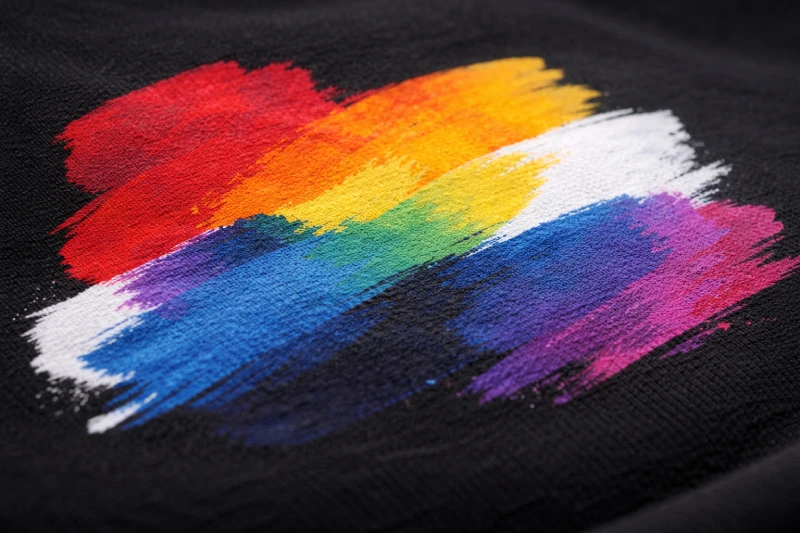
When performing DTG printing on dark shirts, the printer does not simply spray CMYK colors directly onto the fabric. Instead, it first lays down a white ink underbase. This white layer acts as a foundation, allowing the subsequent color layers to appear bright and accurate.
A useful comparison is painting a wall. If you apply colored paint directly onto a dark surface without primer, the color appears muted and inconsistent. The white underbase in DTG printing serves as that primer. It creates a neutral platform so that reds remain red, blues stay vibrant, and fine details are preserved.
However, white ink behaves very differently from standard colored ink. It contains higher pigment density and sits more on the fabric surface rather than soaking deeply into fibers. Without proper surface preparation, it cannot anchor effectively.
Why Cotton Fibers Alone Cannot Hold White Ink
Cotton is naturally porous and absorbent. Through capillary action, liquid ink is drawn into the fiber structure. While this works reasonably well for light garments where no white layer is required, it becomes problematic when printing on dark fabrics.
If white ink is applied directly onto untreated cotton:
- The fibers absorb moisture unevenly
- Pigment particles disperse inconsistently
- Surface bonding remains weak
Instead of forming a smooth, opaque layer, the ink sinks into the fabric. The result is reduced opacity and uneven texture.
Pretreatment changes this interaction. It reduces uncontrolled absorption and encourages surface-level bonding rather than deep penetration. This allows the white underbase to sit evenly on top of the fabric.
What Happens Without Pretreatment
Skipping pretreatment on dark garments typically leads to several issues:
- Faded or grayish white underbase
- Ink migration into fibers
- Reduced color vibrancy
- Poor wash durability
- Cracking after curing
In production environments, most DTG failures occur on dark garments precisely because pretreatment was insufficient or inconsistent.
For manufacturers and brands seeking reliable results, pretreatment is not an optional enhancement—it is a structural requirement for stable, professional dtg printing on dark shirts.
The Chemistry Behind Cotton Pretreatment
How Pretreatment Affects Fiber Surface
To understand why pretreatment works, we need to look at fiber-level interaction. Cotton fibers are naturally hydrophilic, meaning they attract water. DTG inks are water-based, so without modification, they are pulled into the fiber structure through capillary action.
Pretreatment introduces a polymer-based binder layer onto the surface of the cotton. After drying and heat curing, this binder forms a thin film that partially seals the outer fiber structure. It does not coat the fabric like plastic, but it changes the surface tension and chemical bonding behavior.
This polymer layer performs three critical functions:
- Improves pigment adhesion by giving white ink particles something to bond to
- Controls ink spread, preventing bleeding and excessive absorption
- Enhances opacity, especially for the white underbase
Instead of the ink disappearing into the fabric, it remains closer to the surface—where color vibrancy and detail retention are strongest.
Moisture Content & Humidity Impact
Pretreatment is highly sensitive to moisture balance. Over-wetting the garment during application can cause uneven absorption and visible staining after curing. Under-application, on the other hand, results in weak ink anchoring.
Environmental humidity also plays a role. High humidity slows drying time and can create inconsistent curing results. Uneven moisture distribution often leads to patchy white underbases—one of the most common quality issues in DTG production.
Professional manufacturers monitor:
- Spray volume per square meter
- Drying time before printing
- Ambient humidity levels
These variables directly influence print consistency.
Curing Temperature and Pressing Pressure
After pretreatment is applied, it must be heat-cured—typically between 160–170°C (320–338°F). Proper curing activates the binder and stabilizes the surface chemistry.
Under-curing can leave the polymer unstable, reducing wash durability. Over-curing may scorch fibers, stiffen the fabric surface, or cause discoloration—especially on black shirts.
Pressing pressure during heat curing also matters. Excessive pressure can flatten fiber structure too aggressively, affecting texture and breathability.
At a manufacturing level, pretreatment is not simply “spray and print.” It is a calibrated chemical preparation process that determines whether DTG printing on dark shirts performs reliably over time.
DTG Printing on Black Shirts vs Light Shirts
From a production standpoint, the difference between printing on light garments and dark garments is not cosmetic—it is structural. The technical workflow, ink behavior, and failure risk all increase significantly when moving from white to black shirts.
Below is a simplified comparison:
| Factor | Light Shirt | Dark Shirt |
|---|---|---|
| White underbase | Not required | Required |
| Pretreatment | Optional (in many cases) | Mandatory |
| Ink volume | Lower | Higher |
| Production cost | Lower | Higher |
On light shirts, DTG ink absorbs naturally into cotton fibers. Since there is no need for a white underbase, the print process involves fewer ink layers, shorter print time, and reduced curing complexity. Even if pretreatment is skipped, the print may still appear acceptable for basic promotional use.
In contrast, DTG printing on dark shirts requires a carefully built white base layer before color application. This doubles the ink workload and increases sensitivity to surface preparation. Any inconsistency in pretreatment immediately becomes visible—patchy whites, dull colors, or poor adhesion.
Black shirts, in particular, amplify technical risk because:
- They expose opacity weaknesses in white ink
- They highlight uneven pretreatment application
- They require higher ink density and longer curing
This is why most DTG quality failures occur on dark garments rather than white ones. The margin for error becomes much smaller.
For brands aiming for retail-grade durability and vibrant color output, dark garment production demands controlled pretreatment and disciplined process management.
Cost Impact: How Much Does Pretreatment Add Per Shirt?
For B2B buyers and apparel brands, one of the most practical questions is cost. While pretreatment improves print stability, it also adds measurable production expense. Understanding this breakdown helps evaluate whether pretreated shirts for DTG printing make financial sense for your product line.
In a standard production environment, pretreatment adds cost through several components:
1. Chemical Solution Cost
The pretreatment liquid itself has a direct material cost. Depending on concentration and regional sourcing, this typically adds a small per-unit expense.
2. Labor Time
Manual spray application requires operator time. Even with automatic pretreatment machines, there is machine setup, garment loading, and quality verification.
3. Drying and Curing Process
After application, garments must be heat-cured—either via heat press or tunnel dryer. This step consumes additional energy and increases production cycle time.
4. Energy Consumption
Heating to 160–170°C requires electricity or gas. In high-volume runs, this becomes a noticeable operating cost.
5. Quality Control & Rejection Rate
Improper pretreatment can lead to uneven prints, meaning rejected units. Manufacturers often factor a small loss percentage into pricing.
On average, pretreatment adds approximately $0.20–$0.60 per shirt, depending on production scale, automation level, and labor costs in the region.
While this may appear minor, in bulk orders of thousands of units, it becomes a meaningful budget consideration. However, for DTG printing on dark shirts, skipping pretreatment often results in higher defect rates and reduced durability—costs that can exceed the savings from avoiding the process.
From a manufacturing perspective, pretreatment is both a quality investment and a controlled cost variable.
Production Control: How Manufacturers Ensure Consistency
In professional DTG environments, pretreatment is not handled casually. Because dtg printing on dark shirts is highly sensitive to surface preparation, manufacturers implement standardized control systems to reduce variability and defect rates.
Automatic Pretreatment Machines
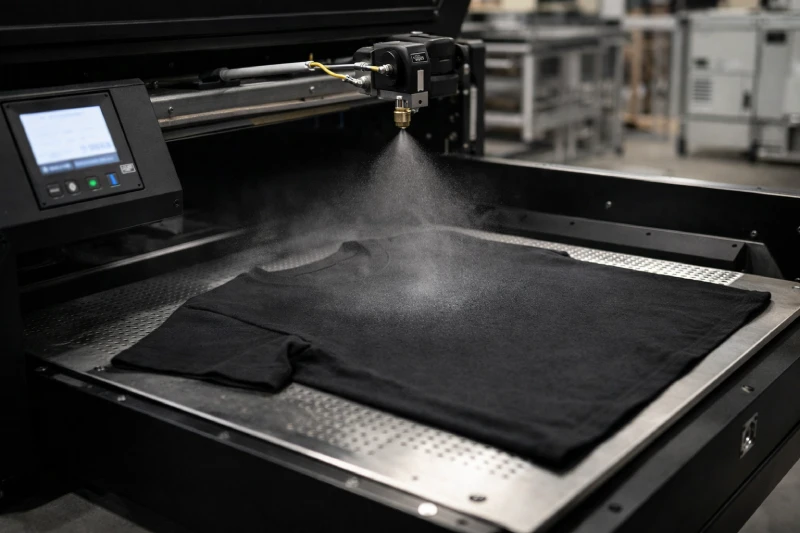
Large-scale factories typically use automatic pretreatment machines instead of manual spray guns. These systems offer:
- Controlled spray density
- Measured liquid volume per print area
- Even horizontal coverage
- Adjustable settings for different fabric weights
By calibrating the exact milliliters applied per square meter, manufacturers eliminate the inconsistency common in manual application. Uniform pretreatment directly translates to consistent white underbase opacity and improved wash durability.
Standardized Drying Process
After spraying, garments must be dried before printing. Two common methods are:
- Heat press pre-drying – Suitable for small batches
- Tunnel dryer systems – Used in bulk production for continuous processing
Tunnel dryers offer better temperature stability and airflow consistency, reducing the risk of under-cured or over-cured surfaces. Maintaining the correct curing window ensures the polymer binder activates properly without scorching the fabric.
QC Testing Before Bulk Production
Before full-scale production begins, responsible manufacturers conduct validation checks such as:
- Sample wash testing
- Ink adhesion testing
- White opacity comparison
- Surface smoothness inspection
These tests confirm that the pretreatment parameters are correctly calibrated.
From a factory perspective, pretreated shirts for DTG printing are not just sprayed garments—they are controlled substrates engineered for predictable ink performance. Consistency at this stage determines whether bulk production achieves retail-grade quality or faces costly rework.
When Do You Actually Need Pretreated Shirts? (Decision Guide)
Not every DTG project requires the same level of preparation. The need for pretreated shirts for DTG printing depends on garment color, product positioning, and quality expectations. Below is a practical decision framework used in production environments.
You Need Pretreatment If:
- Printing on black or dark garments
Dark fabrics require a white underbase. Without pretreatment, white ink cannot anchor properly, leading to dull or unstable prints. - High color vibrancy is required
Retail-quality graphics with strong opacity and sharp detail depend on controlled surface bonding. - You are selling premium or branded products
If your garments are intended for resale, brand reputation depends on wash durability and consistent appearance. - You expect long-term wash resistance
Pretreatment significantly improves pigment adhesion, reducing fading and cracking.
Pretreatment May Be Optional If:
- Printing on white or very light shirts
Since no white underbase is needed, ink can absorb directly into cotton fibers with acceptable results. - A vintage or faded aesthetic is desired
Some fashion styles intentionally embrace softer, washed-down prints. - Producing low-cost promotional items
For short-term use or event giveaways, durability standards may be lower.
However, even when technically optional, skipping pretreatment increases variability. In professional manufacturing, most serious brands choose controlled pretreatment to minimize risk—especially when producing DTG printing on dark shirts at scale.
Common Mistakes in DTG Printing on Dark Shirts
Even when pretreatment is used, improper handling can still lead to print failures. In fact, many quality complaints in DTG printing on dark shirts are caused not by the printer itself, but by surface preparation errors.
Below are the most common production mistakes:
Over-Spraying Pretreatment
Applying too much solution saturates the fabric. This can cause visible staining, uneven white opacity, and a stiff hand feel after curing. Excess moisture also increases drying time and may trap steam during heat pressing.
Uneven Application
Inconsistent spray coverage leads to patchy white underbases. Areas with insufficient pretreatment show dull or grayish whites, while over-treated areas may appear overly glossy.
Poor Curing Control
Under-curing prevents the polymer binder from fully activating, reducing wash durability. Over-curing can scorch fibers or create discoloration—especially noticeable on black shirts.
High Humidity Environment
Excessive ambient humidity interferes with drying consistency. Moisture imbalance can cause unpredictable ink behavior and surface defects.
Using Low-GSM or Low-Quality Cotton
Thin fabrics with loose fiber structure provide less stable bonding surfaces. Lower-GSM shirts are more prone to ink migration and cracking after repeated washing.
From a manufacturing perspective, pretreatment is only effective when applied with precision. Controlling spray volume, drying parameters, and environmental conditions is essential for producing stable, retail-grade pretreated shirts for DTG printing.
Should Brands Source Pretreated Blanks or Let the Factory Handle It?
For brands entering DTG production, another strategic decision arises: should you purchase pretreated blank garments in advance, or allow the printing factory to manage pretreatment in-house?
Both approaches have advantages and trade-offs.
| Option | Advantage | Risk |
|---|---|---|
| Pretreated blanks | Faster setup, simplified workflow | Shelf-life limitations, surface degradation over time |
| Factory pretreatment | Better process control, adjusted per fabric | Slightly longer lead time |
Pretreated Blanks
Some wholesale suppliers offer ready-to-print garments labeled as pretreated shirts for DTG printing. This can reduce setup time, especially for small brands or print-on-demand operations.
However, pretreatment has a shelf-life. Exposure to humidity, dust, or improper storage can degrade the treated surface. If blanks sit too long before printing, ink adhesion may weaken, leading to inconsistent results.
Factory-Controlled Pretreatment
Allowing the factory to apply pretreatment immediately before printing offers stronger quality control. Parameters such as spray volume, fabric type, humidity, and curing temperature can be calibrated for each batch.
For bulk brands or premium retail products, factory-controlled pretreatment typically delivers more stable performance—especially for DTG printing on dark shirts, where precision is critical.
In large-scale production, maintaining control over surface preparation often outweighs the minor increase in lead time.
FAQs
Do you need pretreated shirts for DTG printing?
It depends on the garment color and quality expectations. For white or very light shirts, pretreatment may be optional in basic applications. However, for DTG printing on dark shirts, pretreatment is essential to ensure white opacity, color vibrancy, and wash durability.
Can you print DTG on black shirts without pretreatment?
Technically, yes—but the results are usually unacceptable for retail use. Without pretreatment, the white underbase absorbs into cotton fibers, appearing gray and uneven. Durability also decreases significantly after washing.
How long does pretreatment last on blank shirts?
Pretreated garments have a limited effective window. Depending on storage conditions (humidity, temperature, exposure to dust), surface performance may decline over time. Many manufacturers recommend printing within days or weeks rather than long-term storage.
Does pretreatment affect fabric feel?
When properly applied and cured, pretreatment should not dramatically stiffen the fabric. Over-application, however, can create a slightly rigid or textured feel in the print area. Controlled spray volume prevents this issue.
How much does pretreatment cost per shirt?
On average, pretreatment adds approximately $0.20–$0.60 per unit, depending on scale, automation, and regional labor costs. The cost includes chemicals, labor, energy, and quality control.
Is pretreatment required for white shirts?
Not always. Since white shirts do not require a white underbase, ink can bond directly to cotton fibers with acceptable results. However, for higher durability standards, some manufacturers still apply light pretreatment for consistency.
Discuss Your Apparel Sourcing Requirements
Whether you're launching a startup clothing brand, expanding a streetwear label, or looking for a reliable OEM apparel manufacturer, speaking directly with an experienced production team can help you avoid costly sourcing mistakes.
Talk With Our Manufacturing Team