
Introduction
Private label clothing allows brands to launch apparel products without owning manufacturing facilities. Instead of producing garments themselves, brands collaborate with specialized apparel manufacturers that handle the technical aspects of garment production. This model enables fashion startups, ecommerce clothing businesses, and boutique brands to focus on product design, branding, and marketing while relying on experienced manufacturers for production.
However, private label clothing manufacturing is not a single step. It is a structured process that typically includes product concept planning, fabric sourcing, sample development, branding customization, bulk production, quality control, and final delivery.
Understanding how private label clothing is manufactured helps brands communicate more effectively with suppliers, make better production decisions, and avoid costly mistakes during development and manufacturing.
In this guide, we will explain the real private label clothing manufacturing process used by apparel factories, from initial concept to finished garments ready for market.
What Is Private Label Clothing Manufacturing?
Private label clothing manufacturing is a production model in which an apparel manufacturer produces garments for a brand that sells the products under its own label. The manufacturer is responsible for sourcing materials, producing garments, and managing the technical aspects of production, while the brand controls product design, branding, and marketing.
In this arrangement, clothing brands do not need to operate their own factories. Instead, they collaborate with experienced apparel manufacturers that have the equipment, skilled workers, and production systems required to manufacture garments at scale.
The relationship between brands and manufacturers is typically collaborative. Brands provide product ideas, design references, and branding requirements, while manufacturers translate those ideas into finished garments through pattern making, sampling, and bulk production.
Private label clothing manufacturing is widely used by many types of businesses, including startup fashion brands, ecommerce clothing stores, boutique labels, and companies launching custom apparel collections.
Because production is handled by specialized manufacturers, brands can focus on building their identity, marketing their products, and growing their business.
OEM vs Private Label vs White Label Clothing Manufacturing
Different apparel manufacturing models offer varying levels of customization and brand control. Understanding these differences helps clothing brands choose the most suitable production model.
| Manufacturing Model | Product Design Responsibility | Branding Control | Customization Level | Typical Use Case |
|---|---|---|---|---|
| OEM (Original Equipment Manufacturer) | Brand provides full product design | Full brand ownership | Very high customization | Established fashion brands with detailed product specifications |
| Private Label | Manufacturer provides base product structure; brand customizes design and branding | Brand sells products under its own label | Medium to high customization | Startup brands, ecommerce clothing businesses |
| White Label | Manufacturer provides ready-made products | Minimal customization | Low customization | Retailers selling generic apparel under their brand |
Key Differences
- OEM manufacturing offers the highest level of customization but requires detailed technical specifications from the brand.
- Private label manufacturing balances customization and production efficiency, making it popular among emerging clothing brands.
- White label products involve minimal design changes and are often used for fast product launches.
For many new apparel brands, private label manufacturing provides the best balance between customization, branding control, and production cost.
Overview of the Private Label Clothing Production Workflow
Private label clothing production follows a structured workflow used throughout the apparel manufacturing industry. Although specific procedures may vary between factories, most manufacturers follow a similar sequence of development and production stages to ensure consistent product quality and efficient manufacturing.
The process usually begins with product concept planning, where brands define the type of garment they want to produce, the target market, and the overall design direction. Once the concept is defined, manufacturers assist with fabric sourcing and material selection based on the product’s function, cost target, and performance requirements.
After materials are confirmed, the manufacturer develops prototype samples. These samples allow brands to evaluate garment fit, construction, and design details before approving the product for mass production.
When the sample is approved, the manufacturer prepares branding elements such as labels, prints, or embroidery and begins bulk production. Garments are then assembled through organized production lines inside the factory.
Before shipment, finished garments undergo quality inspections, packaging, and preparation for delivery to the brand or distribution centers.
Step 1 — Product Concept and Design Planning
The private label clothing manufacturing process begins with defining a clear product concept. Before any production work starts, brands must determine what type of garment they want to develop and how it will fit within their overall product line.
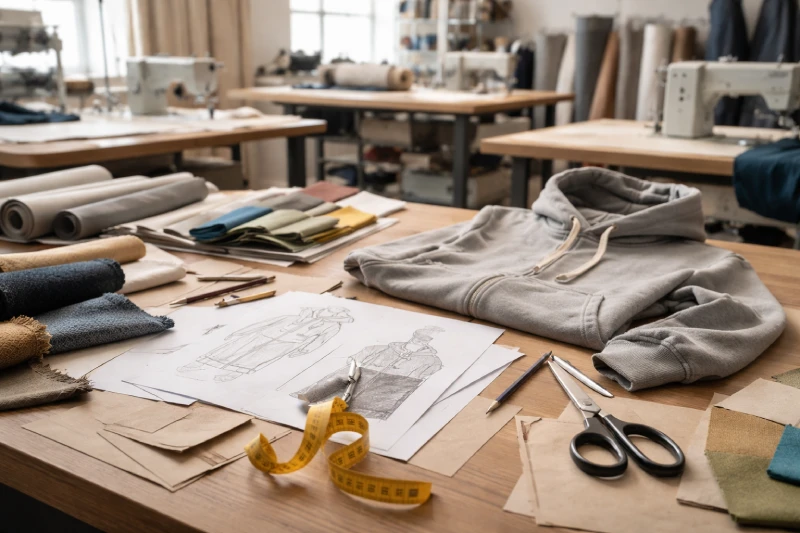
This stage usually involves selecting the product category, such as t-shirts, hoodies, sportswear, or workwear. Brands also establish the design direction by providing visual references, sketches, or sample garments that represent the desired style. These references help manufacturers understand the intended structure, silhouette, and design details of the garment.
In many cases, brands also prepare a technical document known as a tech pack. A tech pack typically includes garment measurements, fabric requirements, construction details, logo placement, and other specifications needed for production.
Defining the target customer is another important part of this stage. Factors such as fit style, comfort, durability, and price positioning influence both design decisions and material selection.
A well-defined product concept allows manufacturers to evaluate production feasibility, estimate costs, and prepare accurate samples. Clear planning at this stage significantly reduces development delays and prevents misunderstandings during the manufacturing process.
Step 2 — Fabric and Material Selection
Fabric and material selection is a key stage in the private label clothing manufacturing process because it directly influences the garment’s comfort, durability, performance, and production cost. Once the product concept and design direction are defined, manufacturers work with brands to determine the most suitable fabrics and supporting materials for the garment.
Cotton fabrics are commonly used for casual apparel such as t-shirts, hoodies, and everyday wear due to their softness and breathability. Polyester fabrics are widely used in sportswear and performance clothing because they offer durability, moisture-wicking properties, and shape retention. Many garments also use blended fabrics, such as cotton–polyester or cotton–spandex combinations, to balance comfort, flexibility, and long-term durability.
In addition to the main fabric, manufacturers must also select supporting materials, including ribbing, linings, threads, zippers, and buttons. These components affect both the functionality and appearance of the final garment.
Some brands also prioritize sustainable materials, such as organic cotton or recycled polyester, to meet environmental goals.
Choosing the right fabric is essential because it affects garment quality, printing compatibility, manufacturing efficiency, and the overall price of the finished product.
Step 3 — Sample Development and Prototype Creation
After fabrics and design specifications are confirmed, the manufacturer begins the sample development stage. This step involves producing a prototype garment that represents the intended final product. Sampling allows both the brand and the manufacturer to evaluate the design before committing to large-scale production.
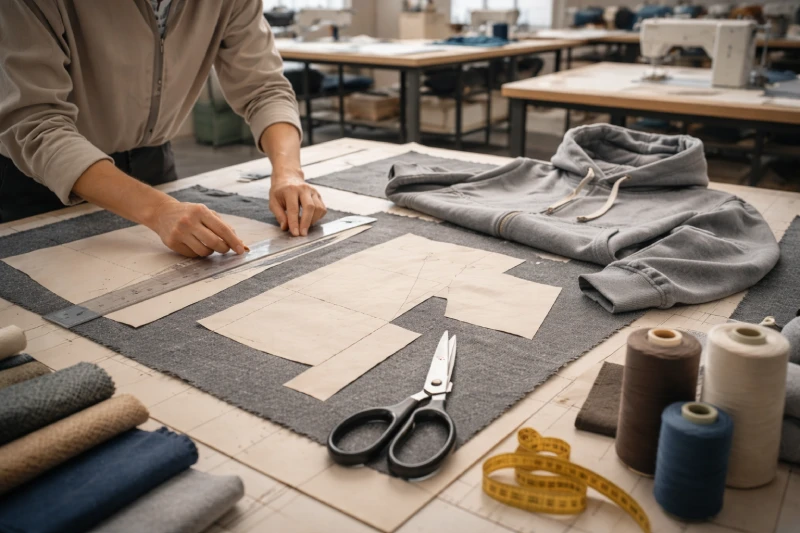
The process usually starts with pattern making. Based on the design references or tech pack provided by the brand, pattern makers create the garment patterns that define the shape and dimensions of each component. Fabric pieces are then cut according to these patterns and assembled through sample sewing.
The first prototype sample is used to evaluate several key factors, including garment fit, fabric behavior, construction quality, and overall appearance. Brands review the sample to confirm that measurements, design details, and functionality match their expectations.
In many cases, adjustments are required after the first sample. Manufacturers may produce revised samples to refine sizing, modify stitching details, or improve overall garment structure.
Once the sample meets the required standards and receives final approval, the product is ready to move forward to bulk production.
Step 4 — Branding and Customization
After the sample is approved, the next stage focuses on preparing the branding elements that will appear on the finished garments. Branding is what transforms a standard piece of clothing into a recognizable product associated with a specific brand.
Private label clothing typically includes several types of brand identifiers. One of the most common is the garment label, which may be a woven label sewn into the collar or a printed neck label applied directly to the fabric. These labels usually display the brand name, size information, and care instructions.
Logo application is another important part of customization. Depending on the design and fabric type, logos can be applied using embroidery, screen printing, heat transfer printing, or digital printing methods. Each technique offers different visual effects and durability characteristics.
Brands may also include additional elements such as hang tags, branded packaging, or custom polybags to enhance product presentation.
During this stage, manufacturers organize the placement and production of these branding components so they can be integrated smoothly into the bulk manufacturing process.
Step 5 — Bulk Production
Once samples and branding specifications are finalized, the manufacturer begins bulk garment production. This stage involves producing the garments in large quantities using organized production lines within the apparel factory.
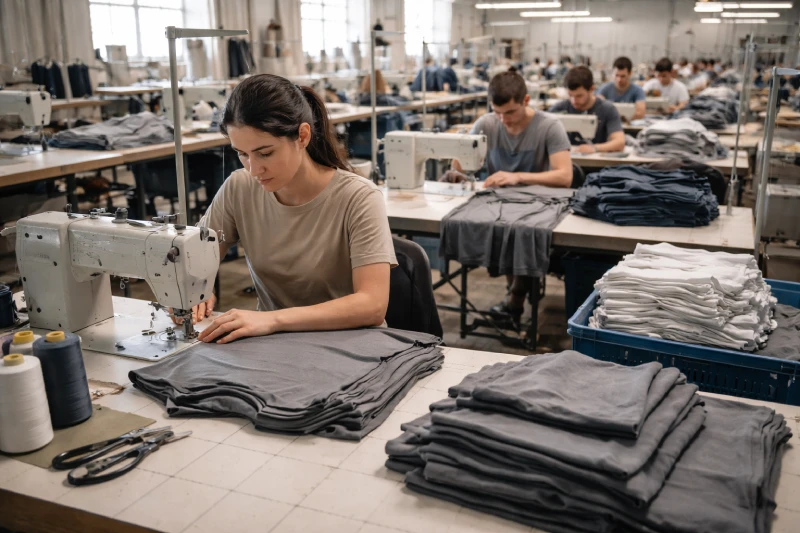
The process usually starts with fabric preparation and cutting. Fabric rolls are spread across large cutting tables and cut into garment panels using industrial cutting machines or automated cutting systems. These panels form the individual components of each garment, such as sleeves, collars, and body sections.
After cutting, the panels move to the sewing stage. Garments are assembled through a sequence of sewing operations carried out by specialized workers or sewing stations. Each station performs a specific task, such as attaching sleeves, sewing side seams, installing collars, or finishing hems.
If the product includes logos or decorative elements, printing or embroidery may be applied during or after the sewing stage, depending on the production plan.
Modern apparel factories typically use assembly-line production systems to maintain efficiency and consistency. This organized workflow allows manufacturers to produce large quantities of garments while maintaining uniform quality across all units.
Step 6 — Quality Control and Inspection
Quality control is an essential part of the private label clothing manufacturing process. To ensure that finished garments meet brand specifications, apparel manufacturers perform inspections at multiple stages during production.
The first step often involves fabric inspection before cutting begins. During this stage, manufacturers check the fabric rolls for defects such as holes, color inconsistencies, or weaving flaws that could affect the final garment.
As production progresses, factories conduct in-line inspections on the sewing floor. These checks monitor stitching quality, seam strength, and construction accuracy. Inspectors may also verify that labels, prints, or embroidery are placed correctly according to the approved design specifications.
After garments are fully assembled, a final inspection is usually performed before packaging. Inspectors examine finished pieces for measurement accuracy, visual defects, loose threads, and overall construction quality.
These quality control procedures help ensure that garments meet production standards and maintain consistent quality across the entire order. For brands, this process reduces the risk of defective products reaching customers or entering retail distribution.
Step 7 — Packaging and Delivery
After garments pass the final quality inspection, they move to the packaging stage. Proper packaging ensures that the products are protected during transportation and prepared for distribution to retailers, warehouses, or ecommerce fulfillment centers.
The process usually begins with garment folding. Each item is folded according to the packaging requirements defined by the brand. Consistent folding helps maintain product presentation and simplifies storage and inventory management.
Next, garments are placed into individual packaging, commonly polybags or protective sleeves. These bags may include size stickers, barcodes, or product identification labels that allow retailers and warehouses to manage inventory efficiently.
Once individual pieces are packaged, garments are sorted and packed into export cartons. Manufacturers often organize cartons by size, color, or SKU to make handling easier for logistics providers and distribution centers.
Before shipment, cartons are sealed, labeled, and prepared for transportation. The finished products are then delivered to the brand’s warehouse, retail partners, or directly to ecommerce fulfillment facilities.
Factors That Affect Private Label Clothing Production Time
The production time for private label clothing can vary depending on several factors related to product design, materials, and manufacturing requirements. Understanding these factors helps brands plan realistic production schedules and avoid delays during product launches.
One important factor is product complexity. Garments with simple construction, such as basic t-shirts, are typically faster to produce than products with multiple panels, technical stitching, or specialized features.
Customization requirements also influence production timelines. Additional elements such as embroidery, screen printing, woven labels, or custom packaging introduce extra production steps that may increase manufacturing time.
Order quantity is another key variable. Larger orders require more production capacity and scheduling coordination within the factory’s production lines.
Fabric availability can also affect timelines. If fabrics are readily available in stock, production can begin sooner. However, custom fabrics or special materials may require additional sourcing and preparation time.
For this reason, brands often plan both the sampling stage and bulk production stage carefully to ensure their clothing collections are ready for market launch.
FAQ
What is the private label clothing manufacturing process?
The private label clothing manufacturing process involves several stages that transform a product concept into finished garments. The typical workflow includes product design planning, fabric sourcing, sample development, branding preparation, bulk production, quality inspection, and final packaging. Apparel manufacturers handle the technical production steps while brands focus on product design, branding, and sales.
How long does private label clothing manufacturing take?
Private label clothing production timelines vary depending on product complexity, customization requirements, and order quantity. Sample development usually takes 1–3 weeks, while bulk production often requires 3–6 weeks after sample approval. Additional time may be needed for fabric sourcing or specialized printing processes.
What is the difference between private label and OEM clothing manufacturing?
Private label clothing allows brands to sell garments under their own brand name while the manufacturer produces the products. In OEM manufacturing, brands usually provide detailed product designs and specifications, and the manufacturer produces garments exactly according to those requirements.
What is the minimum order quantity for private label clothing?
Minimum order quantities vary by manufacturer and product type. Many apparel manufacturers require minimum orders ranging from 50 to 300 pieces per style. The exact MOQ depends on factors such as fabric sourcing, customization methods, and production efficiency.
Can startups launch clothing brands using private label manufacturing?
Yes. Private label manufacturing is widely used by startup clothing brands because it allows them to produce branded apparel without investing in factories or production equipment. By working with experienced manufacturers, startups can focus on product design, branding, and marketing.
What types of clothing can be produced through private label manufacturing?
Private label manufacturers can produce many types of apparel, including t-shirts, hoodies, sportswear, activewear, workwear, uniforms, and fashion garments. The production process can also support various customization options such as embroidery, screen printing, and custom labels.
Conclusion
Private label clothing manufacturing follows a structured process that transforms a product idea into finished garments ready for sale. From the initial concept and design planning to fabric selection, sample development, branding customization, and bulk production, each stage plays an important role in ensuring that the final product meets the brand’s expectations.
Quality control and inspection help maintain consistent standards throughout production, while proper packaging and delivery prepare garments for distribution to retailers or fulfillment centers. When each step is managed carefully, the manufacturing process becomes more efficient and predictable.
For clothing brands, understanding how private label apparel is produced makes it easier to communicate with manufacturers, plan production timelines, and avoid costly development mistakes.
Experienced private label clothing manufacturers provide the technical expertise and production infrastructure needed to turn design ideas into reliable, scalable apparel products.
Discuss Your Apparel Sourcing Requirements
Whether you're launching a startup clothing brand, expanding a streetwear label, or looking for a reliable OEM apparel manufacturer, speaking directly with an experienced production team can help you avoid costly sourcing mistakes.
Talk With Our Manufacturing Team