Introduction
For anyone entering the apparel industry, understanding private label clothing MOQ is essential. MOQ, or Minimum Order Quantity, determines how many units you must produce in a single order before a manufacturer agrees to start production. It directly impacts your budget, inventory risk, and product strategy.
Many startups struggle with MOQ because they want flexibility, while manufacturers prioritize efficiency. This gap often leads to confusion during sourcing.
In this guide, you’ll learn what MOQ means in clothing manufacturing, why it exists, typical MOQ ranges, and how to work with suppliers effectively. Whether you’re launching a new brand or scaling production, understanding MOQ will help you make smarter sourcing decisions and reduce risk.
What Is MOQ in Clothing Manufacturing
MOQ (Minimum Order Quantity) in apparel manufacturing refers to the smallest number of units a factory requires per order. It ensures that production is economically viable for the manufacturer.
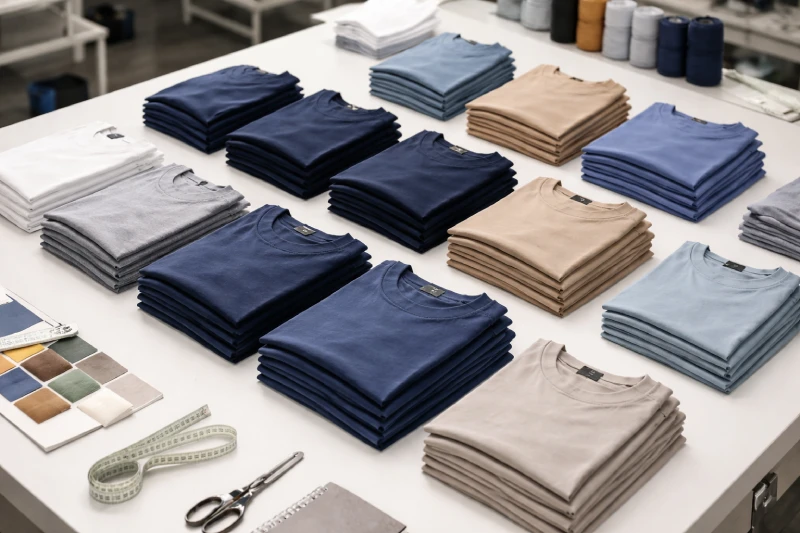
MOQ is not always a single number—it can apply at multiple levels:
- Per style: Each design requires a minimum number of pieces
- Per color: Different colors often need separate production runs
- Per size: Size distribution affects total quantities
For example, if a manufacturer sets an MOQ of 300 pieces per style and you want three colors, you may need to order 100 pieces per color.
It’s also important to distinguish between:
- Total order MOQ: Overall minimum quantity across all items
- Per SKU MOQ: Minimum per specific combination of style, color, and size
Understanding these distinctions helps avoid misunderstandings and allows you to plan your product assortment more effectively.
Why Clothing Manufacturers Require MOQ
Manufacturers impose MOQ requirements for practical and financial reasons. It is not arbitrary—it ensures production efficiency and cost control.
Material Sourcing Efficiency
Fabric suppliers often have their own minimum order requirements. For example, a textile mill may require 100–300 meters per fabric type. If your order is too small, the manufacturer cannot source materials cost-effectively.
Production Cost Optimization
Each production run involves setup costs, including pattern making, cutting preparation, and machine setup. Larger quantities spread these fixed costs across more units, reducing the cost per piece.
Labor and Factory Scheduling
Factories operate on planned production schedules. Small orders disrupt workflow and reduce overall efficiency, making them less attractive for manufacturers.
Risk Management
Low-volume orders often carry higher risks, especially for customized products. Manufacturers may avoid small orders to minimize potential losses from errors or unsold inventory.
In short, MOQ ensures that production remains efficient, predictable, and profitable for both parties.
Typical MOQ for Private Label Clothing
The private label clothing minimum order quantity varies depending on product type, manufacturing method, and supplier scale. Below are common ranges:
| Product Type | Typical MOQ |
|---|---|
| Basic T-shirts | 100–300 pcs |
| Hoodies | 150–400 pcs |
| Activewear | 200–500 pcs |
| Caps / Accessories | 50–200 pcs |
Several factors influence these numbers:
- OEM (Cut & Sew) Production:
Fully customized garments usually have higher MOQ due to fabric sourcing and pattern development. - Blank Apparel Customization:
Printing or embroidery on pre-made garments allows much lower MOQ. - Factory Scale:
Large factories often require higher MOQ, while smaller workshops may offer more flexibility. - Region:
Countries like China typically offer competitive MOQ ranges due to mature supply chains.
Ultimately, MOQ is not fixed—it varies based on your product complexity and supplier capabilities.
Factors That Affect MOQ Requirements
MOQ is influenced by multiple variables in the production process. Understanding these can help you negotiate better terms.
- Fabric Type
Custom-developed fabrics or specialty materials usually require higher MOQ due to textile mill limitations. - Customization Level
Advanced customization such as embroidery, printing, washing effects, or special trims increases production complexity and MOQ. - Number of Variants
More colors and sizes split your total quantity, making it harder to meet per-SKU minimums. - Production Method
Cut-and-sew manufacturing requires more resources compared to simple customization on ready-made garments. - Supplier Type
Large-scale manufacturers prioritize efficiency and may enforce strict MOQ, while smaller factories may accept lower quantities.
By simplifying your product design and reducing variations, you can often lower MOQ requirements significantly.
Low MOQ vs Large Production Runs
Choosing between low MOQ and large production runs depends on your business stage and risk tolerance.
| Aspect | Low MOQ | Large MOQ |
|---|---|---|
| Cost per unit | Higher | Lower |
| Risk | Lower | Higher |
| Customization | Limited | More options |
| Scalability | Limited | Strong |
Low MOQ is ideal for startups testing new designs or entering the market with limited capital. It allows flexibility but comes with higher per-unit costs.
Large production runs, on the other hand, reduce costs and enable full customization. However, they require greater upfront investment and carry higher inventory risk.
A balanced approach is often best: start with smaller quantities to validate demand, then scale up once your products gain traction.
How Startups Can Work With MOQ Requirements
Meeting clothing manufacturing MOQ requirements can be challenging, but there are practical strategies to overcome this barrier.
- Work With Low MOQ Manufacturers
Look for suppliers that specialize in small-batch production or startups. Many offer flexible solutions for new brands. - Use Blank Apparel
Start with ready-made garments and apply custom branding through printing or embroidery. This significantly reduces MOQ. - Limit Product Variants
Focus on fewer colors and sizes to concentrate volume and meet minimum requirements more easily. - Negotiate With Suppliers
Some manufacturers are willing to lower MOQ for first-time orders or long-term partnerships. - Combine Orders
Group multiple styles or products into a single order to meet total MOQ thresholds. - Test Before Scaling
Launch with small batches to validate your designs, then increase production once demand is proven.
By using these strategies, startups can reduce financial risk while still building a strong product line.
Conclusion
Understanding private label clothing MOQ is key to making informed sourcing decisions. MOQ is not a limitation but a reflection of how manufacturing works efficiently.
By learning typical MOQ ranges, recognizing influencing factors, and applying practical strategies, you can navigate production requirements with confidence. Start small, focus on validated designs, and scale gradually as your brand grows.
Choosing the right manufacturing partner and structuring your orders strategically will help you balance cost, flexibility, and growth potential in the long term.
Discuss Your Apparel Sourcing Requirements
Whether you're launching a startup clothing brand, expanding a streetwear label, or looking for a reliable OEM apparel manufacturer, speaking directly with an experienced production team can help you avoid costly sourcing mistakes.
Talk With Our Manufacturing Team