

For procurement managers and brand decision-makers, choosing between pullover vs zip-up hoodies is not a matter of style preference. It is a structural sourcing decision that affects production complexity, cost stability, decoration compatibility, inventory planning, and long-term program scalability.
In bulk apparel manufacturing—across categories such as Hoodies & Sweatshirts, T-Shirts & Polos, Sportswear & Activewear, Workwear & Safety Apparel, and Headwear & Caps—garment construction directly influences procurement efficiency. This guide provides a decision-oriented framework to help overseas B2B buyers determine which hoodie structure aligns best with their operational objectives.
Understanding the Structural Differences in Pullover vs Zip-Up Hoodies
Before comparing pricing or customization options, buyers should understand how structural design impacts manufacturing.
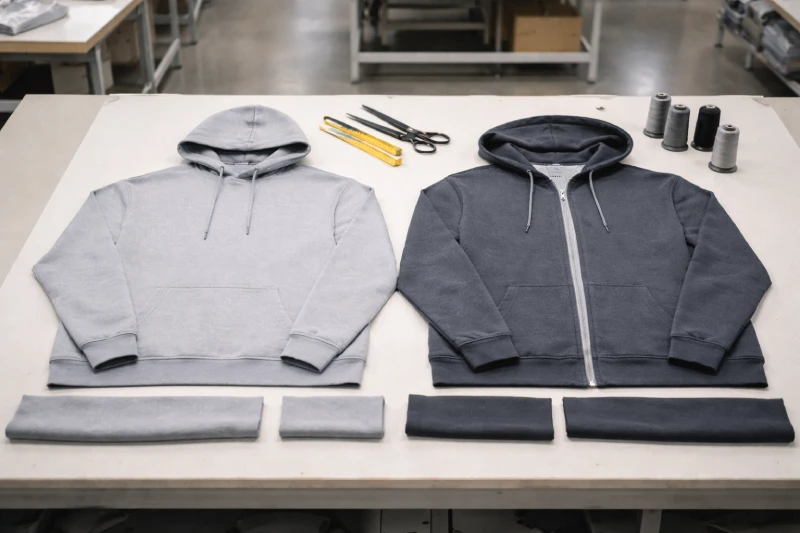
Pullover Hoodies – Simplified Construction
Key features:
- No front zipper
- Continuous front panel
- Optional kangaroo pocket
- Lower component count
Manufacturing implications:
- Fewer trims and external suppliers
- Reduced sewing operations
- Larger uninterrupted decoration area
- More stable production rhythm
From a production engineering perspective, pullovers typically require fewer assembly steps. The absence of zipper insertion reduces seam alignment risk and shortens sewing cycle time per unit. Fabric utilization can also be slightly more efficient due to the single front panel structure, depending on marker layout.
For high-volume orders, fewer components generally translate to lower defect probability and easier in-line quality control.
Zip-Up Hoodies – Functional Layered Construction
Key features:
- Full-length front zipper
- Split front panels
- Additional stitching reinforcement
- Increased trim components
Manufacturing implications:
- Additional trim sourcing (zippers, pulls)
- Higher labor input per garment
- Alignment sensitivity during assembly
- Expanded quality checkpoints
Zipper installation introduces extra production stages: trimming, alignment, reinforcement stitching, and functional testing. Color matching between fabric and zipper tape must be confirmed during sampling. Any delay in zipper procurement may affect overall lead time.
From a sourcing standpoint, zip-up hoodies involve a slightly more complex supply chain structure.
Pullover vs Zip-Up Hoodies for Bulk Orders: A Strategic Comparison
| Evaluation Factor | Pullover Hoodie | Zip-Up Hoodie |
|---|---|---|
| Production Complexity | Lower | Higher |
| Unit Cost (Same Fabric) | More cost-efficient | Slightly higher |
| Decoration Area | Full uninterrupted front | Split by zipper |
| Lead Time Stability | Higher | Moderately dependent on trim supply |
| Hardware Risk | Minimal | Zipper-related |
| Quality Control Points | Fewer | More inspection stages |
| Functional Versatility | Moderate | High |
For buyers managing tight margins or strict production schedules, structural simplicity often improves predictability. For projects emphasizing functionality and layering, zip-up styles may justify additional complexity.
Decision Framework for Procurement Managers
Rather than asking which style is “better,” evaluate based on operational criteria.
1. End-Use Environment
- Corporate uniforms: Zip-ups allow flexibility in temperature-controlled offices.
- Promotional programs: Pullovers provide larger front print zones.
- Sportswear & Activewear: Zip-ups improve ventilation adjustment.
- Workwear layering systems: Zip-ups integrate smoothly under outer jackets.
- Institutional programs: Pullovers simplify standardization and cost control.
Clarifying wear conditions reduces mismatch risk during large-scale procurement.
2. Branding & Decoration Strategy
Decoration placement influences garment selection.
Pullover advantages:
- Larger central chest print
- Better compatibility with screen printing and DTG
- Cleaner symmetry
Zip-up considerations:
- Split front panel limits graphic size
- Suitable for chest embroidery
- Back panel remains unaffected
For graphic-driven merchandise programs, pullovers often offer more flexibility.
3. Budget Planning & Cost Structure
Bulk hoodie cost drivers include:
- Fabric type and GSM
- Trim components
- Sewing labor time
- Packaging dimensions
- Defect management
Zip-up hoodies introduce additional cost layers:
- Zipper material (metal, nylon, reverse coil, etc.)
- Color matching and sampling
- Reinforcement stitching
- Higher inspection labor
In large-scale orders, even a small per-unit increase can significantly affect total budget allocation. Buyers operating under strict target pricing frequently favor pullovers due to simplified cost modeling.
MOQ & Scalability Considerations
MOQ structures depend on:
- Fabric type
- Color variation count
- Size ratio complexity
- Decoration method
- Trim sourcing
Pullover Hoodies
- Lower structural variation
- Easier line balancing in factories
- Greater flexibility in mixed-size bulk programs
Because pullovers eliminate zipper color dependency, multi-color orders can be consolidated more efficiently. Factories may also accept lower MOQs when trim sourcing is simplified.
Zip-Up Hoodies
- Zipper color must match each fabric color
- Increased SKU complexity
- Additional trim inventory planning
For example, a 4-color hoodie program may require 4 zipper colors, increasing procurement coordination. If zipper suppliers have separate MOQs, this can influence minimum total order volume.
In distributor programs with rolling replenishment cycles, structural simplicity generally improves scalability.
Fabric & Performance Considerations
Fabric selection interacts with hoodie structure.
Common materials:
- Cotton fleece
- Cotton-poly blends
- French terry
- Performance polyester blends
GSM and Weight Impact
Higher GSM fabrics (320–400gsm) are common for winter programs. In zip-up hoodies, heavier fabrics increase zipper load stress, requiring stronger reinforcement stitching. Pullovers distribute fabric tension more evenly.
Shrinkage & Stability
Fabric shrinkage affects front alignment in zip-up styles more visibly than in pullovers. Post-wash distortion may impact zipper straightness if pre-shrinking control is insufficient.
Application by Category
- Sportswear & Activewear: Zip-ups support temperature regulation.
- Corporate apparel: Mid-weight pullovers simplify branding consistency.
- Workwear: Durability-focused fleece may benefit from simpler construction.
Material and structure should be evaluated together during sampling.
Differences Compared to Other Apparel Categories
Compared to T-Shirts & Polos
T-shirts and polos have minimal structural complexity. Hoodies introduce layering, rib trims, and heavier fabrics, increasing production variables.
Compared to Headwear & Caps
Caps involve panel structure and hardware such as buckles or snaps. Zip-up hoodies parallel this hardware dependency through zipper components.
Compared to Workwear & Safety Apparel
Workwear emphasizes durability and compliance. In rugged environments, fewer structural failure points (such as zippers) may reduce long-term maintenance risk.
Structural complexity typically correlates with operational risk exposure.
Quality Control & Risk Management in Bulk Hoodie Orders
For Pullover Hoodies
- Rib cuff elasticity testing
- Hood seam reinforcement
- Fabric pilling performance
- Shrinkage tolerance verification
Fewer structural components reduce inspection stages and simplify bulk QA sampling.
For Zip-Up Hoodies
- Zipper alignment precision
- Slider smoothness testing
- Bottom stop reinforcement
- Color consistency
Zipper-related defects are among the most common quality issues in large-scale hoodie production. Misalignment, tension distortion, or inconsistent slider movement can lead to rework.
Buyers should confirm:
- Functional testing standards
- Batch inspection ratio
- Replacement component availability
Risk mitigation planning is especially important in high-volume export programs.
Inventory & Distribution Implications
Downstream logistics should be considered during planning.
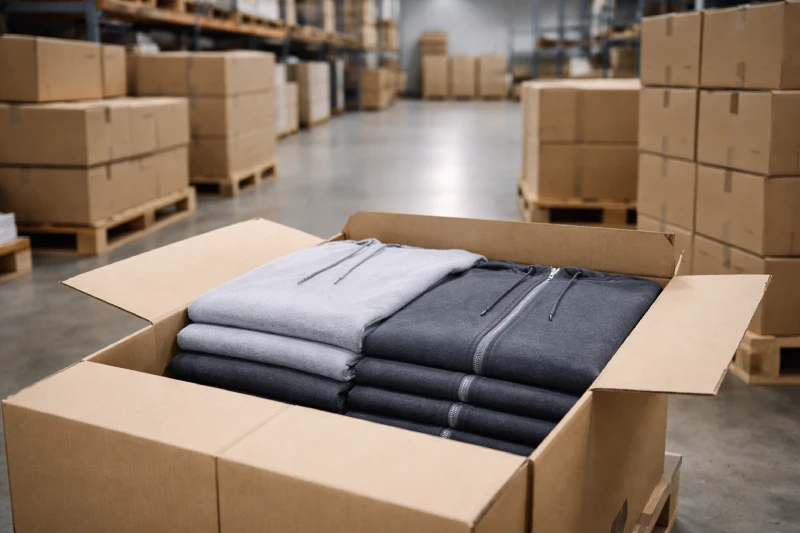
- Zip-up hoodies may increase folded thickness slightly due to zipper bulk.
- Hardware adds marginal weight.
- Repair or replacement rates may be higher if zipper damage occurs.
Shipping Considerations
For container loading:
- Pullovers may allow marginally more efficient carton stacking.
- Bulk compression packaging must avoid zipper distortion.
For air freight:
- Weight difference is minimal but may accumulate in large consignments.
For distributor warehouses:
- Simpler garments often reduce return and inspection complexity.
Operational efficiency extends beyond factory production into logistics management.
When to Choose Pullover Hoodies for Bulk Orders
Select pullovers when:
- Budget control is a primary objective
- Large graphic prints are required
- Lead time is compressed
- Low defect risk is prioritized
- High-volume standardized programs are planned
Suitable for:
- Promotional campaigns
- Institutional uniforms
- Distributor inventory programs
When to Choose Zip-Up Hoodies for Bulk Orders
Select zip-ups when:
- Layering flexibility is necessary
- Climate variation is expected
- Corporate uniform systems require adaptability
- Premium positioning supports higher cost structure
Suitable for:
- Corporate apparel programs
- Fitness and activewear brands
- Outdoor service teams
Procurement Checklist for Hoodie Bulk Orders
Product Structure
- Pullover or zip-up
- Fabric type and GSM
- Rib composition
Customization
- Decoration method
- Logo placement approval
- Color matching
Production Planning
- MOQ confirmation
- Lead time schedule
- Zipper sourcing (if applicable)
Quality Standards
- Wash testing
- Shrinkage tolerance
- Zipper durability testing
Logistics
- Packaging method
- Carton dimensions
- Export documentation
Final Considerations: Pullover vs Zip-Up Hoodies in Multi-Category Apparel Manufacturing
In bulk sourcing, the question is not which style is universally superior, but which structure aligns with cost strategy, production planning, and end-use functionality.
Pullover hoodies typically provide greater manufacturing stability and lower structural risk. Zip-up hoodies offer enhanced functional versatility but introduce additional supply chain variables.
For overseas B2B buyers managing multi-category apparel programs—including caps, polos, sportswear, and workwear—structural evaluation is a core part of procurement strategy.
Discuss Your Project Requirements
If you are evaluating pullover vs zip-up hoodies for an upcoming bulk program, we welcome the opportunity to review your volume targets, fabric specifications, branding requirements, and delivery timeline.
Our production team can assist in assessing structural feasibility, customization planning, MOQ optimization, and manufacturing scheduling to support your sourcing objectives.
Discuss Your Apparel Sourcing Requirements
Whether you're launching a startup clothing brand, expanding a streetwear label, or looking for a reliable OEM apparel manufacturer, speaking directly with an experienced production team can help you avoid costly sourcing mistakes.
Talk With Our Manufacturing Team