
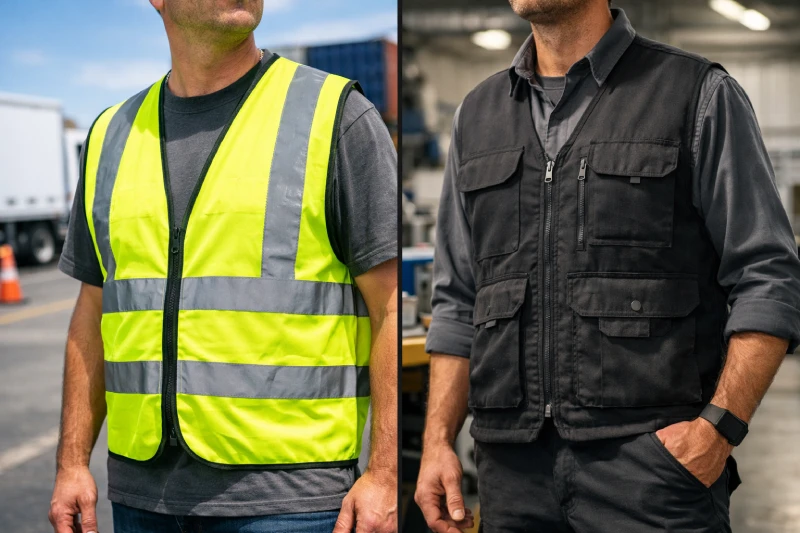
For B2B buyers sourcing custom apparel, vests are often grouped into a single category. In practice, however, safety vests and workwear vests serve very different operational, compliance, and branding purposes.
This buying guide is written for procurement managers, brand owners, uniform buyers, and distributors who need to make clear, scalable decisions across multiple apparel categories—without focusing on individual SKUs.
The goal is to help you choose the right vest type based on use case, risk profile, customization needs, and supply constraints, regardless of whether your broader order includes caps, T-shirts, hoodies, sportswear, or full workwear programs.
Understanding the Core Difference: Function First, Not Style
At a high level, the distinction comes down to primary function.
| Aspect | Safety Vest | Workwear Vest |
|---|---|---|
| Primary purpose | High visibility & hazard awareness | Utility, protection, durability |
| Typical environments | Traffic zones, construction, logistics yards | Factories, warehouses, maintenance sites |
| Compliance driven | Yes (often mandatory) | Sometimes (depends on industry) |
| Wearing duration | Short-term / task-based | Full shift / daily wear |
| Branding priority | Secondary | Often important |
Before considering fabric, price, or logo placement, buyers should define what problem the vest must solve.
What Is a Safety Vest?
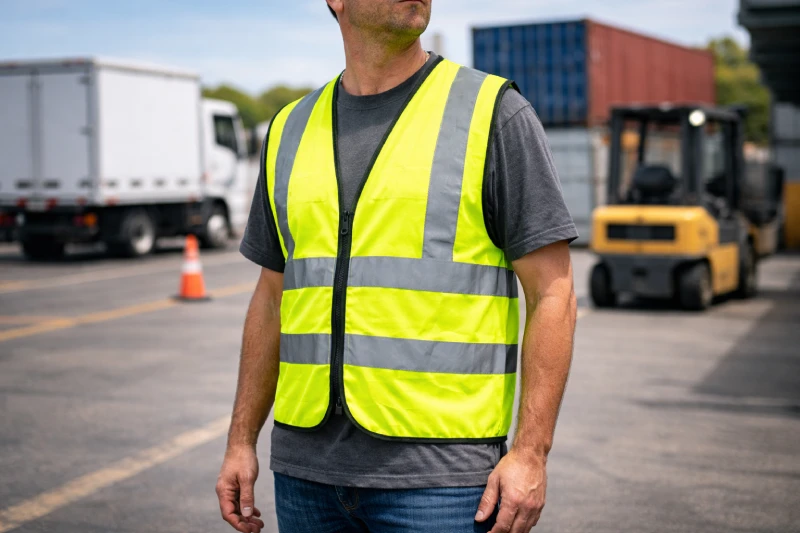
High-Visibility as the Core Requirement
A safety vest is designed to make the wearer immediately visible in environments with moving vehicles, machinery, or low-light conditions.
Key characteristics:
- Fluorescent base colors (yellow, orange, lime)
- Reflective tape or panels
- Lightweight construction
- Minimal pockets or accessories
In many regions, safety vests are regulated by visibility standards, making compliance the first decision filter.
Typical Use Scenarios
- Road construction and traffic control
- Ports, airports, and logistics terminals
- Warehouses with forklift traffic
- Event security and crowd management
In these contexts, visibility outweighs comfort, aesthetics, or durability.
What Is a Workwear Vest?
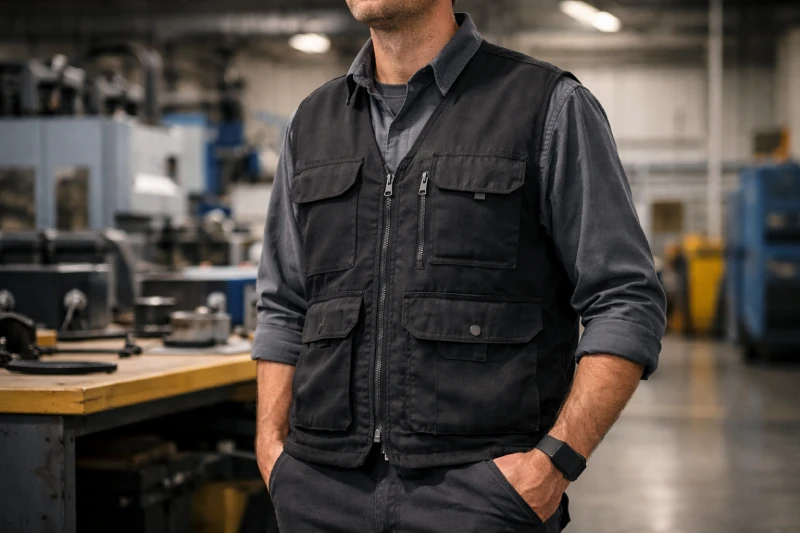
Utility, Protection, and Integration with Uniform Systems
A workwear vest is part of a broader industrial or corporate uniform program. Visibility may be included, but it is not always the main driver.
Key characteristics:
- Durable woven or softshell fabrics
- Multiple pockets and tool storage
- Reinforced seams and trims
- Neutral or corporate colors
- Designed for long wear
Workwear vests often function as a layering piece, worn over T-shirts, polos, hoodies, or thermal garments depending on season.
Typical Use Scenarios
- Factory floor operations
- Equipment maintenance teams
- Utility services and technicians
- Warehouse picking and supervision
Here, functionality and wear resistance are more important than maximum reflectivity.
Safety Vest vs Workwear Vest: Decision Framework for Buyers
1. Risk Level and Visibility Requirement
Ask first: Is the primary risk related to being seen or doing work?
- Choose a safety vest if:
- Workers operate near vehicles
- Visibility is mandated by law or client contracts
- The vest is worn only during specific tasks
- Choose a workwear vest if:
- The role involves tools, materials, or repeated motion
- Visibility is helpful but not the sole requirement
- The vest is worn throughout the workday
2. Compliance and Regional Standards
Safety vests are often subject to local or international visibility standards, while workwear vests may not be.
Buyer considerations:
- Does the destination market require certified reflective coverage?
- Is proof of compliance needed for tenders or audits?
- Will different countries require different specifications?
For multi-country procurement, this may lead to:
- One standardized safety vest
- Multiple localized versions
- Or combining safety vests with compliant outerwear
3. Comfort vs Durability Trade-Off
| Factor | Safety Vest | Workwear Vest |
|---|---|---|
| Fabric weight | Very light | Medium to heavy |
| Breathability | High | Moderate |
| Abrasion resistance | Low | High |
| Seasonal adaptability | Limited | Strong |
If workers already wear T-shirts, polos, or hoodies, a safety vest adds visibility without heat buildup.
If the vest replaces an outer garment, workwear construction becomes critical.
Customization & Branding Considerations
Logo Application Differences
- Safety vests
- Limited flat areas
- Reflective tape restricts placement
- Heat transfer or reflective-compatible printing preferred
- Workwear vests
- Larger chest and back panels
- Embroidery, woven patches, or screen printing feasible
- Better alignment with brand identity
Color Strategy Across Categories
Many buyers align:
- Safety vests → compliance colors
- Workwear vests → corporate palette
- Caps / T-shirts / hoodies → brand-driven colors
This layered strategy keeps teams compliant without sacrificing brand consistency.
MOQ, Bulk Orders, and Lead Time Planning
Minimum Order Quantity (MOQ)
- Safety vests often have lower MOQs
- Simpler construction
- Fewer size variations
- Faster production cycles
- Workwear vests usually require higher MOQs
- More components
- Size grading complexity
- Custom fabric sourcing
Lead Time Factors Buyers Often Overlook
| Factor | Impact |
|---|---|
| Reflective tape sourcing | Can extend safety vest lead time |
| Custom fabric dyeing | Common for workwear vests |
| Multi-size ratio planning | Critical for workwear |
| Logo approval cycles | Affects both |
When bundled with other apparel categories (caps, polos, hoodies), aligning production timelines early helps avoid partial shipments.
How Vest Selection Interacts with Other Apparel Categories
Caps vs Vests
- Caps support brand visibility
- Vests support safety or function
- Rarely interchangeable in purpose
T-Shirts / Polos + Vests
- Safety vest often layered over lightweight tops
- Workwear vest may replace a jacket in mild climates
Hoodies / Sweatshirts
- Safety vest must accommodate bulkier layers
- Workwear vest sizing must consider underlayers
Sportswear / Activewear
- Safety vests may prioritize stretch and breathability
- Workwear vests less common unless hybrid designs are used
Quick Buyer Checklist
Before confirming a vest type, align on:
☐ Primary risk: visibility vs task performance
☐ Compliance requirements by destination market
☐ Wearing duration (task-based or full shift)
☐ Climate and layering needs
☐ Branding priority and logo method
☐ MOQ and size ratio feasibility
☐ Lead time aligned with other apparel items
Conclusion: Choose by Function, Scale by System
The difference between a safety vest and a workwear vest is not cosmetic—it reflects fundamentally different operational needs.
For B2B buyers managing multi-category apparel programs:
- Safety vests solve visibility and compliance
- Workwear vests solve utility and durability
- The right choice depends on risk profile, usage pattern, and integration with the full uniform system
If you’re planning a bulk order that includes vests alongside caps, T-shirts, polos, hoodies, or other workwear items, aligning specifications early can significantly reduce cost, delays, and rework.
If you’d like to discuss your project requirements, usage scenarios, or regional compliance considerations, a manufacturer-side consultation can help clarify the optimal vest strategy before production begins.
Discuss Your Apparel Sourcing Requirements
Whether you're launching a startup clothing brand, expanding a streetwear label, or looking for a reliable OEM apparel manufacturer, speaking directly with an experienced production team can help you avoid costly sourcing mistakes.
Talk With Our Manufacturing Team