
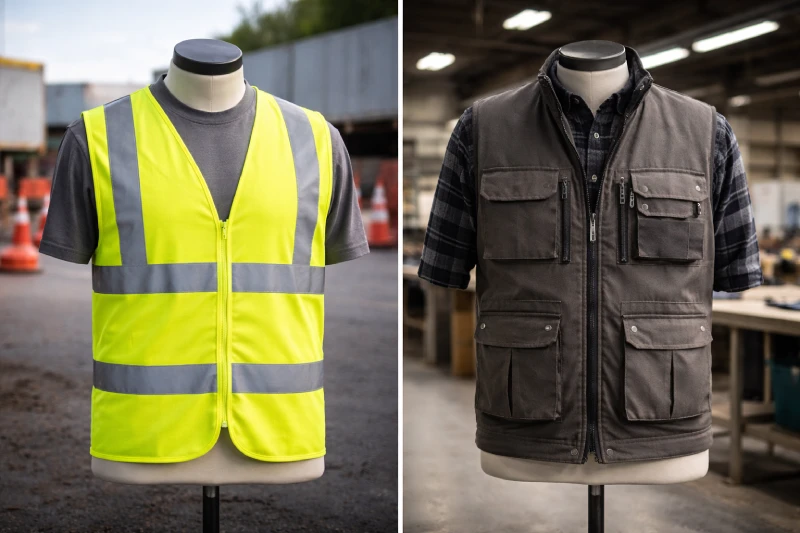
For procurement managers, brand owners, and corporate uniform buyers, choosing between safety vests and workwear vests is not simply a matter of appearance. Each serves a different operational role, carries different compliance expectations, and affects cost, customization, and lead time in distinct ways.
This buying guide is written from a manufacturer’s perspective and is designed to be category-agnostic, applicable across multiple apparel types such as headwear, T-shirts, hoodies, sportswear, and full workwear systems. The goal is to help B2B buyers make clear, defensible sourcing decisions—especially for overseas production and bulk orders.
Understanding the Core Purpose: Why the Distinction Matters
For overseas B2B buyers, the distinction between safety vests and workwear vests goes beyond visual design or garment category. It is a functional sourcing decision that directly affects regulatory exposure, operational efficiency, and total cost over the lifecycle of a uniform program.
Safety vests are purpose-built to address visibility-related risk in defined hazard environments. Their value lies in compliance, standardization, and rapid deployment. Selecting the wrong type—such as substituting a general-purpose workwear vest where high-visibility apparel is mandated—can result in non-compliance, rejected inspections, or project delays.
Workwear vests, by contrast, are designed to support task execution and daily wear. They integrate with broader uniform systems and are expected to withstand repeated use, washing, and physical strain. Over-specifying safety features where they are not required often leads to unnecessary cost increases and lower wearer acceptance.
From a procurement perspective, choosing between safety vests and workwear vests is less about product preference and more about aligning garment function with job role, regulatory context, and program duration. A clear understanding of this core purpose helps buyers avoid misallocation of budget, reduce reordering risk, and build more consistent multi-category apparel programs.
Safety Vests vs Workwear Vests: Functional Comparison
| Dimension | Safety Vests | Workwear Vests |
|---|---|---|
| Primary function | High visibility & hazard awareness | Utility, protection, task support |
| Typical environments | Roads, construction sites, logistics yards | Factories, workshops, warehouses |
| Visibility requirement | Mandatory | Optional or situational |
| Regulatory relevance | High (often required by law) | Moderate (industry or employer driven) |
| Design complexity | Low to medium | Medium to high |
| Expected lifespan | Short to medium | Medium to long |
This functional difference drives material choice, customization limits, MOQ, and pricing structure, which are critical for overseas buyers.
Key Selection Factors Buyers Should Evaluate
Visibility & Compliance Requirements
When evaluating safety vests vs workwear vests, visibility and compliance requirements are often the first—and most critical—decision checkpoint for B2B buyers. In many regions, high-visibility apparel is not optional but legally mandated for specific job roles and environments such as road work, logistics yards, and construction sites.
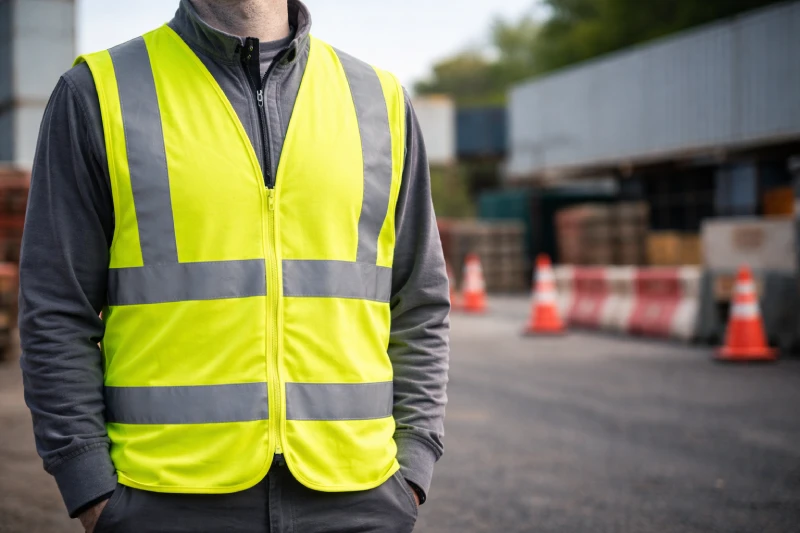
For overseas sourcing, buyers should clearly identify which party owns compliance responsibility. While manufacturers can produce garments according to specified standards, the legal and operational risk typically remains with the importer, brand owner, or project contractor. Misalignment between intended use and actual compliance requirements can result in failed site inspections, rejected shipments, or project penalties.
Another common challenge arises when a single vest style is intended for multiple markets or jurisdictions. Safety standards, color requirements, and reflective tape specifications may vary across regions. In such cases, buyers must decide whether to standardize to the highest common requirement or manage separate SKUs—each approach carrying different cost and inventory implications.
Workwear vests, by contrast, usually fall outside mandatory visibility regulations. However, buyers should still assess whether optional reflective elements are needed to align with internal safety policies or client expectations. Clarifying these requirements early helps avoid redesigns, relabeling, or compliance disputes later in the sourcing process.
Material Selection Logic
Material choice differs significantly between the two vest types.
Safety vest materials typically prioritize:
- Lightweight polyester mesh or woven fabric
- Breathability over durability
- Color fastness for fluorescent shades
Workwear vest materials typically prioritize:
- Abrasion resistance
- Tear strength
- Compatibility with other garments (jackets, hoodies, polos)
For multi-category buyers (e.g. sourcing caps, T-shirts, and workwear together), this affects fabric sourcing efficiency and minimum order planning.
Design Complexity & Customization Scope
Customization is often where cost, lead time, and production risk intersect, especially when sourcing vests alongside other apparel categories such as T-shirts, hoodies, or headwear. The degree of allowable customization differs significantly between safety vests and workwear vests, and overlooking these boundaries is a common cause of rework and delays.
Safety vests typically rely on standardized patterns, colors, and reflective layouts. While basic branding—such as logo printing or heat transfer—is usually feasible, altering panel construction, tape placement, or fabric type may affect compliance and require additional validation. Even minor design changes can increase sampling cycles or trigger higher MOQs if non-standard materials are introduced.
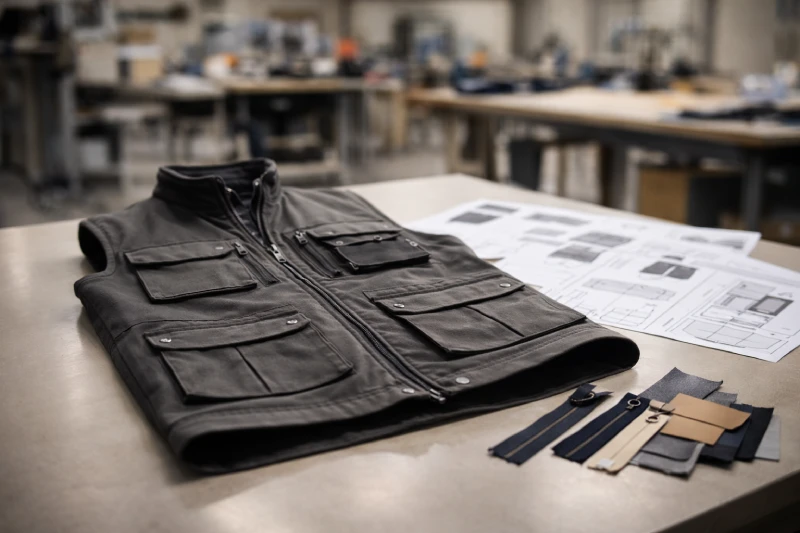
Workwear vests offer broader design flexibility, including pocket configuration, closures, fabric weight, and trim matching with other garments in a uniform system. However, each additional feature introduces variables that influence material sourcing, size grading, and assembly time. From a manufacturer’s perspective, customization decisions made late in development are the most common drivers of MOQ increases and sample revisions.
For buyers managing multi-category programs, early alignment on customization boundaries helps control complexity, stabilize pricing, and reduce production uncertainty across all apparel types.
Bulk Order Considerations for Overseas Buyers
MOQ Differences
MOQ is often misunderstood as a fixed number. In reality, it depends on production complexity.
| Item Type | Typical MOQ Characteristics |
|---|---|
| Safety vests | Lower MOQ due to standardized patterns |
| Workwear vests | Higher MOQ due to custom materials & trims |
| Caps | MOQ driven by embroidery & mold setup |
| T-shirts / Polos | MOQ driven by fabric color & GSM |
Practical takeaway:
For pilot projects or short-term contracts, safety vests are easier to scale quickly. For long-term uniform programs, workwear vests justify higher MOQs through extended use.
Lead Time Expectations
Lead time planning is critical for project contractors and distributors.
- Safety vests:
- Shorter sampling cycles
- Faster bulk production
- Easier replenishment
- Workwear vests:
- Longer development phase
- More pre-production approvals
- Longer material procurement window
If your program includes multiple apparel categories (e.g. hoodies, polos, and vests), aligning timelines early helps avoid staggered deliveries.
Cost Structure & Budget Planning
Unit Cost vs Total Cost of Ownership
Safety vests often appear cheaper on a per-unit basis. However, they may require more frequent replacement.
Workwear vests have:
- Higher initial unit cost
- Lower replacement frequency
- Better alignment with brand image
Decision framework:
- Short-term projects → prioritize unit cost
- Long-term workforce programs → prioritize durability and consistency
Customization Cost Drivers
Customization cost is influenced by:
- Number of logo positions
- Decoration method (print vs embroidery)
- Reflective material sourcing
- Color matching across apparel categories
Buyers sourcing caps, T-shirts, and workwear together should evaluate whether branding can be standardized to reduce setup costs.
Category Differences Buyers Often Overlook
Integration with Other Apparel Types
A vest rarely stands alone. It interacts with:
- T-shirts or polos underneath
- Hoodies or jackets in colder climates
- Headwear for brand visibility
Workwear vests are often designed as part of a layered system, while safety vests are typically worn over existing clothing.
User Acceptance & Wear Compliance
From a manufacturer’s feedback perspective:
- Workers are more likely to wear comfortable, functional workwear vests
- Safety vests may be worn only when enforced
For corporate uniform buyers, this affects real-world safety outcomes, not just compliance on paper.
Quick Decision Checklist
Choose a Safety Vest if:
- Visibility is legally required
- Deployment is short-term or project-based
- Speed and flexibility matter more than durability
Choose a Workwear Vest if:
- Workers perform tool-intensive tasks
- Brand consistency is important
- The vest is part of a long-term uniform system
Working with an Overseas Manufacturer — What to Clarify Early
When sourcing safety vests or workwear vests from an overseas manufacturer, early clarification is critical to avoid downstream cost overruns and production delays. Many issues commonly attributed to “factory problems” are, in practice, the result of incomplete alignment during the initial planning stage.
Buyers should first confirm how MOQs are calculated—not only per style, but also by size ratio, color, and material variation. For customized workwear vests, small changes in fabric weight or trim can fragment production runs and significantly affect pricing. Safety vests may allow lower MOQs, but only when standard materials and layouts are maintained.
Lead time expectations should also be discussed beyond headline timelines. Sampling rounds, compliance validation (if applicable), and material booking all add complexity, particularly when vests are ordered alongside other apparel categories such as polos, hoodies, or caps.
Finally, buyers should address reorder consistency upfront. Clarifying fabric sourcing, color references, and reflective material specifications ensures that future replenishment orders remain consistent in performance and appearance. This is especially important for long-term uniform programs, where batch-to-batch variation can undermine brand and safety expectations.
Conclusion: Align the Vest Type with the Job, Not Just the Budget
The choice between safety vests and workwear vests is a strategic sourcing decision. It affects compliance, cost control, worker acceptance, and brand perception—especially in multi-category apparel programs.
A manufacturer-led evaluation, grounded in use case, lifecycle cost, and production realities, will always outperform decisions based solely on unit price.
If you are evaluating safety vests, workwear vests, or integrated uniform programs across multiple apparel categories, a structured discussion with your manufacturing partner can clarify the most efficient path forward.
Sharing your use environment, compliance needs, customization scope, and order scale early helps ensure accurate planning and smoother execution.
Discuss Your Apparel Sourcing Requirements
Whether you're launching a startup clothing brand, expanding a streetwear label, or looking for a reliable OEM apparel manufacturer, speaking directly with an experienced production team can help you avoid costly sourcing mistakes.
Talk With Our Manufacturing Team