A ready-stock blank T-shirt and a custom-manufactured blank may look similar, but they solve very different purchasing problems.
A screen-printing company preparing 200 event shirts usually needs available inventory, predictable sizing and fast replenishment. A streetwear label developing a proprietary 280 GSM oversized tee needs control over the pattern, fabric, collar, wash treatment and branding. Comparing these two sourcing models solely by garment price or stated MOQ can lead to the wrong supplier choice.
This guide compares manufacturers and manufacturer-backed blank suppliers according to how buyers actually use them. It covers stocked wholesale blanks, decoration-ready garments, private-label customization and fully custom OEM production.
Quick Answer
The right blank T-shirt manufacturer depends on whether you need an existing garment or want to develop your own specification.
Gildan, Next Level Apparel, AS Colour and similar blank brands are generally more suitable for decorators and merchandise companies that need established styles and repeatable stock. Royal Apparel and Create Fashion Brand provide clearer routes from blanks into private-label customization. Seetime Luxury is relevant when a buyer wants a made-to-order blank with a proprietary fabric, fit, neckline, labels or packaging.
Before shortlisting suppliers, define three points: your required order quantity, whether the garment must be available from stock, and how much control you need over fabric and construction. A supplier offering no minimum on stocked blanks is not necessarily a substitute for a factory producing a custom garment.
Quick Comparison of Blank T-Shirt Suppliers
| Company | Base | Production model | Best for | Public MOQ | Main trade-off |
|---|---|---|---|---|---|
| Gildan | Canada | Vertically integrated manufacturer and blank brand | High-volume, replenishable basics | Not publicly stated by Gildan | Limited product ownership for buyers using stock styles |
| BELLA+CANVAS | United States | Blank brand with manufacturing and custom programs | Fashion-fit stock blanks and large custom programs | Custom orders start at 25,000 units per style/color | Custom program is unsuitable for small private-label runs |
| Next Level Apparel | United States | Wholesale blank producer | Soft, print-ready retail blanks | Not publicly stated | Buyers select from existing fabric and fit platforms |
| AS Colour | New Zealand | Premium blank producer and wholesaler | Modern fits and heavyweight stock blanks | No minimum order | Printing and relabeling are handled externally |
| Stanley/Stella | Belgium | Blank brand using partner factories | Sustainable European decoration programs | Not publicly stated | Buyers often work through dealers or decoration partners |
| Continental Clothing | United Kingdom | Manufacturer and wholesale distributor | Organic and environmentally positioned blanks | Not publicly stated | Less suitable when lowest unit cost is the only priority |
| Royal Apparel | United States | Domestic manufacturer and direct supplier | USA-made blanks and custom production | Not publicly stated | Custom commercial terms require direct quotation |
| Los Angeles Apparel | United States | Vertically integrated basics manufacturer | Heavyweight and garment-dyed streetwear blanks | Not publicly stated | Specialized silhouettes may not suit promotional programs |
| Create Fashion Brand | Portugal | Manufacturer and ready-to-brand blank supplier | Premium European blanks and customization | No MOQ for stock blanks; custom blanks from 50 per color/style | MOQ depends heavily on customization route |
| Seetime Luxury | China | OEM/ODM apparel manufacturing partner | Proprietary custom blank development | Not publicly stated | Not intended for immediate, low-volume stock-blank orders |
The business models and public terms above were reviewed through the companies’ official websites on July 16, 2026. Inclusion means the company fits the stated selection criteria; it does not represent a factory audit or product endorsement.
Choose the Right Sourcing Model First
The term “blank T-shirt supplier” can describe three different services.
Ready-Stock Blanks
These are pre-developed garments available in established fabrics, colors and sizes. Buyers normally order them through the brand or an authorized distributor.
This model works well for:
- Screen printers and embroiderers
- Promotional clothing companies
- Event merchandise
- Small e-commerce tests
- Programs requiring quick replenishment
The advantage is speed and lower entry quantities. The limitation is that another brand controls the fabric, measurements, color range and future product changes.
Customized Stock Blanks
Here, the buyer starts with an existing garment and adds decoration, a printed neck label, sewn label, hangtag or custom packaging.
This is often the most practical route for a new private-label brand because it reduces development risk. However, adding a label does not turn an existing blank into a proprietary product. Other companies may still sell the same base garment.
Custom OEM Blanks
A custom T-shirt manufacturer develops the garment around the buyer’s specification. The project may involve custom fabric, GSM, measurements, size grading, neck rib, dye color, wash treatment, labels and retail packaging.
This model takes more development work but gives the brand greater control over fit, appearance and repeat production.
| Factor | Stock blank | Customized stock blank | Custom OEM blank |
|---|---|---|---|
| Development requirement | Minimal | Low to moderate | High |
| Fabric control | None or very limited | Limited | Extensive |
| Fit control | Existing supplier fit | Minor changes at most | Custom pattern and grading |
| Branding | Decoration only | Labels, print and packaging | Integrated into production |
| Replenishment | Fast when inventory exists | Inventory-dependent | Requires production planning |
| Best use | Printing and merchandise | Brand launch or product testing | Proprietary apparel collection |
Preparing a complete specification before contacting manufacturers reduces quotation errors and repeated sample revisions. Buyers needing help reviewing fabric, construction, labels or packaging can discuss the project with Seetime’s apparel development team after defining the required sourcing model.
How We Selected These Companies
The list prioritizes businesses that offer blank T-shirts for decoration, resale or private-label use and provide official evidence of their production or sourcing model.
The selection considered:
- Direct relevance to blank T-shirts
- Evidence of manufacturing or controlled production
- Wholesale or B2B availability
- Fabric and fit specialization
- Decoration suitability
- Private-label or OEM support
- Publicly available MOQ and sampling information
- Production transparency
- A distinct buyer use case
Multi-brand distributors were not included as manufacturer profiles because they primarily resell garments produced by other companies. Consumer fashion brands without a meaningful B2B blank program were also excluded.
10 Blank T-Shirt Manufacturers by Buyer Use Case
1. Gildan — Best for High-Volume, Replenishable Basics
Location: Canada
Production model: Vertically integrated manufacturer and wholesale blank brand
Public MOQ: Not publicly stated by Gildan
Lead time: Depends on distributor inventory and delivery terms
Gildan manufactures undecorated basic apparel at substantial scale and sells products in bulk to printers, brands and companies that decorate them. Its vertical integration gives the company control over multiple manufacturing stages rather than operating only as a reseller.
Its main advantage is access to widely distributed, standardized basics for promotional clothing, uniforms and print programs. Buyers can choose established styles rather than financing fabric and pattern development.
The trade-off is limited differentiation. A buyer using a standard Gildan body does not control its fit or construction, and purchasing terms may depend on the selected distributor. It is a practical option when availability and repeat ordering matter more than garment exclusivity.
2. BELLA+CANVAS — Best for Fashion-Fit Stock and Large Custom Programs
Location: United States
Production model: Wholesale blank brand with manufacturing and custom-development services
Custom MOQ: From 25,000 units per style/color
Public custom lead time: Starts at two weeks after final sample approval and varies by order
BELLA+CANVAS offers fashion-oriented wholesale blanks alongside a separate private-label and custom-manufacturing program. Custom options include patterns, fabric, color, stitching and sewn brand labels. Its published development process includes lab dips, tech packs and sample approval.
This distinction matters. Buying stocked BELLA+CANVAS blanks is accessible to ordinary decorators, but its fully customized program begins at a scale of 25,000 units per style and color. It should therefore not be presented as a low-MOQ custom factory.
The company fits established decorators and brands that value soft-hand fabrics and modern silhouettes. Large programs may also use its custom service, while smaller brands will usually be better served by decorating or relabeling stocked products.
3. Next Level Apparel — Best for Soft, Print-Ready Retail Blanks
Location: United States
Production model: Wholesale producer and seller of premium blank apparel
Public MOQ: Not publicly stated
Lead time: Confirm with the selected distributor or sales channel
Next Level Apparel focuses on garments intended for decoration. Its product range includes cotton jersey, CVC, tri-blend, heavyweight and other fabric platforms. Some T-shirts use tear-away labels, helping decorators produce a cleaner rebranded presentation without removing a conventional sewn label.
Next Level is particularly relevant to screen printers, music-merch businesses and e-commerce brands seeking a softer, more retail-oriented blank than a conventional promotional tee.
Its limitation is product ownership. Buyers select from existing fits, fabrics and colors instead of developing their own specification. Public custom OEM terms are not clearly stated, so buyers needing a proprietary blank should not assume that wholesale access includes custom manufacturing.
4. AS Colour — Best for Modern Fits and Heavyweight Stock Blanks
Location: New Zealand, with international distribution
Production model: Premium blank apparel producer and wholesaler
Public MOQ: No minimum order
Sampling: Samples are purchased as regular orders
AS Colour supplies modern blank styles for printers, embroiderers, merchandise companies and promotional businesses. Its T-shirt collection includes regular, relaxed, boxy and heavyweight options, including styles above 7 oz.
The official wholesale policy states that there is no minimum order. It also explains that products are manufactured in Bangladesh, China and Vietnam, with most cotton products made in Bangladesh. AS Colour does not provide printing or relabeling directly in the United States and instead directs buyers to decoration partners.
This makes AS Colour a strong choice for design-conscious brands testing premium silhouettes in small quantities. It is less appropriate for buyers who expect the blank supplier to manage labels, decoration and packaging as one full-package service.
5. Stanley/Stella — Best for Sustainable Decoration Programs
Location: Belgium
Production model: Blank apparel brand using certified partner factories
Public MOQ: Not publicly stated
Lead time: Confirm through the applicable sales or dealer channel
Stanley/Stella develops blank T-shirts and other garments specifically for professional decoration. Its B2B services include screen printing, DTG, DTF, embroidery, relabeling, hangtags and individual packaging.
The company states that it works with partner factories in Bangladesh and China and identifies GOTS- and GRS-certified production relationships. Its cotton knitwear is positioned around certified organic cotton.
Stanley/Stella is most relevant to European merch, corporate and apparel programs that need decoration-ready garments with documented material positioning. The main trade-off is channel structure: buyers may need to work through approved dealers or ateliers rather than purchasing customized production directly from a factory.
6. Continental Clothing — Best for Organic and Environmental Positioning
Location: United Kingdom
Production model: Designer, manufacturer and wholesale distributor
Public MOQ: Not publicly stated
Lead time: Confirm during account setup or quotation
Continental Clothing designs, manufactures and distributes wholesale garments for fashion retail, music merchandise, corporate promotion and personalization. Its EarthPositive line includes organic cotton blank T-shirts made through its Green Factory program in India.
The range includes different weights rather than one generic organic tee. For example, the EP185 uses 185 GSM organic cotton with a tight-knit print surface, while the EP38 is a 220 GSM heavyweight option.
Continental is a useful candidate for buyers whose product positioning depends on organic fibers and environmental communication. Buyers should still request the certification scope and transaction documentation applying to the exact garment rather than assuming every company-level claim automatically covers every order.
7. Royal Apparel — Best for USA-Made Blanks and Domestic Customization
Location: New York, United States
Production model: Domestic manufacturer and direct wholesale supplier
Public MOQ: Not publicly stated
Lead time: Confirm during quotation
Royal Apparel provides stocked blanks, private-label manufacturing, relabeling, custom finishing and made-to-specification production. Its public material also describes sample garment production and fabric options including organic cotton, polyester sublimation blanks, RPET blends and bamboo-related fabrics.
Royal is more versatile than a conventional stock-blank brand because a buyer can begin with existing inventory or discuss a custom production run. This is useful for US-focused brands that prioritize domestic sewing, specialty materials or direct manufacturing communication.
The company does not publish one universal MOQ because the commercial requirement can vary between stock garments, finishing and custom production. Buyers should request separate quotations for each route instead of comparing an inventory price with a fully customized garment price.
8. Los Angeles Apparel — Best for Heavyweight, Garment-Dyed Streetwear Blanks
Location: Los Angeles, United States
Production model: Vertically integrated basics manufacturer and distributor
Public MOQ: Not publicly stated
Lead time: Confirm for wholesale availability
Los Angeles Apparel manufactures basics in Los Angeles and is particularly relevant to buyers seeking substantial jersey, garment-dyed colors and vintage-influenced fits. The company describes itself as a vertically integrated garment manufacturer.
Its 1801 T-shirt uses 6.5 oz 100% USA cotton, a generous fit, high crewneck and garment-dyed finish. Other styles extend into even heavier constructions.
This specialization is an advantage for streetwear labels and decorators wanting an established heavyweight body. It can also be a limitation: the silhouette and hand feel may not suit lightweight promotional programs, athletic use or buyers wanting a conventional fitted retail tee. Bespoke private-label terms are not clearly published and should be confirmed directly.
9. Create Fashion Brand — Best for Portugal-Made Premium Blanks
Location: Portugal
Production model: Manufacturer, custom developer and ready-to-brand blank supplier
Public MOQ: No MOQ for stocked blanks; customized blanks from 50 units per color/style
Sample lead time: Publicly stated as 5–8 working days for its fitting-sample route
Create Fashion Brand offers stocked premium blanks, customization of existing styles and development from scratch. Its blank shop has no stated minimum, while private-label customization starts at 50 pieces per color and style. Available services include embroidery, screen printing, DTG and brand labels.
This tiered model is useful for a startup that wants to test an undecorated garment before moving into branded production. Buyers should identify exactly which route they are quoting because stock blanks, decorated blanks and fully developed garments have different minimums and cost structures.
The official site provides fitting samples and fabric swatches, making the company especially relevant to premium and streetwear brands seeking European manufacturing without immediately starting a full bespoke program.
10. Seetime Luxury — Best for Proprietary OEM Blank Development
Location: China
Production model: OEM/ODM apparel manufacturing and sourcing partner
Public MOQ: Not publicly stated
Lead time: Confirm during quotation
Disclosure: Seetime Luxury publishes this guide and is included because its services match the selection criteria described above. This is not an independent recommendation.
Seetime Luxury supports custom T-shirt development, fabric sourcing, sampling, printing, embroidery, private labels and packaging. Its role in this comparison is different from a stocked blank brand: it is relevant when a buyer wants to develop the actual garment rather than purchase an existing style.
A custom project may define fabric composition, GSM, measurements, neckline, stitching, wash effects and branding components. This makes Seetime more appropriate for private-label and fashion brands building a proprietary basics program.
It is not the logical choice for a buyer who needs a few dozen immediately available blanks. MOQ, development schedule and production lead time depend on the fabric and customization requirements and should be confirmed through a project-specific quotation.
Technical Checklist for Selecting a Blank T-Shirt
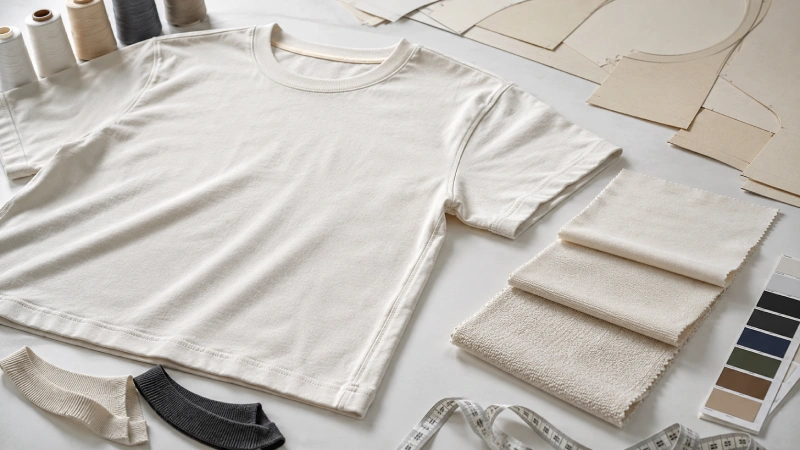
Fabric weight alone does not determine quality. Two T-shirts with the same stated GSM can behave differently because of yarn count, knit density, finishing, compacting, dyeing and surface hairiness.
Fabric Specification
Request:
- Fiber composition and percentage
- Fabric weight in GSM or oz/yd²
- Yarn type and yarn count
- Jersey structure
- Preshrink or compacting treatment
- Piece-dyed or garment-dyed construction
- Target shrinkage tolerance
- Colorfastness requirements
- Fabric hand and surface standard
A smooth cotton surface may support detailed DTG printing, while a firmer jersey can provide more stability for screen printing. Polyester content requires additional attention to heat response and dye migration. Embroidery may require sufficient fabric body or stabilizer to prevent puckering.
Fit and Construction
A usable blank specification should include:
- Chest width and body length
- Shoulder width
- Sleeve length and opening
- Armhole
- Neck opening
- Front-to-back balance
- Size grading
- Measurement tolerances
- Neck-rib composition and width
- Shoulder tape
- Side-seamed or tubular construction
- Hem and seam type
The collar deserves particular attention. Rib composition, attachment tension and recovery influence whether the neck stays flat or becomes stretched and wavy after washing.
Buyers developing proprietary products should document these requirements in a tech pack and review them with a private label T-shirt manufacturer before sampling.
Blank T-Shirt Sample Inspection Scorecard
Use the intended decoration method before approving the sample. An undecorated garment can appear acceptable but react poorly during printing, curing, pressing or washing.
| Inspection category | Score |
|---|---|
| Fabric weight, hand and surface | 15 |
| Measurements and fit | 15 |
| Neckline shape and recovery | 15 |
| Decoration result | 15 |
| Seam and hem construction | 10 |
| Wash shrinkage | 10 |
| Side-seam twist or body skew | 10 |
| Colorfastness and rubbing transfer | 5 |
| Labels and packaging | 5 |
| Total | 100 |
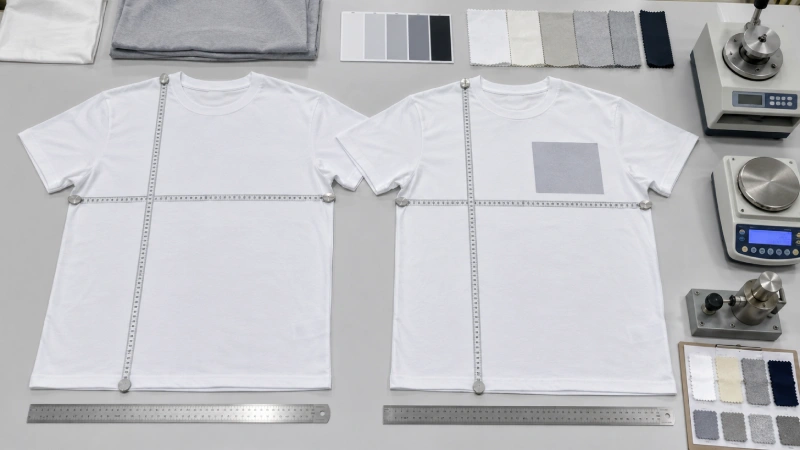
Measure the garment before washing, apply the planned print or embroidery, wash it according to the intended care instructions and measure it again. Check body length, width, sleeve dimensions, neck recovery, side-seam movement and print condition.
AATCC textile testing standards cover laundering colorfastness, garment dimensional change, fabric skew and seam twist. Buyers do not need to perform every laboratory test on every early sample, but bulk standards should identify the relevant method and acceptable result where performance is commercially important.
A sealed approval sample, approved measurement sheet and decoration reference should form part of the apparel quality control process for bulk production.
MOQ, Sampling and Lead-Time Considerations
MOQ cannot be compared without first identifying what is being ordered.
A stock supplier may allow one sample garment because the fabric, pattern and color have already been developed. A custom factory must reserve fabric, dye colors, create patterns, produce labels and configure decoration processes. Its MOQ may therefore apply by style, color, fabric or print design.
Ask each supplier to separate:
- Blank garment MOQ
- Custom-color MOQ
- Fabric-knitting or dyeing MOQ
- Decoration MOQ
- Woven-label MOQ
- Packaging MOQ
- Quantity required per size
Sampling should also be divided into stages. A fitting sample checks measurements and construction. A fabric or color approval checks material and shade. A pre-production sample confirms the complete garment before bulk cutting.
Lead time should be measured from a defined approval point. “Four weeks” is not meaningful unless the supplier states whether it begins at deposit payment, fabric approval or final sample approval.
Common Sourcing Mistakes and Red Flags
Comparing Stock Prices With OEM Prices
A stock blank price excludes pattern development, custom fabric, labels and production setup. It should not be compared directly with a full-package factory quotation.
Approving a Sample Without Decoration Testing
Screen-print curing, DTG pretreatment, embroidery and heat pressing can reveal problems that are invisible on the undecorated garment.
Using GSM as the Only Quality Standard
A heavy fabric can still have poor shrinkage, excessive torque, weak stitching or an unstable collar. Weight is one specification, not a quality grade. Review a T-shirt fabric and material guide when defining weight, composition and finishing requirements.
Accepting “Organic” Without Checking Scope
Ask for the applicable certification number and confirm it in the GOTS Certified Suppliers Database. The database allows buyers to check certified entities, operations and covered products rather than relying only on a logo shown on a website.
Relabeling Without Reviewing Market Requirements
For garments sold in the United States, most textile products require fiber content, country of origin and the identity of the manufacturer or responsible marketer. Clothing also falls under the FTC textile and care-labeling requirements. A decorative brand label does not replace required compliance information.
No Written Bulk Tolerance
A sample can be technically approved while bulk production varies. The purchase specification should state measurement tolerances, shade requirements, shrinkage limits and how nonconforming units will be handled.
FAQ
What is the difference between a blank manufacturer and a wholesaler?
A manufacturer produces garments or directly manages their production. A wholesaler may purchase products from one or several manufacturers and resell them. Distributors can provide useful stock access, but their presence in a supply chain should not be presented as evidence that they manufacture the garments.
Can I replace the label in a wholesale blank?
Some blanks have tear-away labels, while other brands permit relabeling through approved decorators or private-label services. Always confirm the supplier’s policy and retain legally required fiber, origin, business-identity and care information for the destination market.
What fabric weight is best for a blank T-shirt?
There is no universal best weight. Lightweight jerseys may suit promotional programs and warm climates, midweight cotton works across many retail and merchandise applications, and heavyweight jersey can support boxy streetwear silhouettes but costs more to produce and ship.
Are heavyweight T-shirts always higher quality?
No. A high GSM does not guarantee dimensional stability, soft hand feel, good sewing or collar recovery. A well-engineered midweight T-shirt may perform better than a poorly finished heavyweight garment.
Which blank is best for screen printing?
Look for a stable fabric surface, appropriate fiber composition, consistent sizing and compatibility with the selected ink and curing process. The best garment depends on artwork coverage, ink system, required hand feel and end use. Test the intended screen printing and embroidery options on the actual sample.
What is a normal MOQ for private-label blank T-shirts?
There is no universal MOQ. Stock garments may have no minimum, while customized blanks and OEM production can have minimums by style, color, fabric or label. Request a written breakdown from the shortlisted supplier instead of relying on a general website statement.
Final Buyer Recommendation
Choose a stock blank when speed, small quantities and established inventory are the priorities. Gildan, Next Level Apparel, AS Colour and other manufacturer-backed blank brands are designed around this need.
Choose a customized blank when you are satisfied with an existing fit but need printing, labels, hangtags or branded packaging.
Choose custom OEM manufacturing when the blank itself must be different. A proprietary program should define the fabric, GSM, measurements, size grading, collar, sewing, wash treatment and branding before quotation.
For a custom blank T-shirt assessment, provide:
- Product type and reference image
- Target quantity by color
- Fabric composition and preferred GSM
- Size range and target market
- Printing or embroidery requirements
- Labels, hangtags and packaging
- Required delivery date
- Destination country
These details allow a manufacturer to evaluate fabric availability, sampling requirements, production feasibility and commercial terms without relying on assumptions.
Discuss Your Apparel Sourcing Requirements
Whether you're launching a startup clothing brand, expanding a streetwear label, or looking for a reliable OEM apparel manufacturer, speaking directly with an experienced production team can help you avoid costly sourcing mistakes.
Talk With Our Manufacturing TeamRelated Manufacturer Guides

Streetwear & Hip Hop Apparel Programs